Unfolding · Part I: The Person · 1.4, part two
Encouragement (II): The Match and the Companion
A proposal opens a debate. A running system opens a door. The fourth exchange of the Fosterer and Wanderer method, part two: evoking and accompanying. A script nobody asked for, a quiet move to Linux and what it was for, the best strawberries at the wrong market, a leader who has no time and comes every time, why the soft topics are the first to be cancelled, how to turn a want into a should (don't), body doubling, and knowing where your own road ends.
The text of the episode follows, with its diagrams. Below each heading: watch that part on YouTube.
Cold open
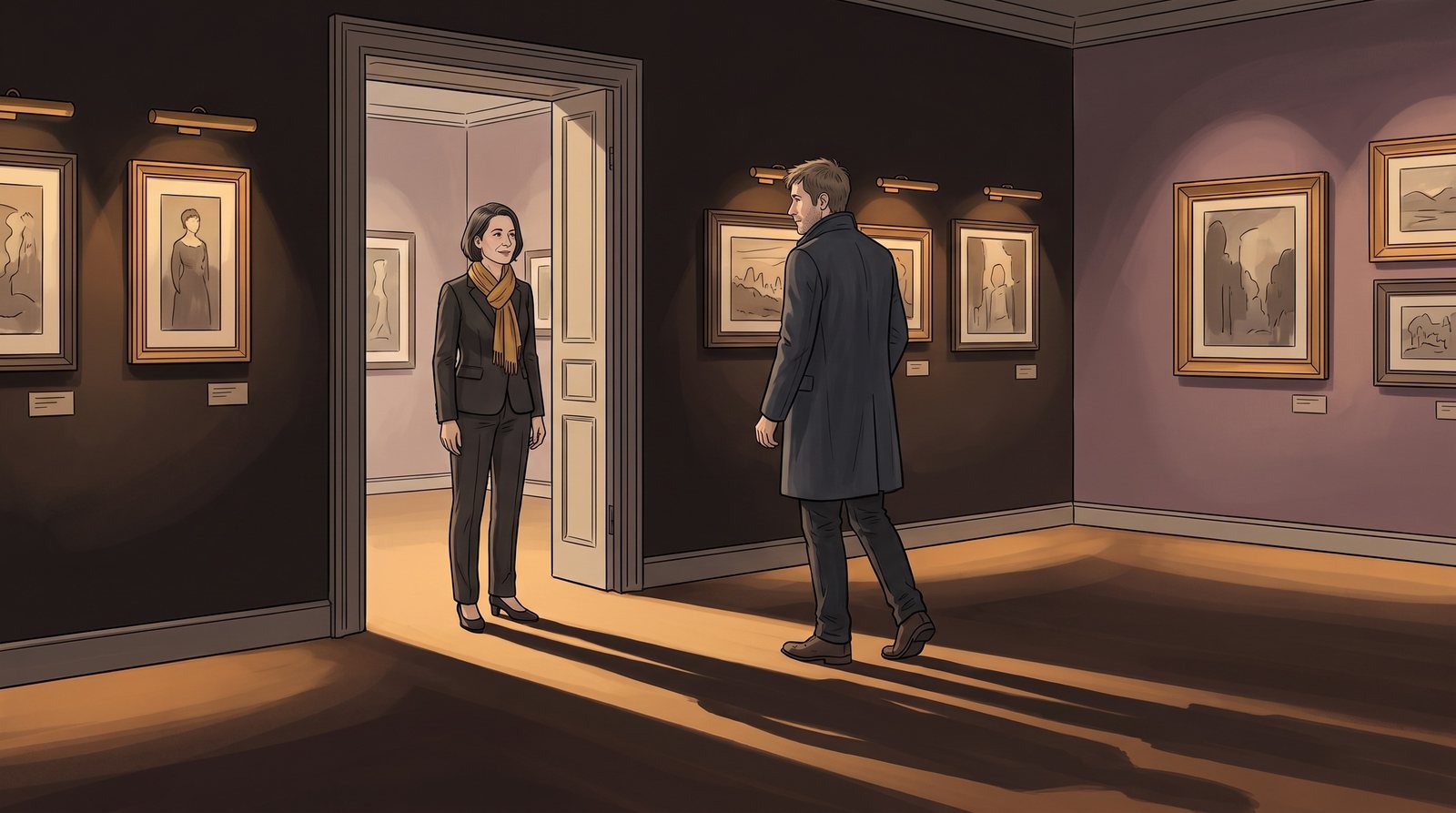
Wanderer You held the door. I walked through.
Wanderer Now what?
Fosterer Now comes the part everyone longs for. In other people.
Wanderer Which part?
Fosterer The part where something actually happens.
Wanderer And you'll keep your hands still.
Fosterer I'll try. On this wall hang two people who stopped talking and showed something instead. Come.
Practise · Evoking
Three. Evoking, to wake a change. Making impulses that are already in the other person speakable. The trail to listen for has a name in motivational interviewing: desire, ability, reasons, need. DARN. They flash up in what someone says, half hidden between the sentences of duty. A sentence like this one:
Participant [rushed] I really don't have time for this today.
We'll come back to her.
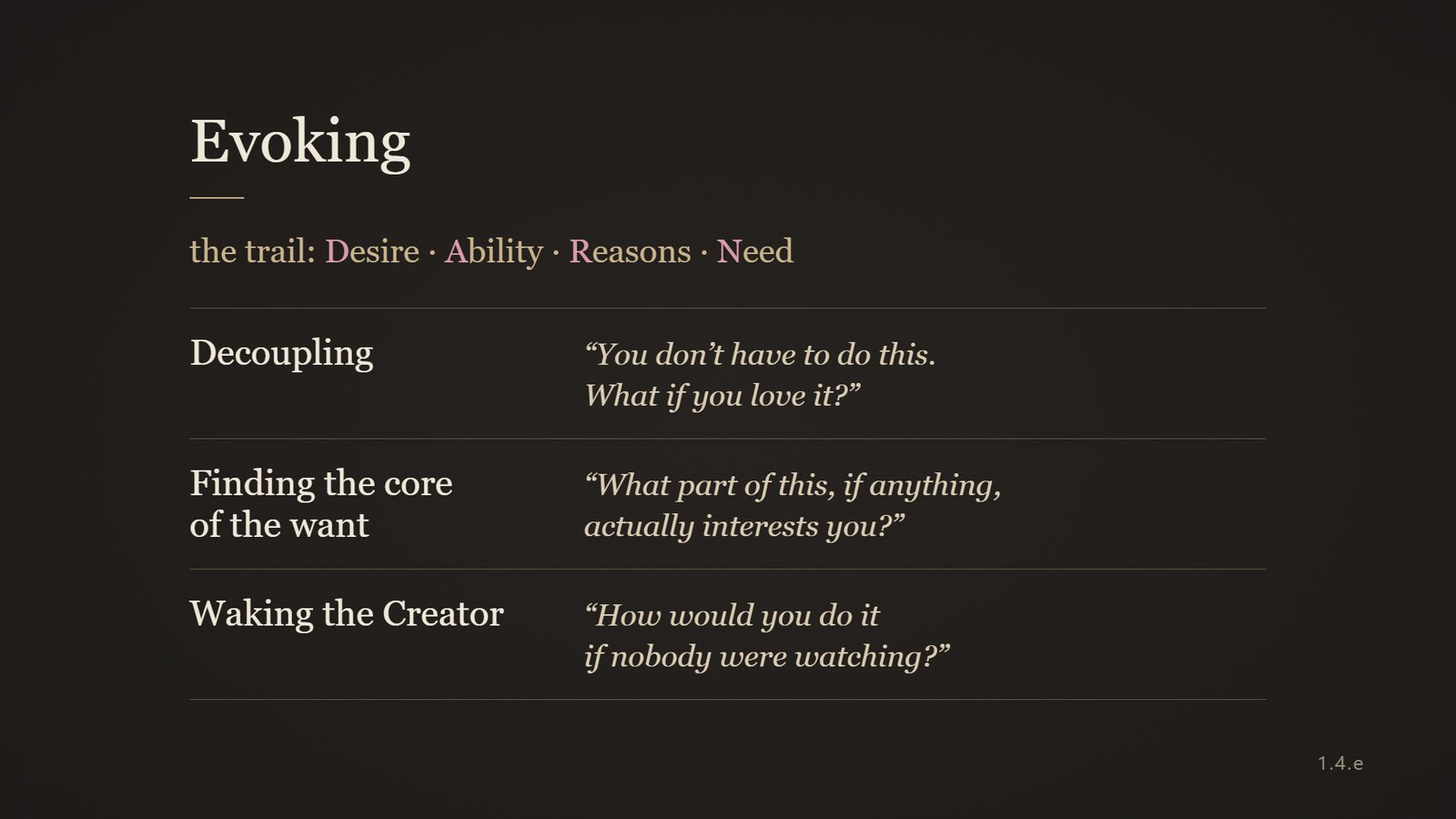
Uncovering a latent want, instead of administering it, takes three moves.
Decoupling: “You don't have to do this. What if you love it?” Or: “Imagine nobody ever checks this.” Finding the core of the want: “What part of this, if anything, actually interests you?” And waking the Creator: “How would you do it if nobody were watching?” Or: “What if you're no good at it: would that be bad?”

Sometimes evoking doesn't need a question but an object. At the time I'm a mix of coach and analyst, pushing a project that hangs between departments and won't move by itself. At one point I see it clearly: we need a script, something that automates a task nobody has touched for weeks. I sit down and write it in Python. A finger exercise: I'm not a programmer any more, but it's like riding a bike. It comes back, bumpier than I thought. The script is a bit overloaded, with places a “real” programmer would have written differently. But it does what it should. I go to one of our developers.
I've programmed something. For the export thing. He looks at me. Disbelief, politely wrapped. For five minutes I explain what the script does and how. He looks at the code. The disbelief stays, but it changes a little, into something I recognise as an itch.

Developer Come on, give it here.
He takes the script, cuts it down to the essentials, and on the way finishes the things we'd been pushing ahead of us for a while.
What I understand afterwards: the spark doesn't have to be perfect. On the contrary. Something unfinished that runs is harder to leave lying than a clean specification. The specification says what should be done. Unfinished code says: someone has already started, and it isn't good enough.
The same mechanism works one size up. I learned that long before the script. Back then I was working for a young company, and everything ran on expensive proprietary servers: powerful, closed, costly. We wanted to grow, and the prices made it impossible. I had an idea for a solution. It was Linux. Today that sounds obvious; back then, few businesses trusted it with the systems they lived on. And I knew the debate that would follow: the proprietary platform was the house religion, and it had a devoted evangelist. Arguing would have taken months and probably failed.
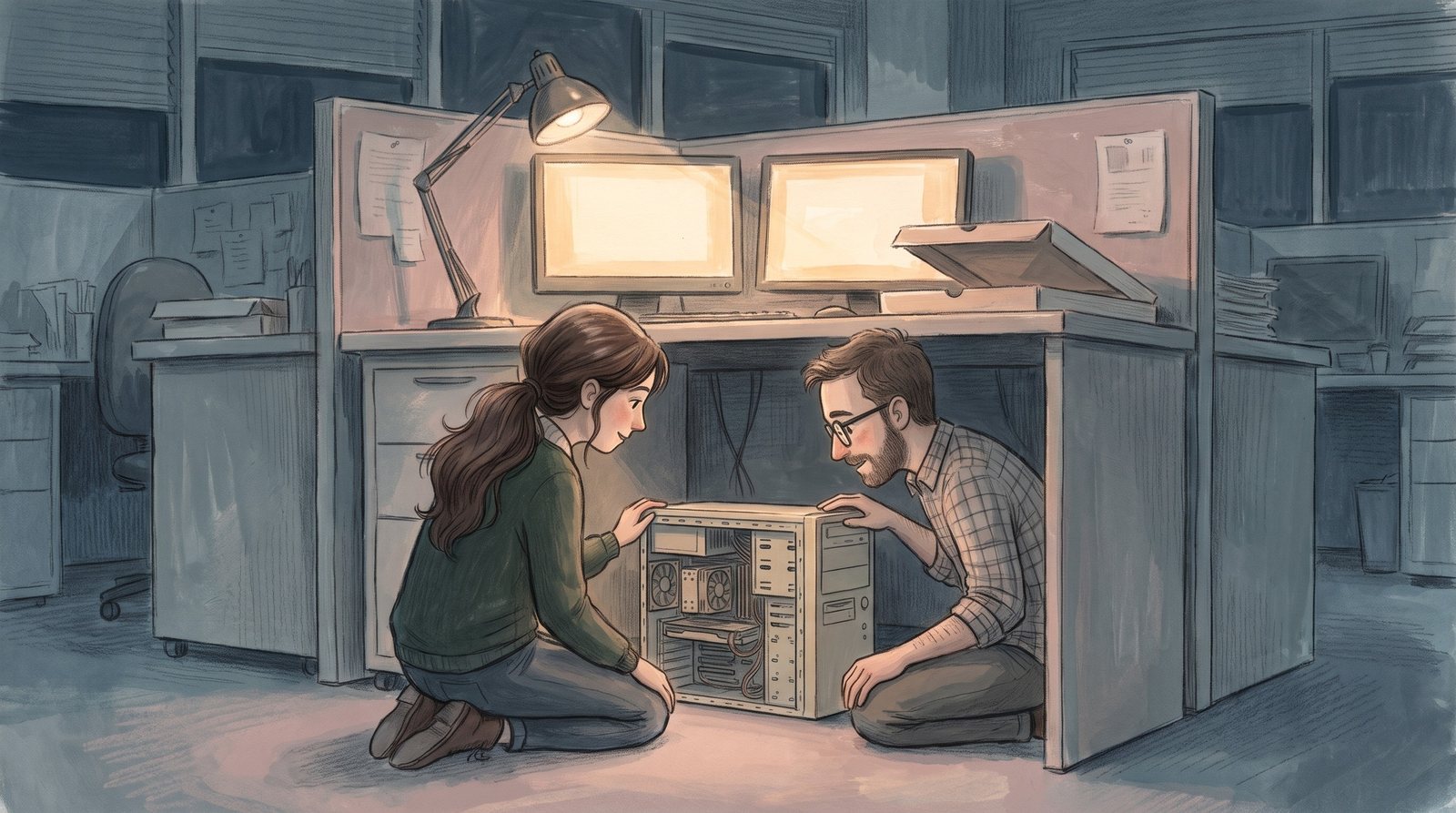
Then the evangelist went on holiday for two weeks. I sat down with our lead developer, and we built a submarine: we quietly ported the system our business ran on to Linux. No announcement, no request, no concept paper.
When the evangelist came back, some time in the first week I mentioned it in passing: Our main system… it's running right now on the machine under my desk.
A short pause. Then the inevitable question. Then the demo.
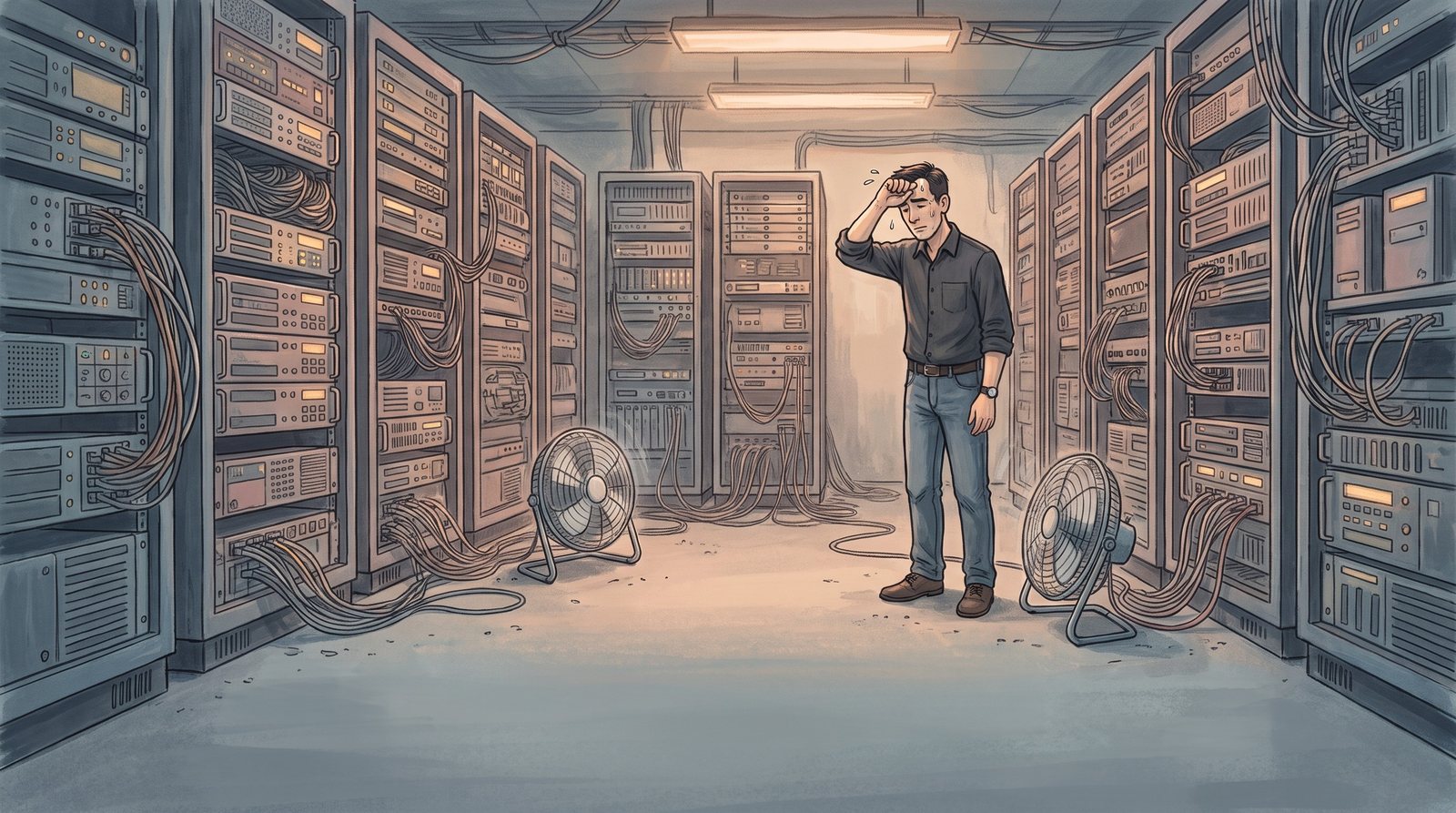
A year later the server room ran out of cooling, because of the number of Linux machines.
A proposal opens a debate. A running system opens a door.
You can't reject a fact; you can only decide what to do with it.
The want, to grow, had been there all along. It didn't need arguments. It needed a possibility you could touch.
Looking back, I don't ask who got to own what grew out of those two weeks. You can't always choose that. And some work needs a big organisation around it to happen at all: the approach in this series, with all its parts, wouldn't fit a five-person company on a tight budget. It needs a playground.
The question I ask is a different one: what is it for?
Does what I'm building let me stay true to my values, and go on with the work I believe in? For me, values are the motivation. And one more.
It worked because I already had their trust. Copied as a method, it builds exactly the kind of secret an organisation later prefers not to remember.
Leaders ask me one question more than any other: how do I get my people to do this or that? Behind it sits a wish: they should want it. Bluntly, you can't make that happen. People pursue their own wants, not the ones handed to them. If you want something to start, you have to walk the first steps yourself, and then look.
Does anyone follow? Is there a spark that can catch?
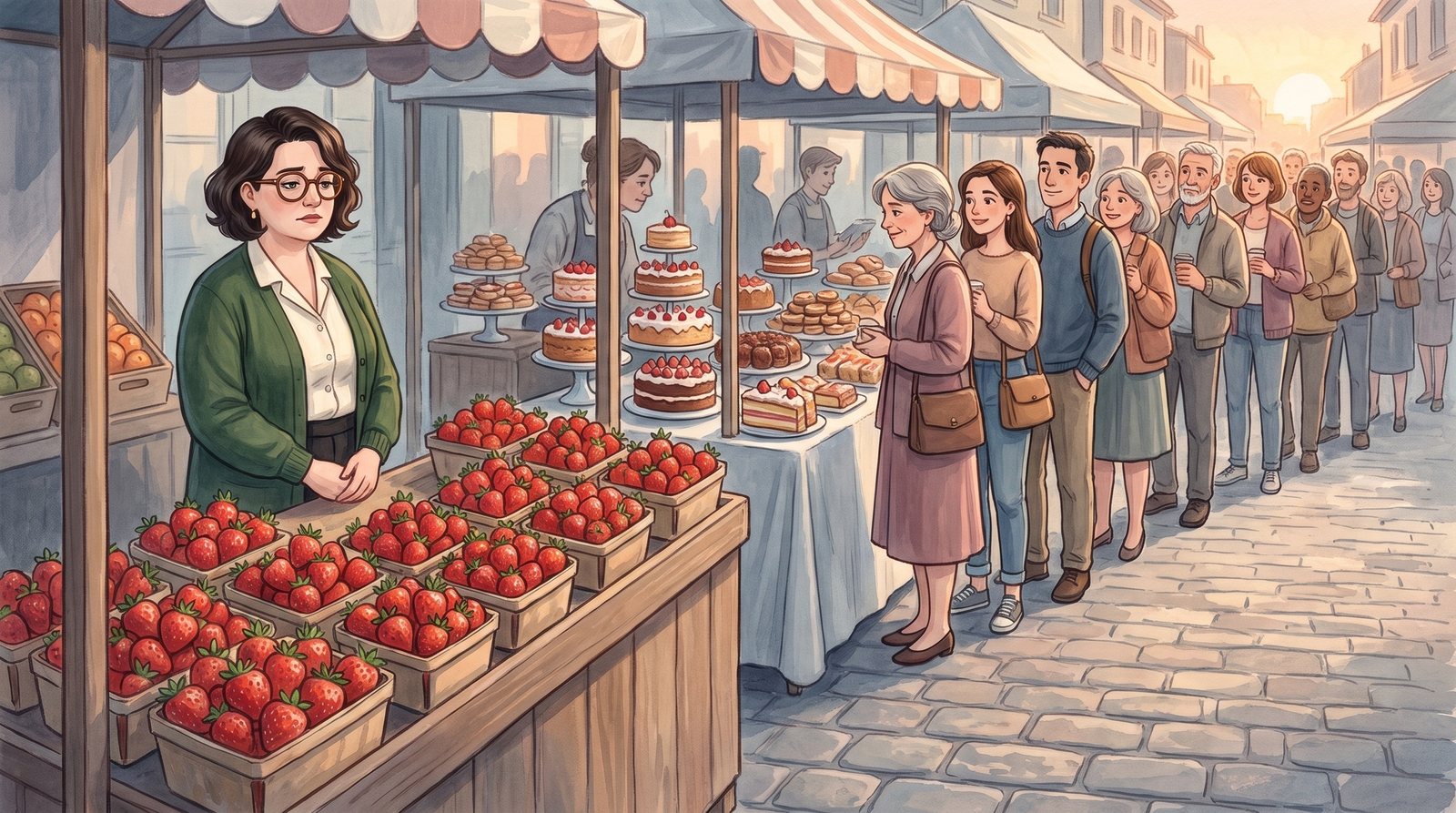
And stay critical of yourself while you look.
Your view is one view, and it may not be the best. If nobody follows, the idea may be good in principle and still be in the wrong place at the wrong time. You can sell the best strawberries at the market and still go home with full crates, if everybody wants cake from the stall next to yours.

And evoking can be as quiet as one sentence said back. A group of leaders that meets once a month to talk about how they lead. One participant opens every session the same way, coat still on, phone in hand:
Participant [rushed] I really don't have time for this today. Month-end close.
Every session. And every session, she comes. In the fourth month I say it back to her:
You say you have no time, every time. And you come, every time. What keeps you here?
Then I say nothing.
A long silence. Nobody breaks it.
Participant [hesitant] … I think I want to be here. I just can't say it matters. Not out there.
Out there?
Participant Out there this is the soft stuff. Nice to have. When things get tight, it's the first thing to be cancelled, and nobody asks why.
And in here?
Participant In here I'm not just my numbers.
Desire, reasons, need: all of it out of one sentence of duty. I don't build on it. I say back what I heard, that she wants to be here, and that here she is more than her numbers, and I leave it at that.
It didn't stop her appointment from being the first to go at the next month-end close.
But the sentence had been said, and she had said it herself.
I hear that sentence often, in many forms.
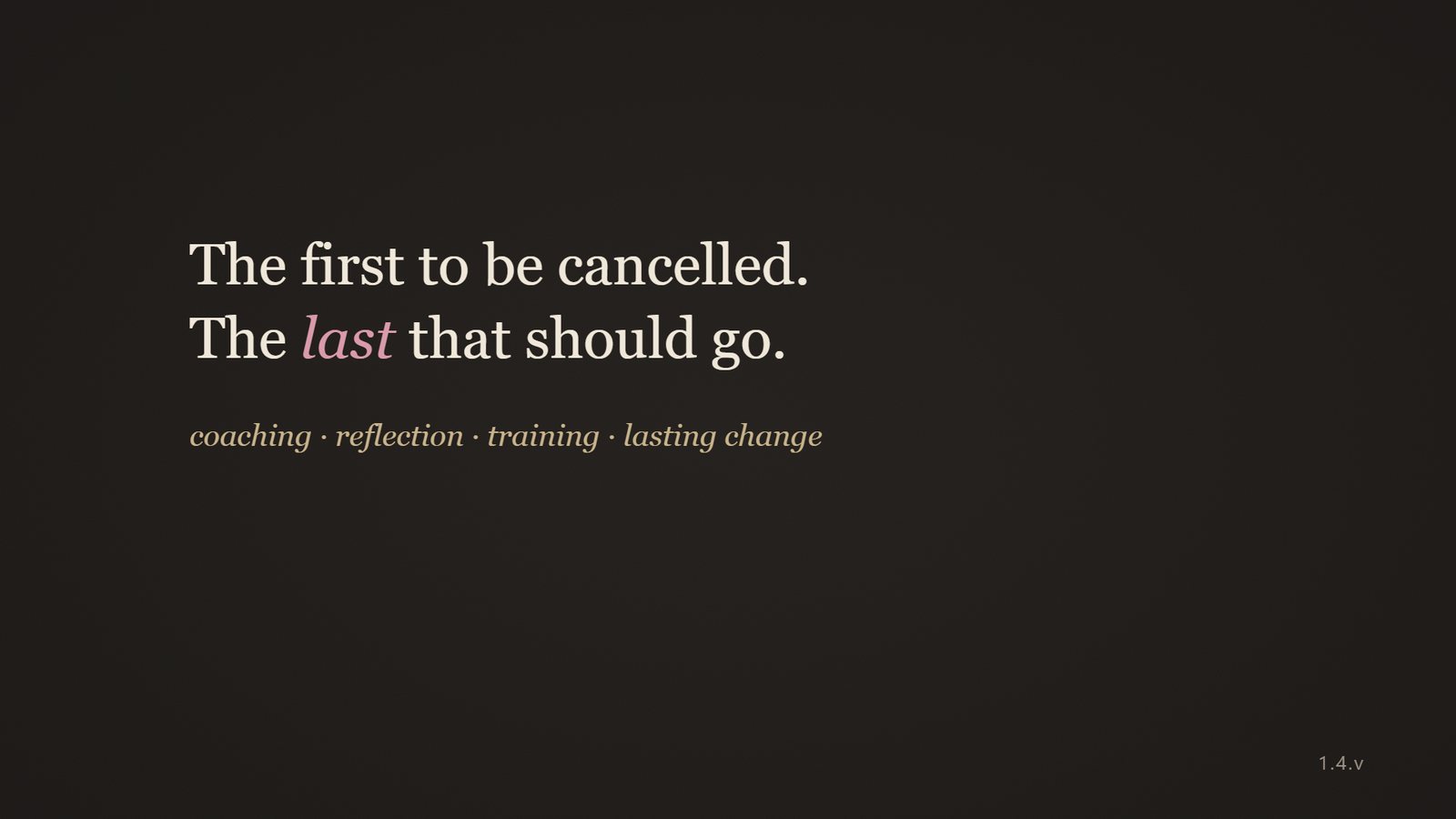
Coaching, reflection, the “soft topics” count as unprofessional: time that could go to something measurably productive. So when the short game calls, their appointments are the first to be cancelled. Training and lasting change are the first to be optimised out as soon as someone raises the measuring stick. They should be the last.
People often told me: “Emotions have no place here.
We're tech professionals.”
Then I heard the Windows department speak with the Apple user group.

Then I heard the product department talk to their IT team, and considered earplugs, minus ten decibels, to adjust the volume.
Then I asked: “Why don't we do it this way?” And I felt the anxiety that answered: “You'd better not mention that approach here.
Management doesn't like to hear it.” It appeared to me that there is a ton of unprocessed emotion, and every bit of it is detrimental to the organisation's performance.
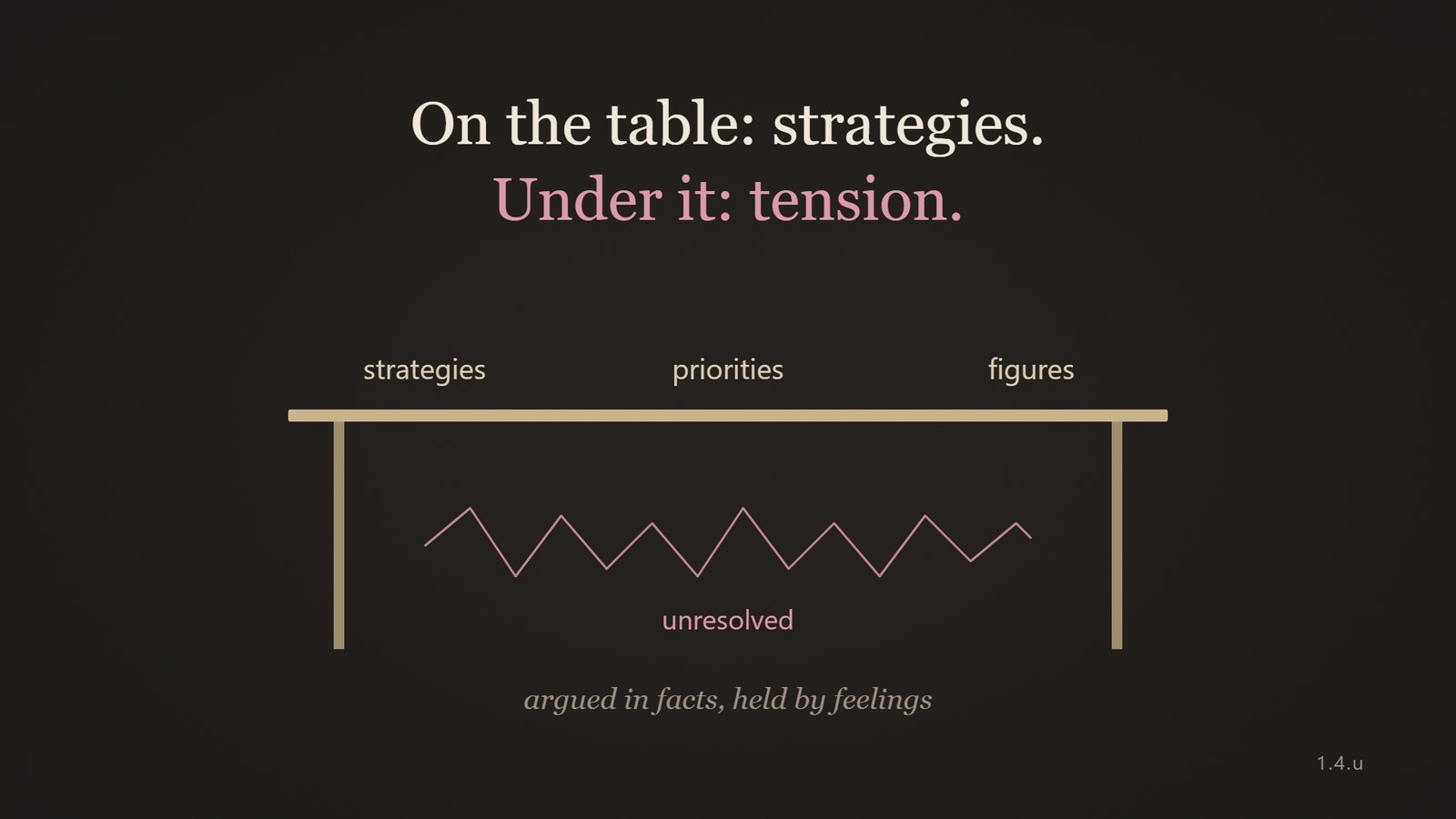
Most of the long conflicts in organisations aren't held by facts.
They're held by tension nobody has resolved, and argued with factual alibis: strategies, priorities, figures. Being seen as a whole person at work isn't a luxury.
It's a need. In the Overture I called it unprofessional to lose either side, the humanity or the skill. The short game counts only one of them.
Next to it, a warning sign.
The reverse craft we all master without wanting to: how to turn a want into a should, reliably. Please don't try this at home.
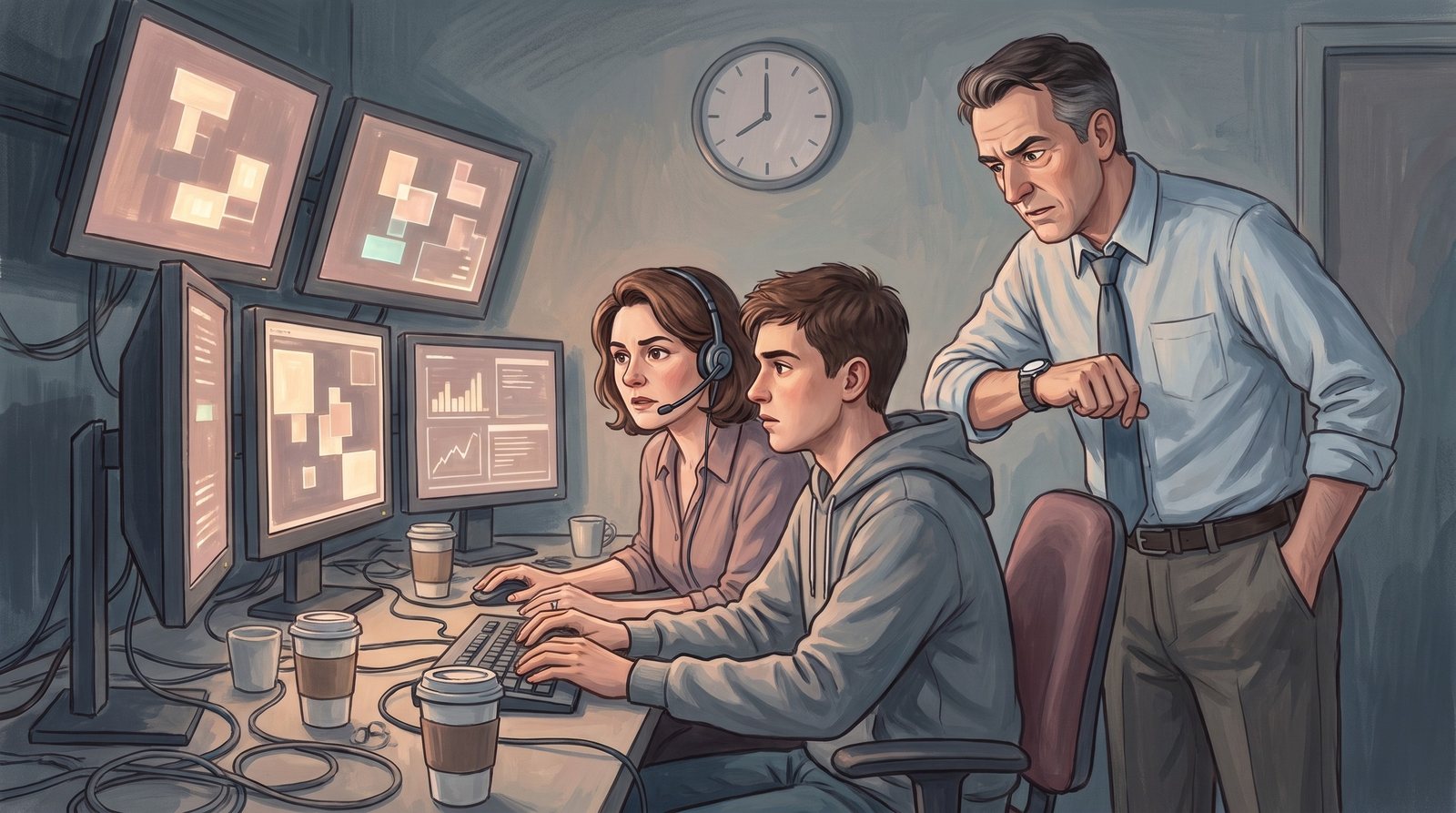
A demonstration. A major incident: the system is down. An administrator and a programmer are debugging it together, deep in it, finally on a trail. Now stand behind them, and every ten minutes, ask:
Manager How far are you?
Manager And how long will you still need?
Keep it up until their brains are fried completely.
Each question costs them the trail they were on; each answer is a promise they can't keep yet. And the want to solve it, the one that kept them there at midnight, turns into a should with a deadline.
The recipe, step by step. First, formalise it: “What's your plan? By when?” That cools it down nicely.
Then externalise it: measure it, have it shown, compare it, praise it too much. That drains it.
And to kill all motivation completely, couple it: “If you take this seriously, we could reflect it in your bonus.”
Anyone who has ever lost a hobby by earning money with it knows how well this works.
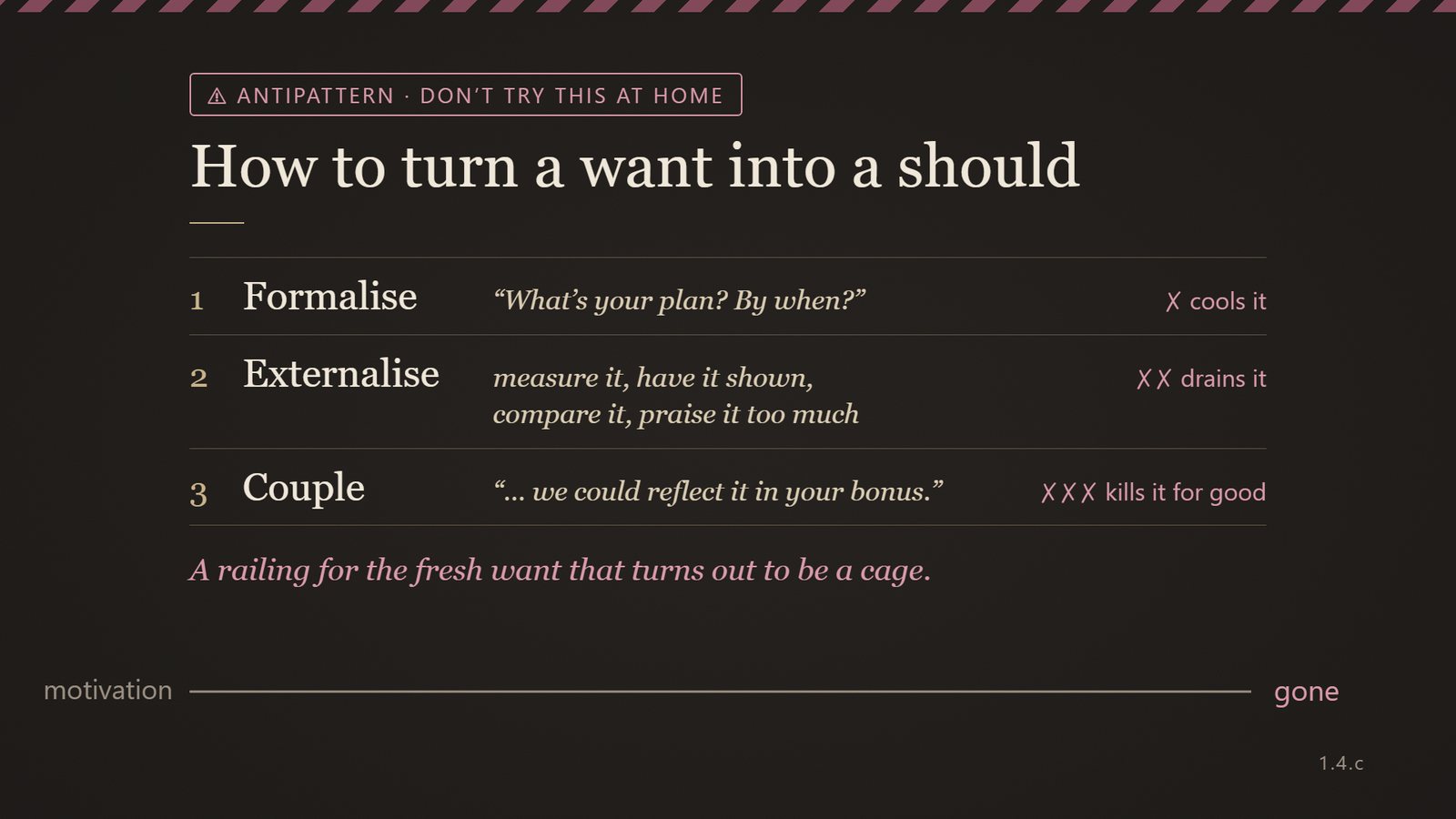
It's the righting reflex in its most diligent form.
It wants to build a railing for the fresh want straight away, and doesn't notice it's building a cage.
Practise · Accompanying
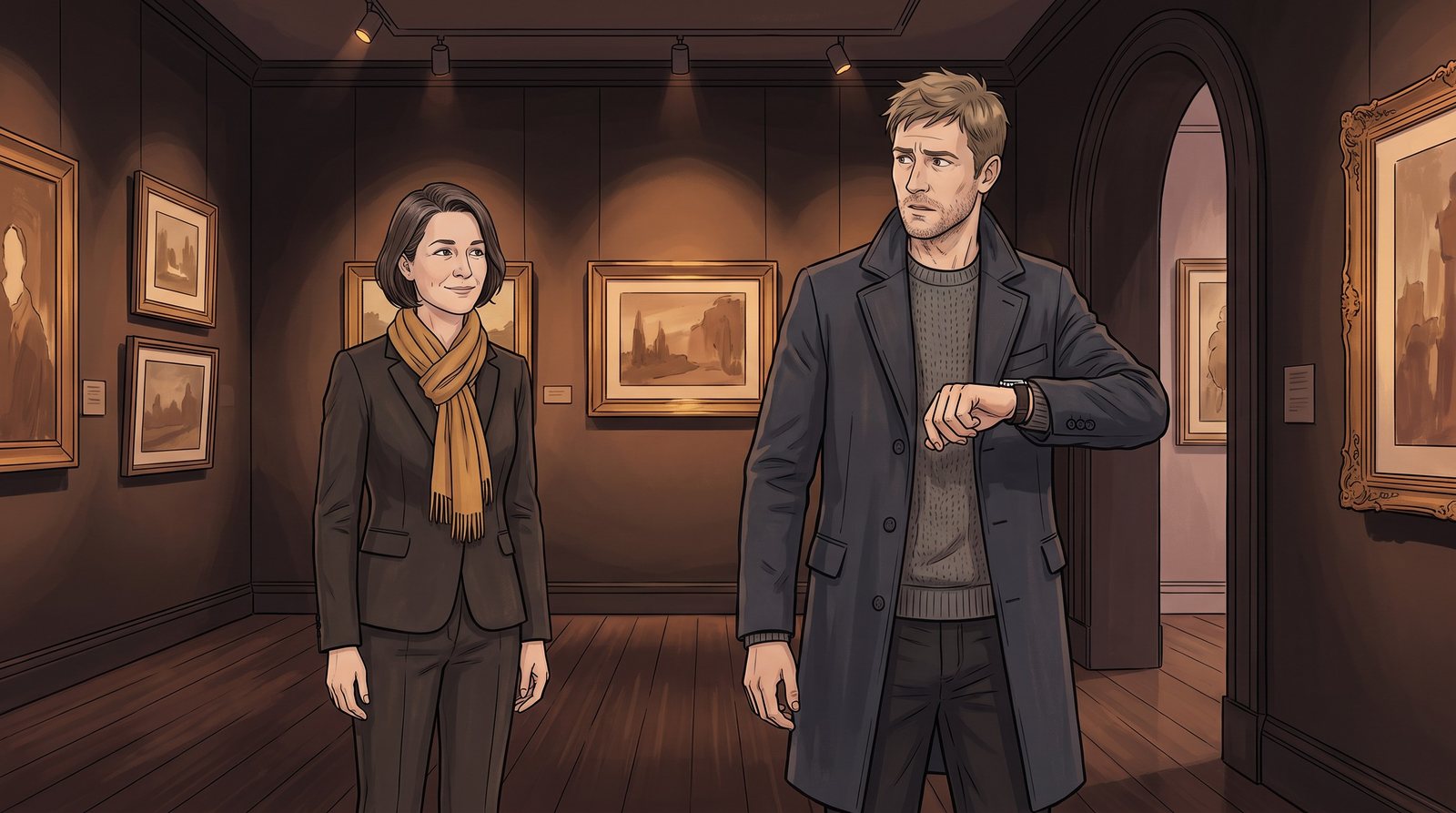
Wanderer I don't have time for this.
Fosterer You're here, though.
Wanderer … Don't make anything of it.
Fosterer I won't.
Four. Accompanying, to smooth the way. DARN has a second half: CAT. Commitment, activation, taking steps. It's the part every manager longs for, in other people, and that's exactly why it carries a warning sign here.
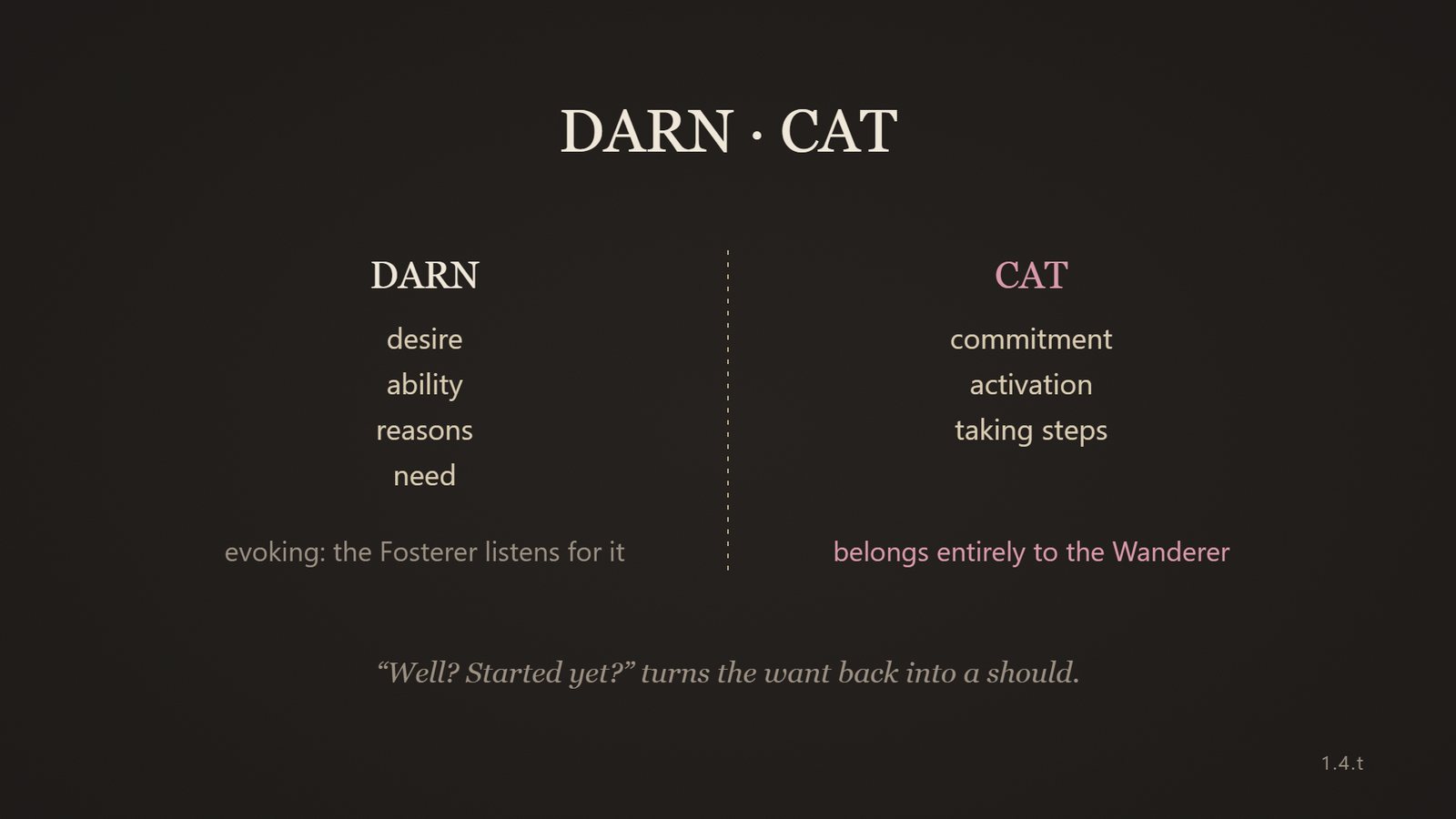
CAT belongs entirely to the Wanderer. At this point the Fosterer becomes a companion and an affirmer, nothing more.
As soon as a single expectation creeps back, “Well? Started yet?”, the freshly uncovered want turns back into a should, and all the effort before it is lost.

Sometimes accompanying is simply a body in the same room. A task someone has been pushing ahead of them for months: too big, too unpleasant, too unclear to even start. I offer no plan, no breakdown into steps, none of the clever things. I say: Let's do it together.
We sit down.
The task that was a mountain for months takes two hours. Nothing about it got easier. Someone was just there. People now have a name for it, body doubling: work is easier to carry when you're not alone in the room.
Clearer still: a flat a friend has lived in for six years, and which for six years has been “still provisional, really”. White walls with nothing ever hung on them. Two or three boxes in the corner, taped shut, labelled in a hand he can barely read himself. He lives in it like on a station platform: ready to leave at any moment, for six years.

I'm visiting, we're having coffee, and at some point I get up and push the sofa to the other wall.
Unasked. Not as a coach, not as an adviser. He looks for a moment, then takes the other end. For an hour we move furniture that hasn't moved in six years. I never suggest redecorating. But some time that afternoon the flat stops being provisional, and I was only there.

Accompanying also has an end, and recognising it is part of the craft. A coaching has been running for weeks, and something isn't right. Not the topic; that's clear. Not the person; they're working seriously.
It's the constellation: on exactly the question at stake, I have the same blind spot as the person in front of me. I could facilitate my way over it; I'm practised enough that it would be difficult to notice. For a while I do. Then I say it:
I don't think I'm the right person for this.
It isn't an easy hour. At first my client hears a rejection, and I have to bear that it feels like one for a moment. I don't say everything will be fine. I say who I know who would carry this better, and I make the contact, carefully, with everything I know. When the handover stands, nothing is solved. There's only someone at work who can solve it.
I achieved nothing that day except that one sentence.
Sometimes that's the whole work: knowing where your own road ends, and not walking on.
Workbench
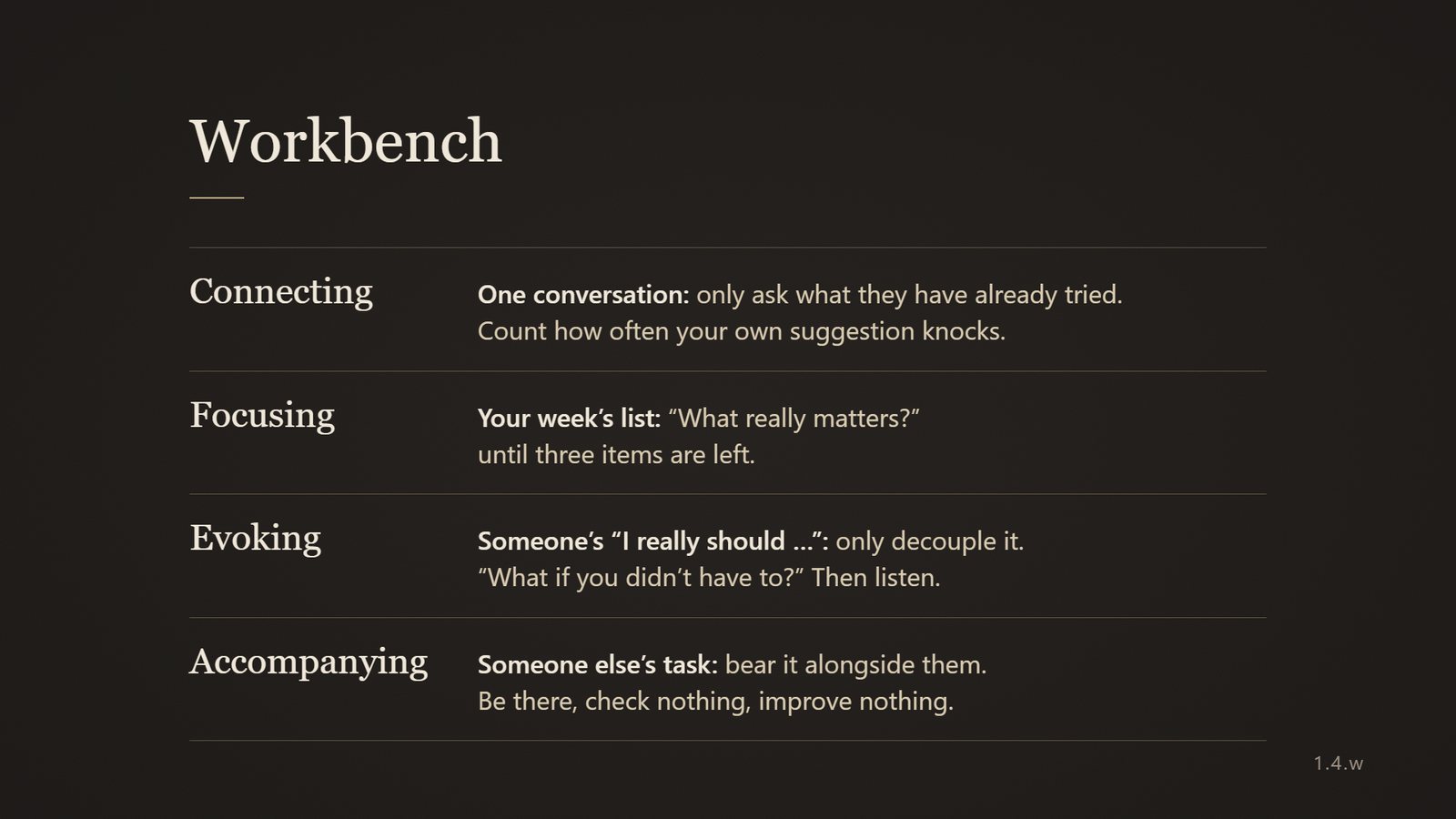
Four exercises to take with you.
For one whole conversation, only ask what the other person has already tried, and count how often your own suggestion knocks. Put your own list for the week to one question until three items are left: what really matters? Take someone's “I really should…” and only decouple it: “What if you didn't have to?” Then listen to what happens. And bear someone else's task alongside them: be there, check nothing, improve nothing.
Mirror
Whose change talk did you miss this week, because you were busy convincing?
What would you keep doing if nobody ever checked?
Which of your appointments is the first to go when the short game calls, and should it be the last?
Echo
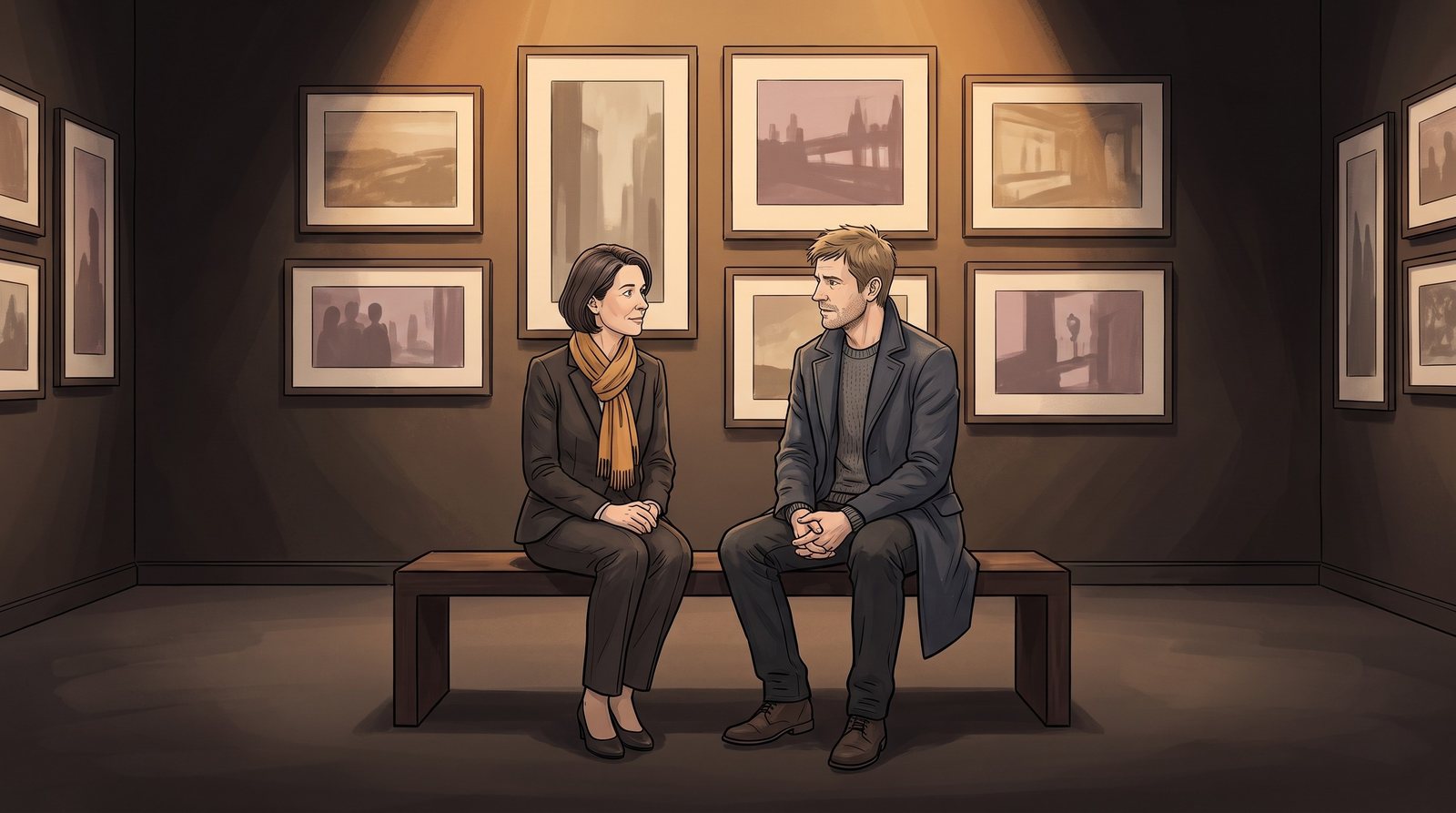
Wanderer Many more ways to kill motivation than to wake it. You did that too, when we met.
Fosterer I know.
Wanderer Not maliciously.
Fosterer No. But still.
Wanderer Keeping something small, so that nobody expects it to stay big. I know that one.
Fosterer What happens if it gets big?
Wanderer Then it can't disappear any more, when you'd like it to.
Fosterer That would be a real shame.
Wanderer That wasn't advice.
Fosterer No.
Wanderer No. That would be a real shame.
Sources
- William R. Miller and Stephen Rollnick, Motivational Interviewing (3rd edition, 2013): evoking, DARN and CAT.
- Edward L. Deci and Richard M. Ryan, Intrinsic Motivation and Self-Determination in Human Behavior (1985).
The stories are drawn from three decades as an employee, leader, coach and facilitator. Places, times and people are changed, and some scenes are composed from several experiences; they allow no reliable conclusions about any company or person. The illustrations and the voices of the episode are made with AI.