Unfolding · Part I: The Person · 1.4, part one
Encouragement (I): Whose Want Is It?
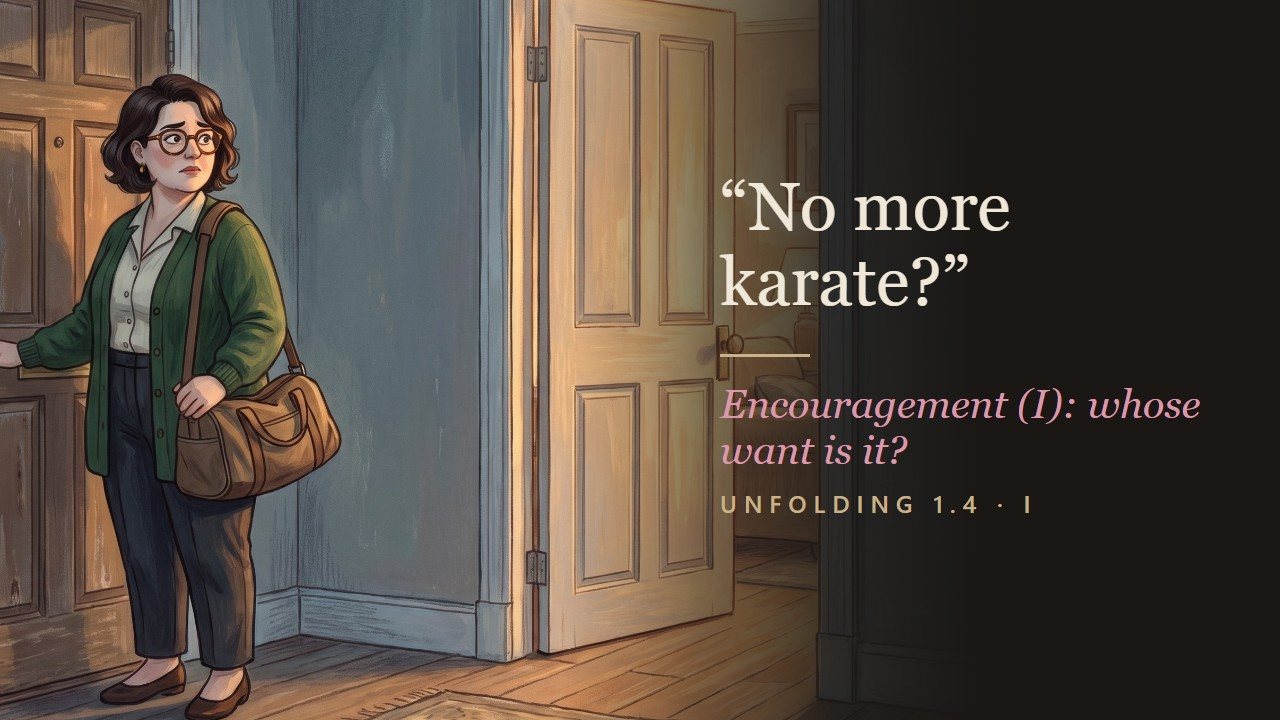
“No more karate?” One casual sentence, and the energy is gone. The fourth exchange of the Fosterer and Wanderer method, part one: the four ways we steer people from outside and the flaw they share, should dressed up as want, perturbing and affirming, a job interview the other way round, and a team that had written the same list five times.
The text of the episode follows, with its diagrams. Below each heading: watch that part on YouTube.
Cold open
Wanderer This room has a direction. The others asked who I am, what goes on in me, whether this holds. This one asks: where to.
Fosterer And where do you want to—
Wanderer There. Exactly there. You felt it, didn't you?
Fosterer … The pull. You hint at a direction, and straight away I want to say it out loud. Hold on to it.
Wanderer Pull. Like when we met. “Wait a month, and only your skeleton will be sitting here.”
Fosterer That didn't move you.
Wanderer No. What moved me was that at some point you stopped pulling.
Wanderer So don't pull now.
Fosterer I'm holding the door open. You have to walk through it.
Wanderer Let's start with what can kill a direction. One sentence is enough. Come.
Exhibit · No more karate?

After a long break, I've finally talked myself into it. Sports bag packed; that alone cost something. The energy is there, fragile, but real. I go down the stairs and reach the front door. A voice from the living room, in passing:
Voice From The Living Room Where are you off to?
The gym.
Voice From The Living Room No more karate?

One sentence, and it cut deep.
Maybe it wasn't meant as anything. It landed as blame: not for what I was doing, but for what I had stopped doing. A moment ago the packed bag was proof that I'd pulled myself together. Now it was proof of what I had dropped. In the same breath the gym became a replacement, and a replacement is always smaller than what it replaced. I'm standing at the front door, and suddenly I'm someone who gave up karate, not someone on her way to train.
What would have helped was just as short.
“Off to train? You're really getting back into it.” One sentence for the bag by the door, for the willingness. An affirmation. I got its opposite.
The bag survived.
I went. But the question came with me.

Questions can open, too. In episode 1.2 my supervisor asked me where I could move my company forward most: leading people, or coaching. It was a real question, and I answered it. But it asked what the company needed.
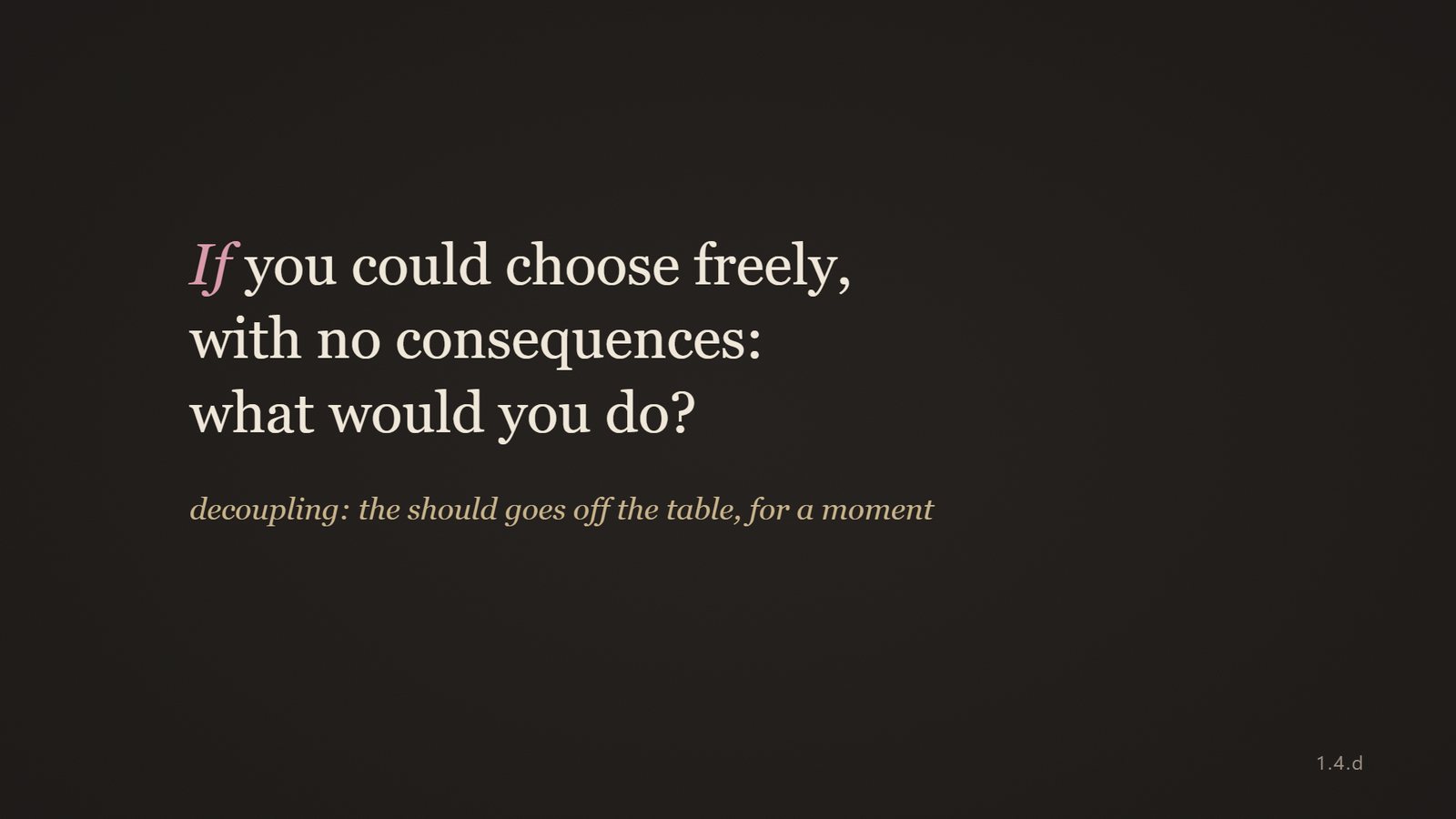
A question that evokes asks the other way round. If you could choose freely, with no consequences: what would you do?
That small “if” takes the should off the table for a moment, so you can hear whether there is a want underneath.
Encouragement
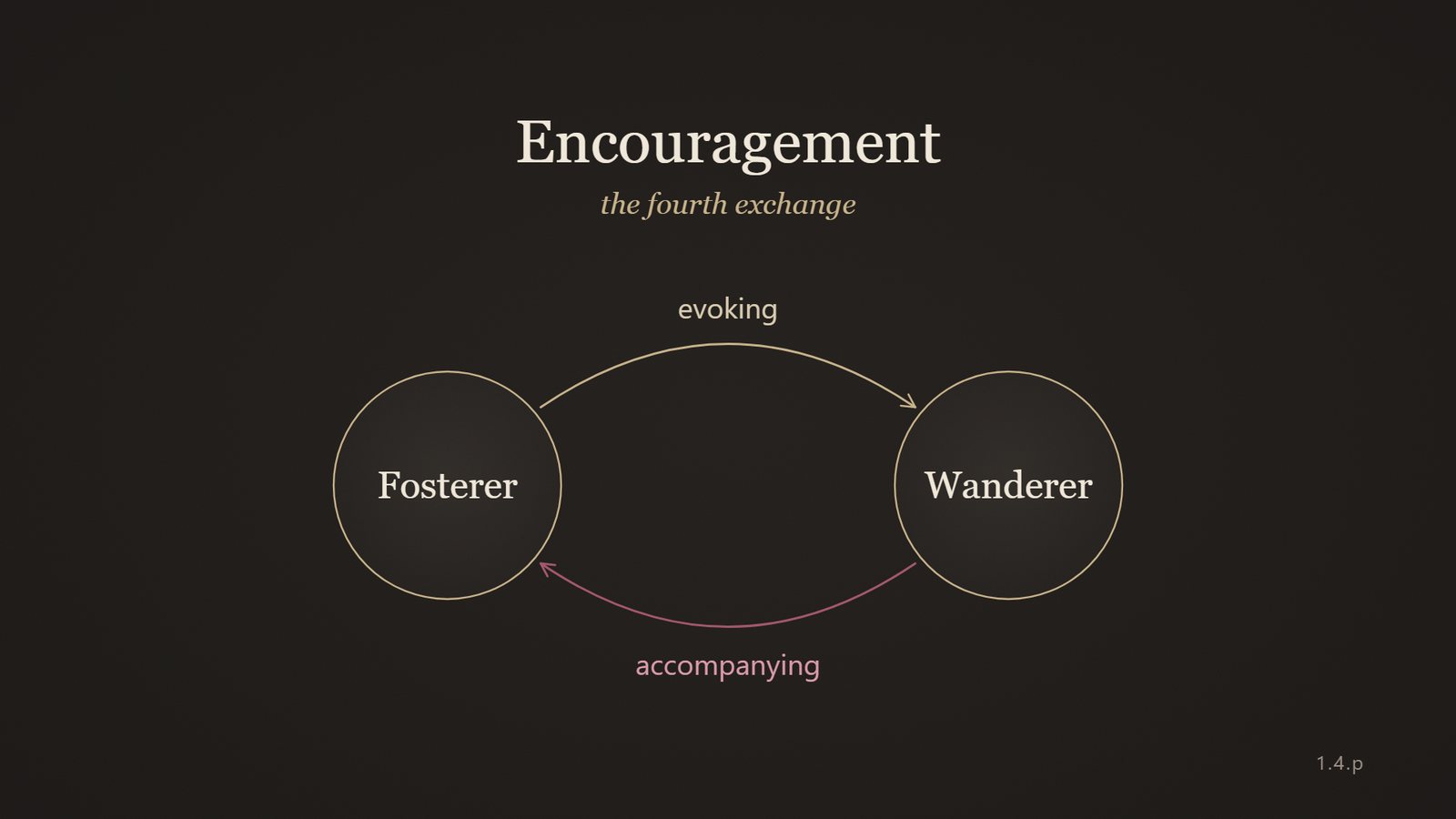
Encouragement is a pair of two movements: evoking on one side, accompanying on the other. And like every exchange, it lives on reciprocity. Whoever evokes without accompanying wakes a want and then leaves it standing alone. Whoever accompanies without evoking pushes: carries someone along a road they never chose. With encouragement the dance gets a “where to” for the first time. The first three exchanges asked who is there, what goes on inside, and whether the relationship holds. But a “where to” has an owner. So something becomes delicate that nobody had to ask before: whose want is at work here? The Wanderer's, or one the Fosterer planted?
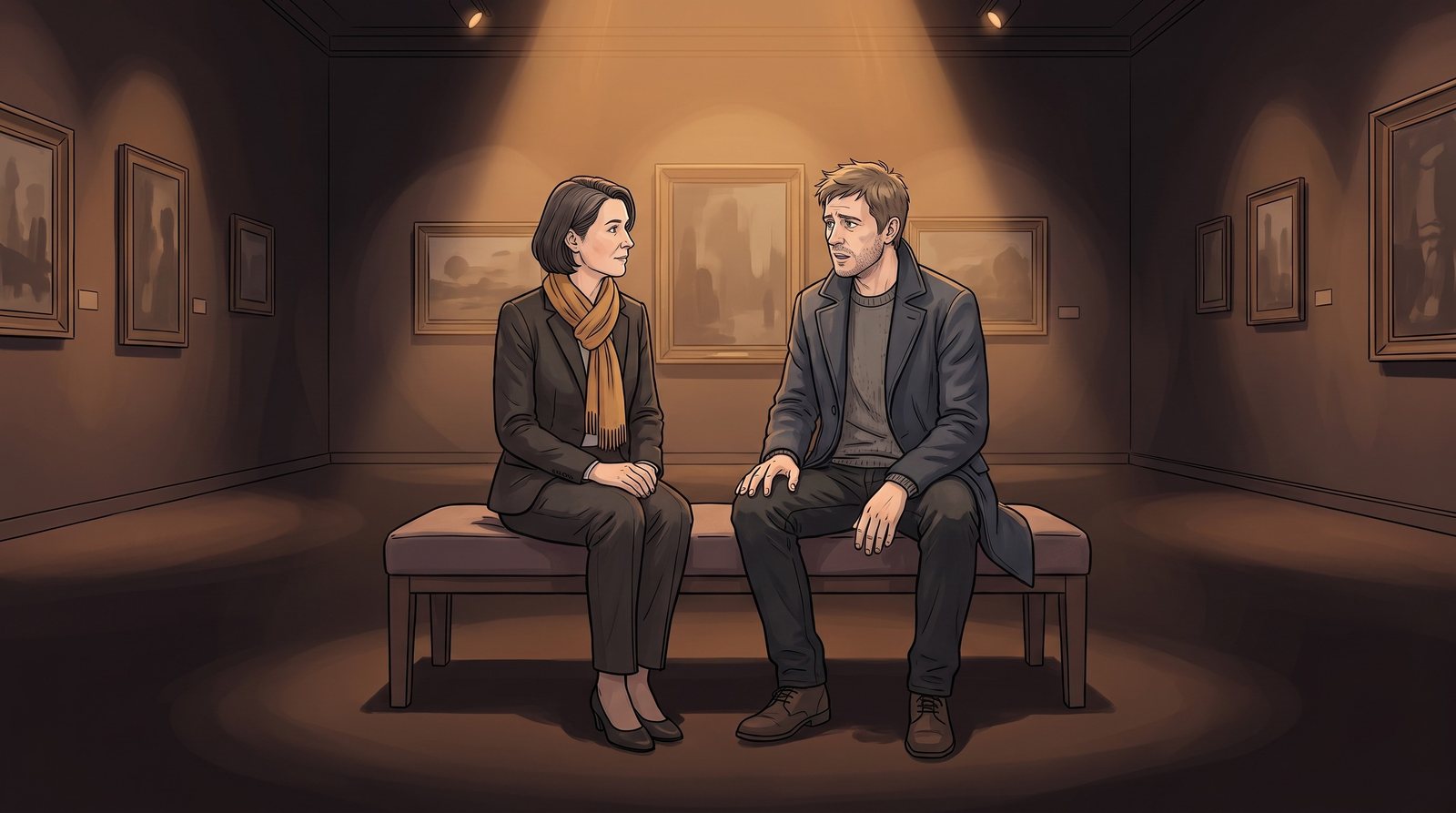
The dance has come a long way. The Wanderer no longer sits on the floor, but walks along: slowly, under their own steam. And unasked, the Wanderer says what would never have been said at the start:
Wanderer Do you know why I came along? I was tired. And you were honest for the first time when you stopped trying to convince me.
Asked how they knew what the Wanderer needed, the Fosterer answers:
Fosterer I didn't know. I stopped knowing.
Right here, where the direction finally becomes tangible, this field's shadow lures, and it deserves a name, because we'll meet it again: the righting reflex. That's Miller and Rollnick's word for it. It's the helper's urge to put right in the other person whatever they see as right: to say the direction out loud as soon as they've spotted it, to pull as soon as the other hesitates. It feels like care. It's a relapse into the two means from the day they met, the lure and the deterrent, only better dressed.
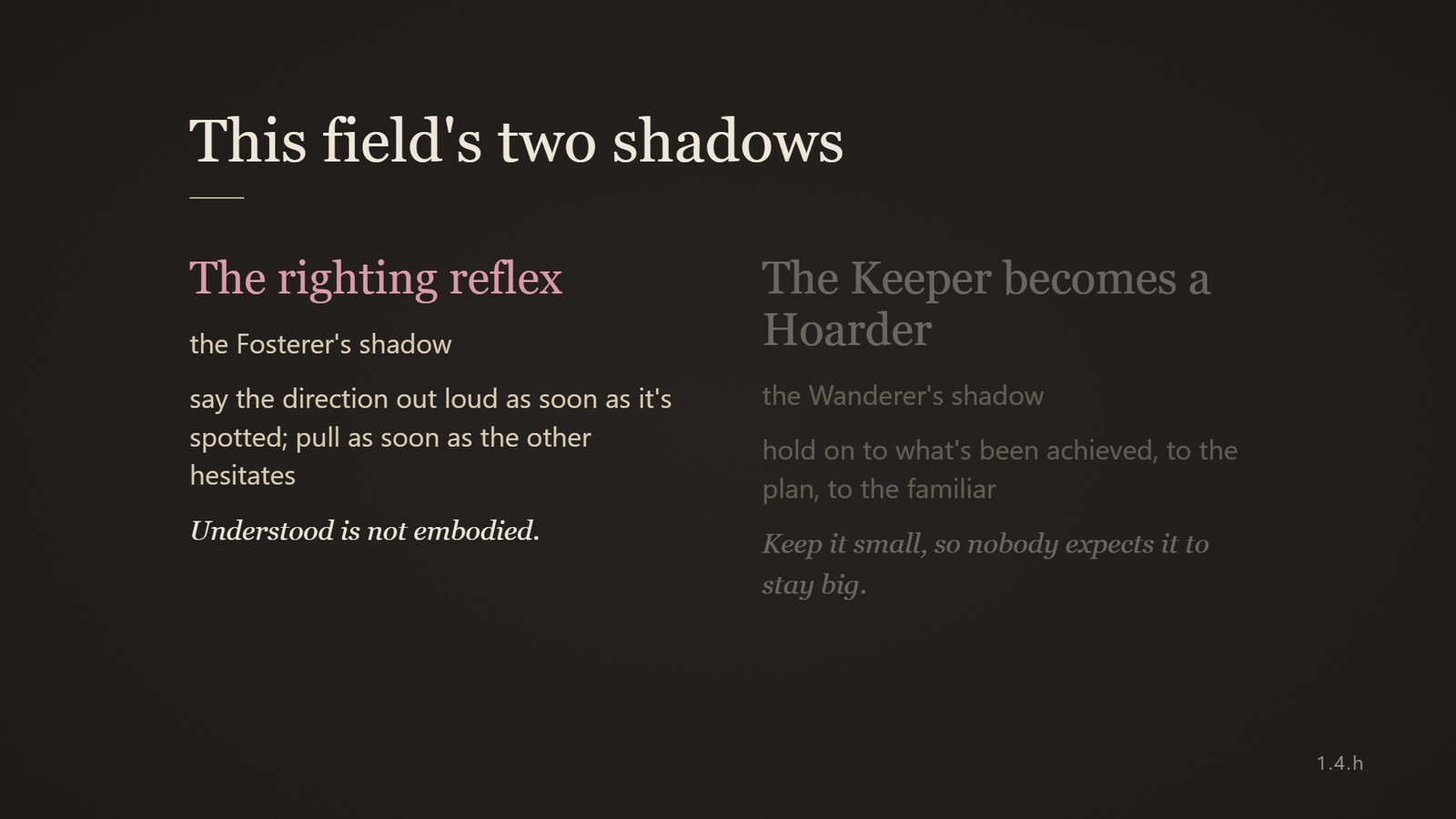
And it isn't a beginner's mistake you drop once. It comes back at every jump to the next level: whenever the Fosterer has understood the principles of one level and wants to explain them on the next, instead of embodying them again. Understood is not embodied.
The Wanderer has a shadow here too: the Keeper who becomes a Hoarder.
Holding on to what's been achieved, to the plan, to the familiar. Keeping something small, so that nobody expects it to stay big.
Observe
What do we do when we want to “motivate” someone? Almost always one of four things, sorted by timing and by pull. Before the action: the lure, “then this awaits you”, or the deterrent, “or else that happens”. After the action: praise, “well done!”, or blame, “not good enough”. All four work, in the short term. And all four have the same design flaw: the direction comes from outside. The energy comes from whoever steers, and the movement stops as soon as they let go. What remains is compliance, and a shrinking creative force. That praise sits next to blame in this table is no mistake. It's the point of episode 1.2, one row lower.
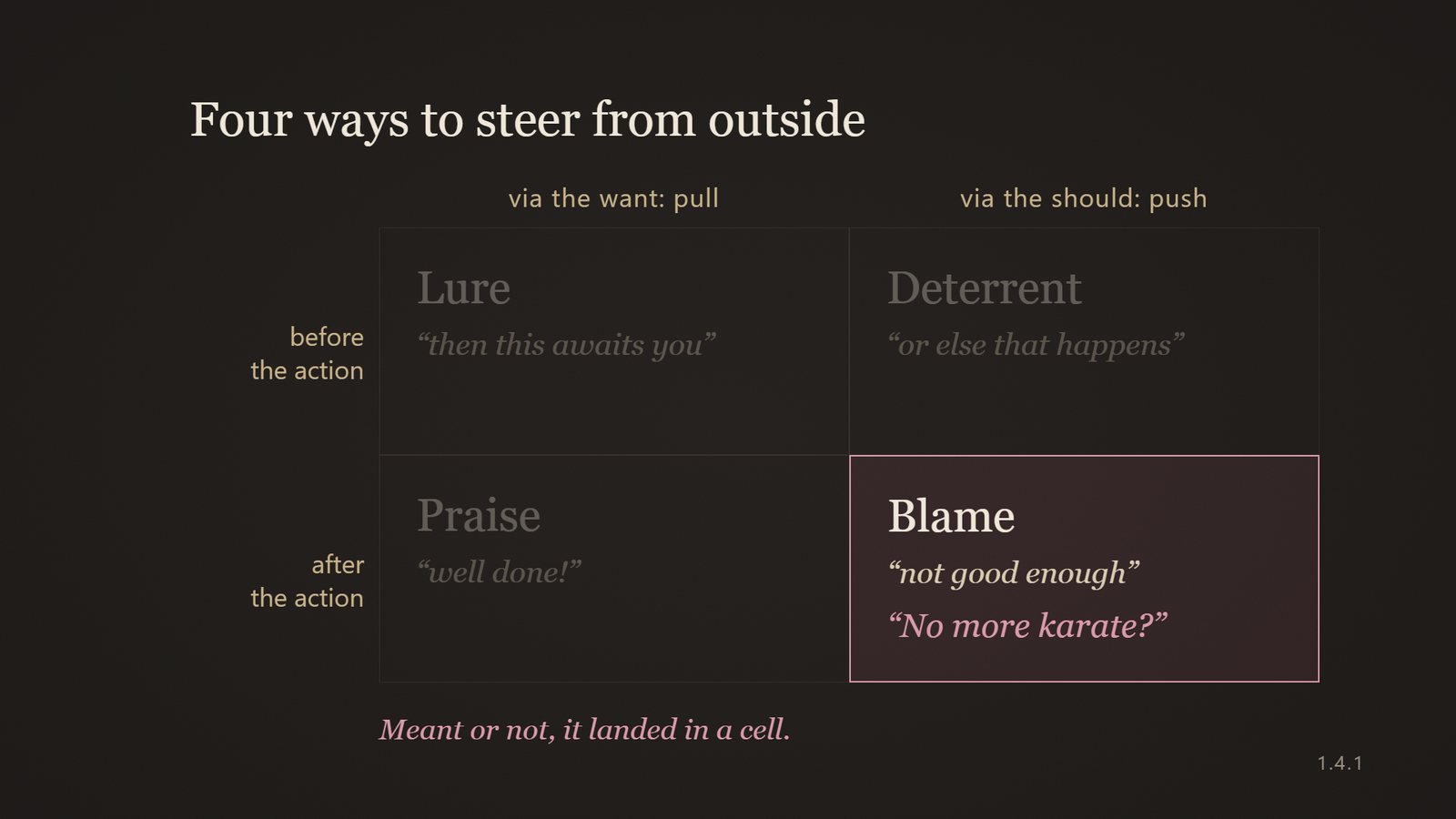
The exhibit shows that it doesn't even take intention. “No more karate?” didn't set out to steer anything, and still it landed in a cell: bottom right, blame. After the action, for not sticking with what came before. The bag was packed, the energy was there, fragile but real, and the sentence walked right past it to what was missing. Motivation is vulnerable in one direction. There are many more ways to kill motivation than to wake it.
So this chapter asks you to observe three things.
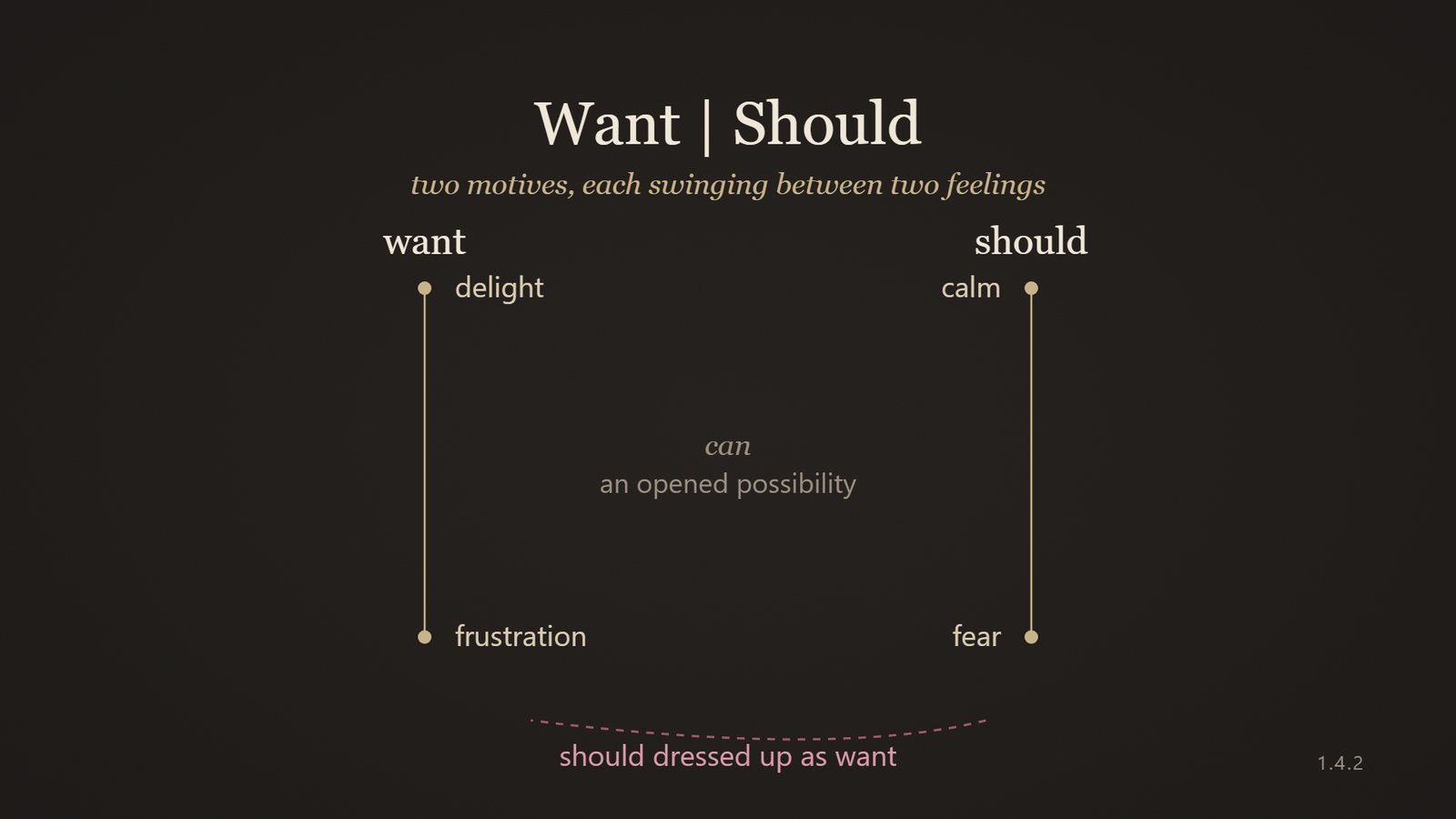
Find your own favourite cell in the table. Add the casual sentences nobody meant, which still land in a cell. And recognise when should dresses up as want: duty in a costume of enthusiasm. That's where the misery begins. Want swings between delight and frustration; should, between calm and fear. Whoever serves the one dressed as the other breeds exhaustion with a clear conscience.
Understand
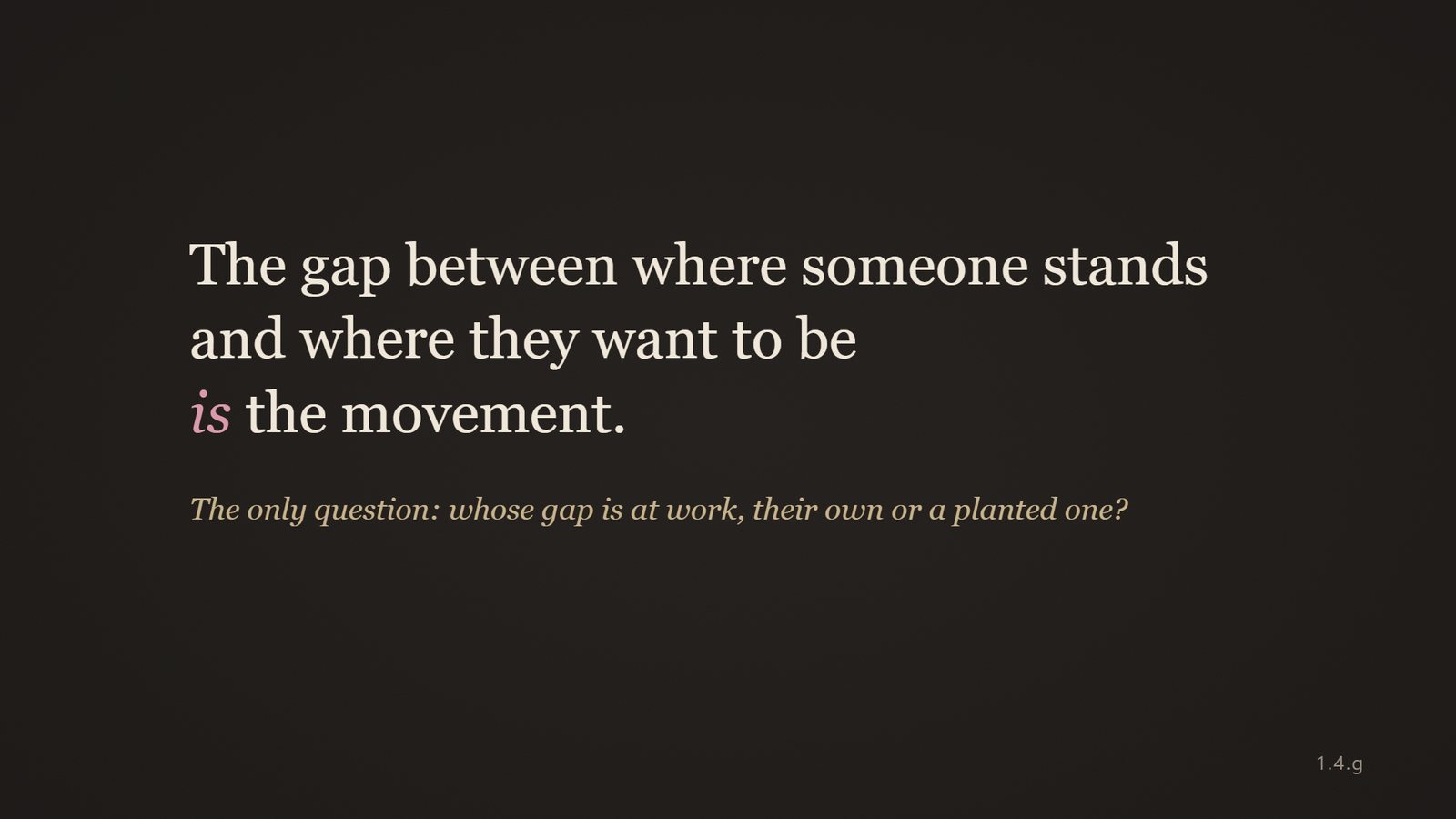
Motivation doesn't need to be manufactured. The gap between where someone stands and where they want, or are supposed, to be is the movement. The only question is whose gap is at work: their own, or a planted one.
The method has two basic acts for this. Perturbing: making the existing inner tension felt without resolving it. Reflecting both sides back: “You say this matters to you, and at the same time you're walking in another direction.” Questioning the way things are. Letting a sentence stand in the room. Silence is an intervention.
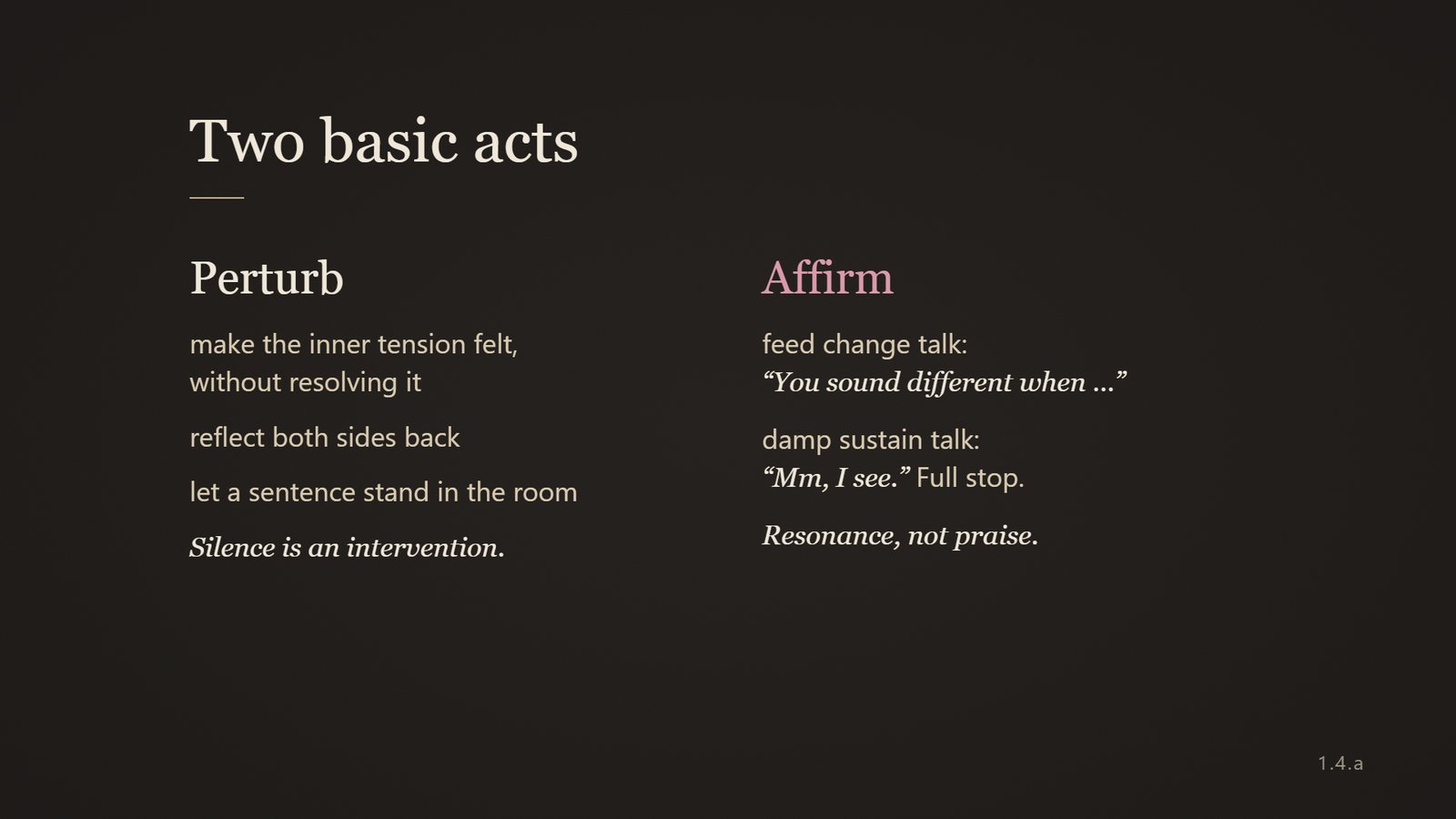
And affirming: feeding change talk, the sentences in which someone talks themselves towards a change. “When you talk about that, you sound different.” And damping sustain talk, the sentences for staying put: take them in politely, and don't build on them. “Mm, I see.” Full stop, no “but”. Resonance, not praise.
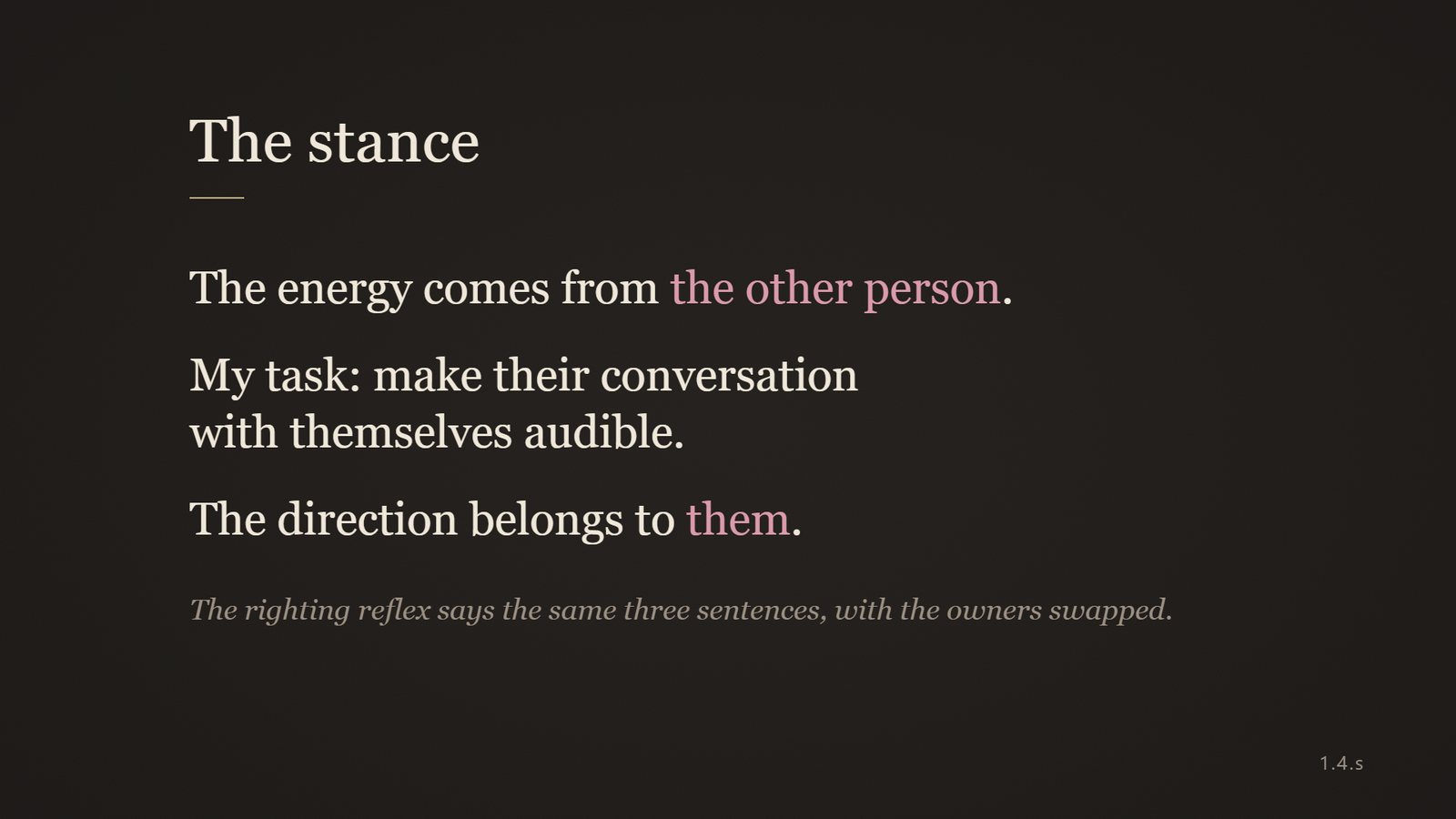
Three sentences hold the stance.
The energy comes from the other person. My task is to make their conversation with themselves audible. The direction belongs to them. In them you can recognise the opposite of the righting reflex, which says the same three sentences with the owners swapped.
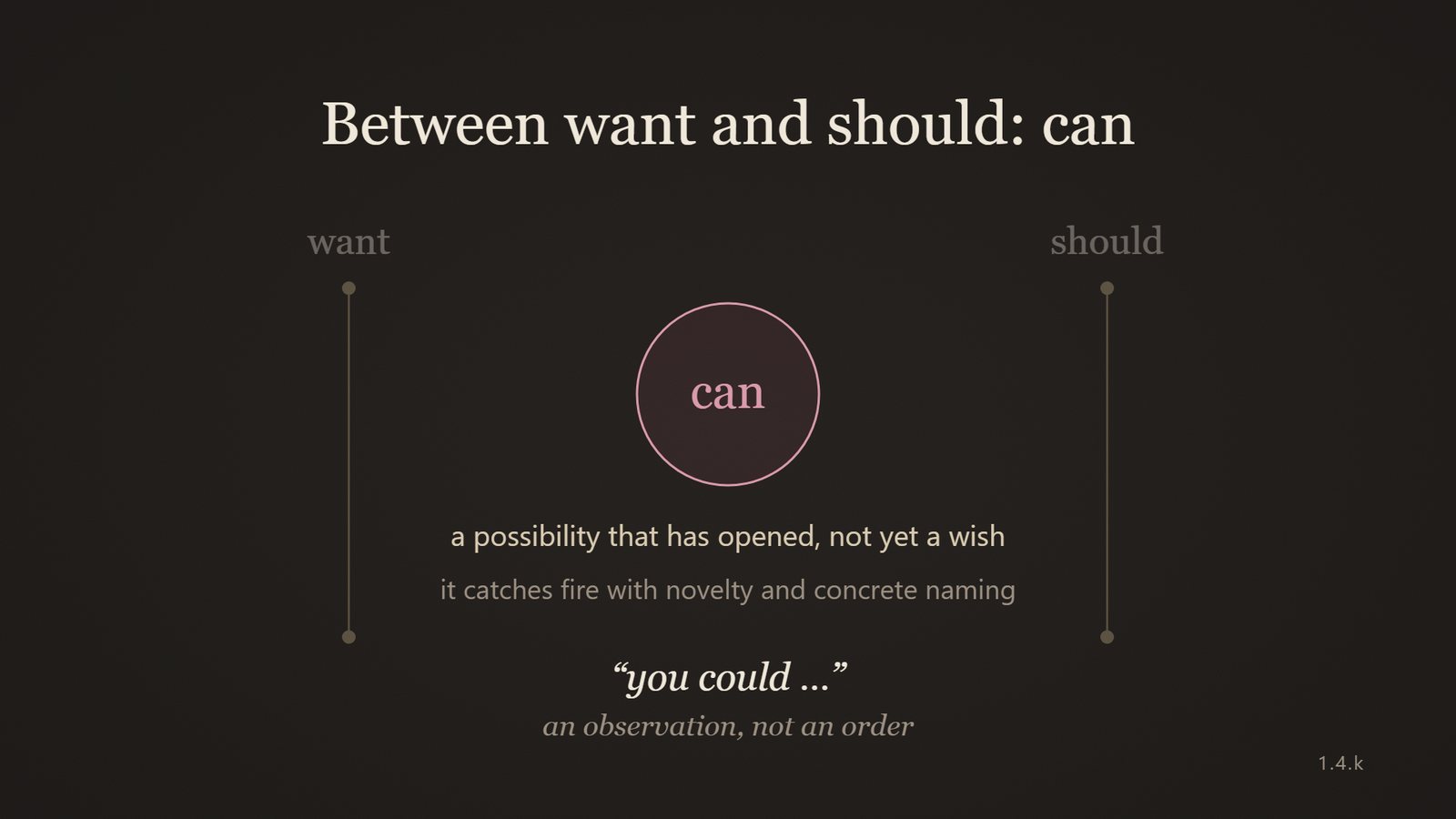
Between should and want lies something else: can.
A possibility that has opened, but hasn't yet become a wish. It needs novelty and concrete naming to catch fire. That's why general open questions fail here, and why naming a possibility concretely, “you could…”, as an observation and not an order, works like a match.

Which tells us what encouragement finally aims at. Not this one action, but the other person's self-efficacy: the grounded confidence that they can do the next thing under their own steam. Every step the Wanderer can credit to themselves raises it. Every step the Fosterer credits to themselves lowers it. And self-efficacy isn't lonely. It's borrowed from someone else's trust before it becomes your own.
So the Fosterer starts from strengths, not from deficits.
Strengths fire the want. Weaknesses belong to the should, where you keep them just in check so they don't get in the way. No more.

I once took this principle literally and made a job out of it. I invited a candidate to an Italian restaurant: a manager from a big, slow organisation, tired of it. I told her not a word about her future tasks. Instead I told her my worst traits, one after the other, all of them, and that her job would be to cover exactly what I'm bad at.
Candidate Still not scared off.
I hired her. Let's call her Rike. In the years that followed she did more for the team than for me, and that was right. Strengths belong to the want; weaknesses need a fence, and the fence can be a person. But only if you've laid your weaknesses out in front of them first. The interview ran the other way round.
She didn't have to prove herself. I had to show myself.
An uncomfortable caveat belongs here too. “The energy comes from the other person” has a limit. Sometimes there's no gap left to uncover: not because the other person wants nothing, but because they've learned that wanting changes nothing. Martin Seligman called it learned helplessness. It isn't a character trait, it's an experience, and its causes are often in the system around the person.
Then evoking alone fails.
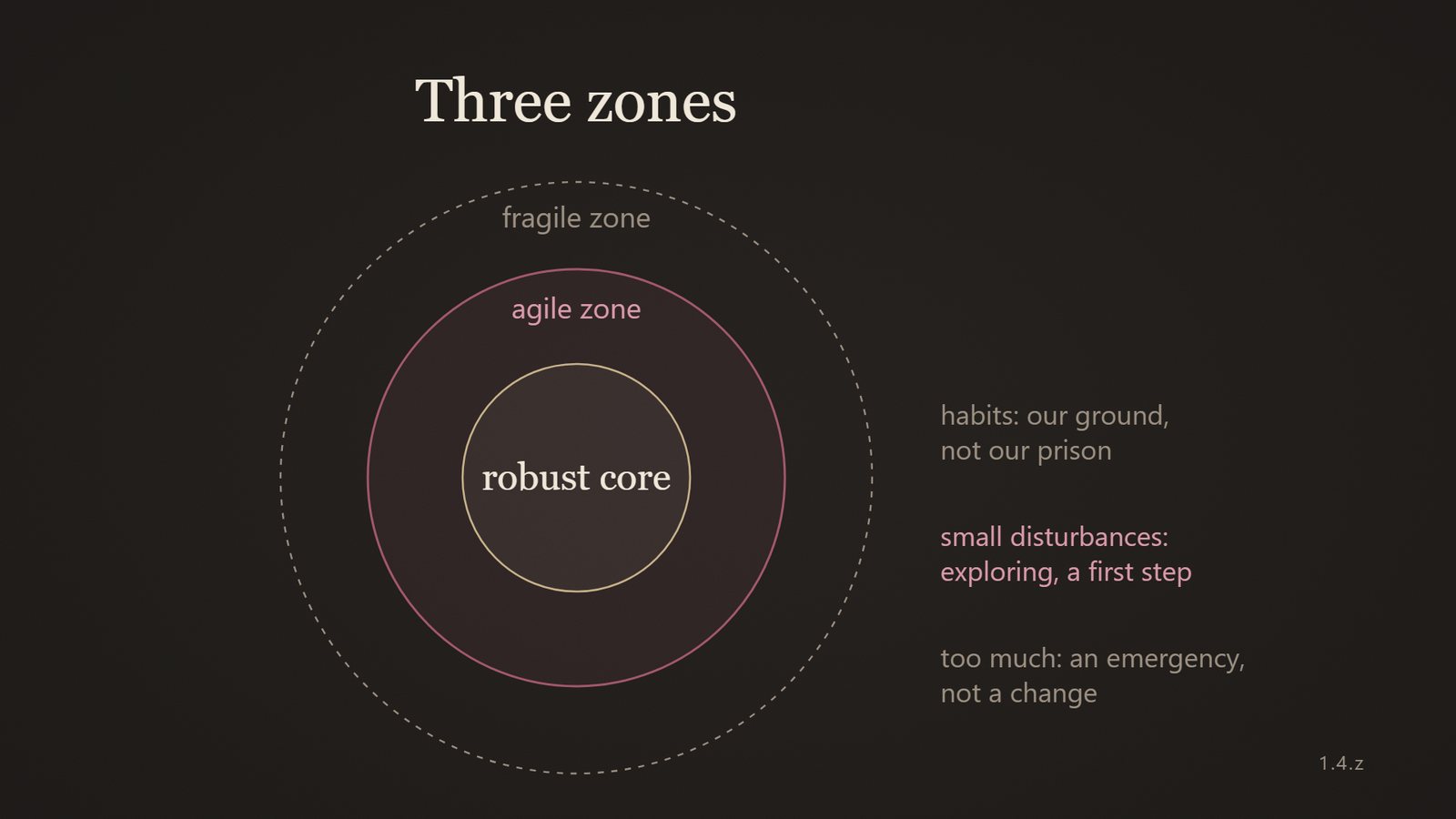
Nobody pulls themselves out of the mud by their own bootstraps. It takes a hand: a first, borrowed success at which self-efficacy can catch again. That's what the agile zone is for: the ring just beyond the robust core of our habits, where small disturbances let us explore. Push someone into the fragile zone beyond it, and you don't get change. You get an emergency. A scaffold in the agile zone serves the first doable step, not the direction. The direction belongs to the Wanderer, as soon as it breathes again.
Practise · Connecting
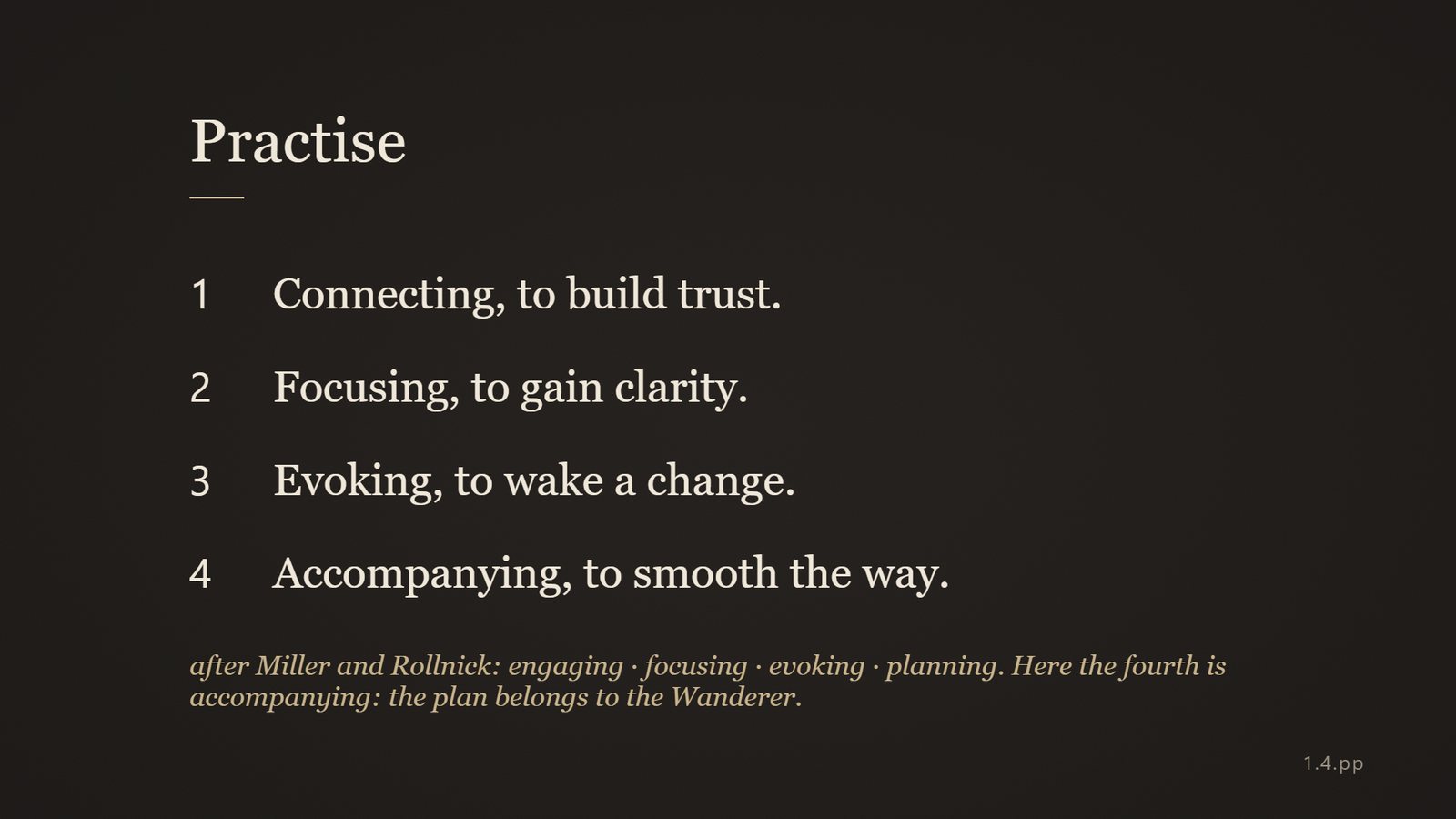
The craft of this level has masters. William Miller and Stephen Rollnick mapped it as motivational interviewing. We leave it with them, and only set its four processes into our playing field. They aren't phases you tick off, but layers that carry each other: connecting, focusing, evoking, and where Miller and Rollnick put planning, accompanying. Because the plan belongs to the Wanderer.
One. Connecting, to build trust. The relationship carries the work, not the other way round.

The same movement carries in groups, only less smoothly than the textbooks promise. I'm brought in to a team that's said to be difficult. Advice-resistant, I'm told beforehand; people have tried a few things. I arrive with nothing. In the first session I still do what one does: a suggestion, carefully placed. It's taken apart, politely, thoroughly. A second one: the same. They're practised at this. Everyone who ever came in here came with a solution. So I stop, and ask what they've already tried themselves.

Team Member We've written that list five times. It never had any impact.
That's where the frustration lives. Not in a lack of ideas: in ideas that went nowhere, five times over. Whoever brings a sixth exercise is the sixth person who didn't listen. So I don't. I say back what I heard: five lists, and nothing came of them. Nobody contradicts, and for the first time in that room nobody has to defend anything.

We don't write a sixth list.
We look through the old ones for the one item that lies in their own hands, however small, and they do it before we meet again. It isn't a breakthrough. It's the first thing on that list that happened.
Practise · Focusing
Two. Focusing, to gain clarity. Whoever is being fostered may wander off; holding the direction is a service, as long as it's their direction.

And a group can dodge its focus in a way that looks like perfect organisation. A project has stalled; twenty people sit in the room. At the end there are twenty items, and each item has exactly one name next to it. Everyone leaves with a task.
Execution: alone.
Maximum separation. Organisations love it, because there is always the one person responsible. I call the pattern conflict avoidance. As long as everyone has their own item, nobody has to argue about what matters most. And it guarantees that the group never becomes a team, because a shared goal is exactly what it avoids. Holding the direction for a group would mean the opposite: asking the question that puts the shared goal back on the table, and with it the conflict everyone has been avoiding. What really matters, to all of you?

Focusing also applies to your own role. Someone once asks me a question. Not as a reproach, not in a conflict: over coffee, almost in passing, and yet so that I notice it's meant seriously.
Colleague Over Coffee What can one actually expect from you?
I have no answer ready. I say something evasive, and we talk about other things. But the question comes with me. For days it lies crosswise, every time I think I've forgotten it. Only at the end of the week, in the shower, do I put a sentence together, and even while I'm forming it I feel it isn't advertising copy but a promise. That I listen before I answer.
That I say when I'm stuck. That I stop when the other person is done. Three sentences, and each one is a fence.
What I expect of myself becomes the line I'm measured by, and people will measure me by it. But the same fence is the first relief in a long time: what's inside is mine. For everything outside, I'm no longer responsible.
And the exhibit shows the dark side of the same tool.
“No more karate?” was a focusing question too. It bundled the gaze, only onto the loss. Focus is a lens, not a virtue. It sets fire to whatever you point it at.
Mirror
Your favourite cell in the table: lure, deterrent, praise or blame. And with whom do you use it?
Which casual question last landed on you as blame, your “No more karate?” And to whom have you asked one without noticing?
Which of your wants is really a should in costume? How do you know?
Echo

Wanderer When we met, you told me to stand up.
Fosterer That was wrong.
Wanderer You said you wanted to accompany me.
Fosterer That was right.
Wanderer What was the difference, for you?
Fosterer The first came from me. The second came from you.
Wanderer There are many more ways to kill motivation than to wake it.
Fosterer Yes. That's true.
Sources
- William R. Miller and Stephen Rollnick, Motivational Interviewing (3rd edition, 2013): the righting reflex, change talk and sustain talk, the four processes.
- Albert Bandura, Self-Efficacy: The Exercise of Control (1997).
- Martin E. P. Seligman, Helplessness: On Depression, Development, and Death (1975).
The stories are drawn from three decades as an employee, leader, coach and facilitator. Places, times and people are changed, and some scenes are composed from several experiences; they allow no reliable conclusions about any company or person. The illustrations and the voices of the episode are made with AI.