Unfolding · Part I: The Person · 1.3
Connection: Connecting Communication
A piano teacher who only ever says “right” and “wrong”, never “good” or “bad”. A seminar leader cured of his “er” in one break, by birds that aren't there. The third exchange of the Fosterer and Wanderer method: resonance and reciprocity, observing without judging, and the four layers of connecting communication.
The text of the episode follows, with its diagrams. Below each heading: watch that part on YouTube.
Cold open · Say what you see

Wanderer You look different from the last room, Fosterer.
Fosterer (begins) I can see you're opening—
Wanderer (cuts in) Don't. Say what you see. Not what it means.
Fosterer (stops, starts again) You're standing closer than before. Your arms aren't crossed.
Wanderer That's an observation. The other would have been an interpretation, wrapped as a gift.
Fosterer (after a moment) And you? What do you see in me?
Wanderer (testing) That you were about to say something that sounds good, and held it back. (pause) I like that better than the good thing.
Fosterer (quietly) That's the first time you've told me what you like.
Wanderer (lets it stand) … Yes.
Fosterer (nods towards the wall) On this wall hangs someone who could do exactly that: observe without judging. A piano teacher. Come.
Exhibit · Katja

Katja is my piano teacher. In my late thirties, after a move, after ten years of keyboards on hobby stages, after a long break, I've started learning the piano again. Not for work. As a pastime. I'm not bad. I'm just doing it wrong.
In the first lesson, Katja has me play something.
Katja I understand what you want to say. But your technique won't let you. Can you play only what I give you, for a year?
I agree. Then we sit, week after week, hour after hour. Sometimes Katja holds my hand while I play: not to guide it, but to explore it. Which muscles move, which don't, where there's tension, where there isn't, while I strike the same notes again and again.
Katja Wrong. Wrong. Right. Wrong. Right.
The words fascinate me. She never says "good" or "bad". Only ever "right" and "wrong". And that's exactly why I find them easier to accept. They speak to what I do, not to what I am. It dawns on me: she must have a very precise ideal in her head to be able to speak of right and wrong. Not of aesthetics. Of mechanics. Of physics.
Katja Right technique feels good. It spares the hand; it doesn't strain it. Right technique also looks right.
Katja doesn't let up until, wherever possible, I let gravity do the work instead of pressing the keys. Until my illusion of linear movement has dissolved completely into a series of small, wonderfully ergonomic rotations, each answering the last. Until I can feel when it's right: not because she says so, but because I've learned to feel it, to hear it. Because it feels right and looks right, and then suddenly sounds right too.

Exhibit · The birds
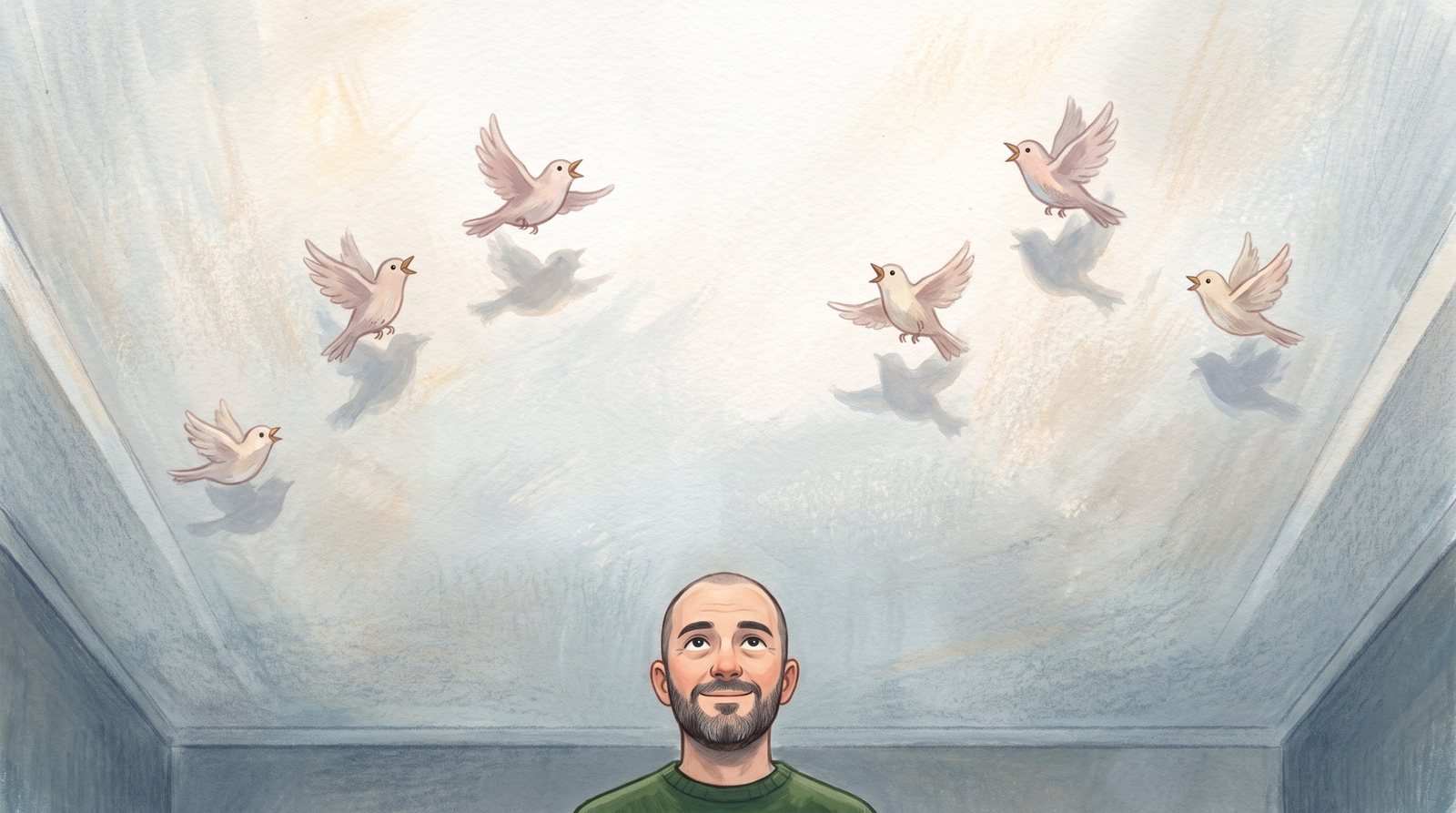
And a second one, from the seminar room. I'm sitting in on a seminar as a quiet observer, to gather impressions. I know the seminar leader a little; I know he sings. He's well prepared, solid in content. He just keeps saying "er".
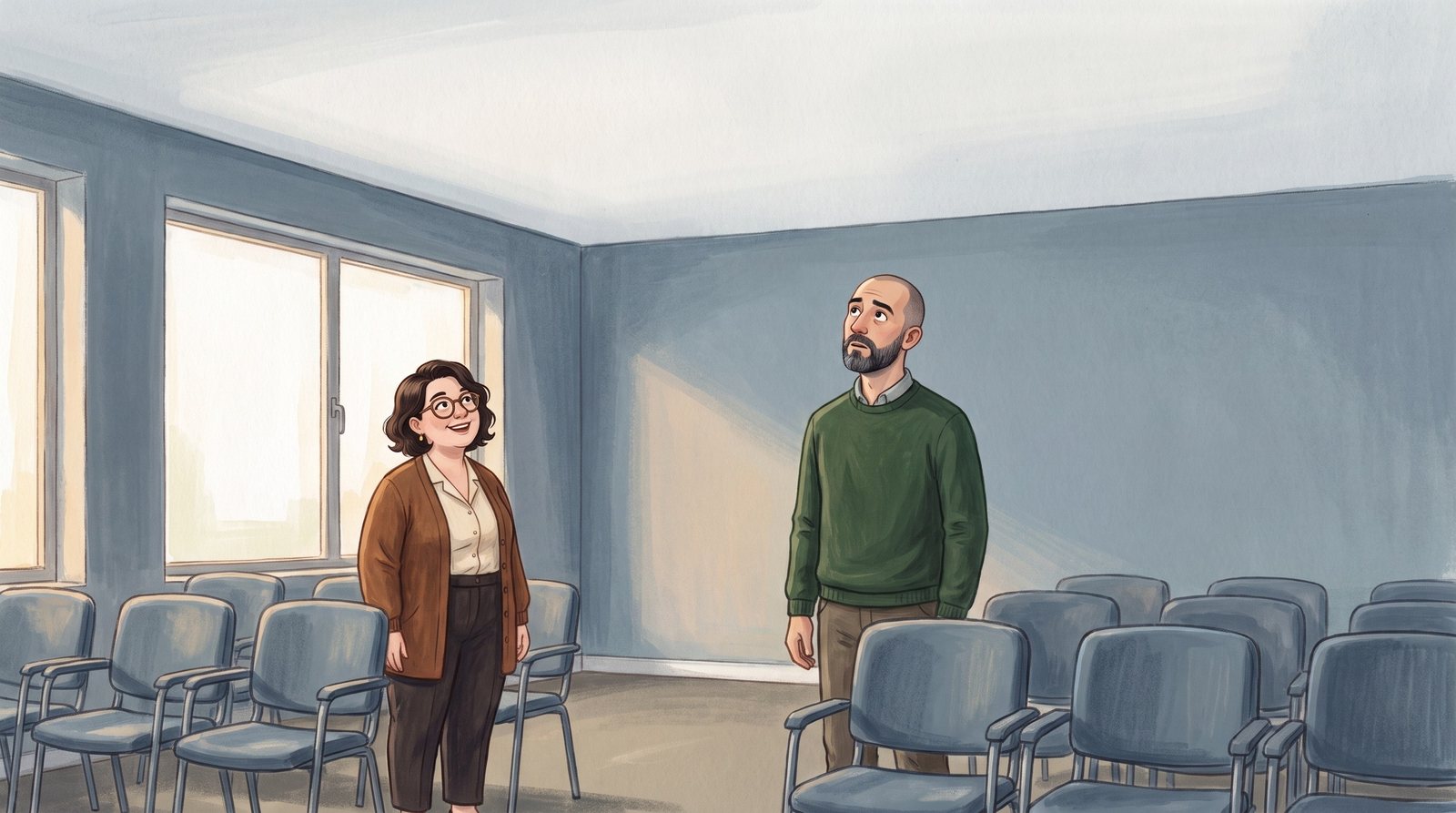
I watch when he says it. Not why: only when. And the when is precise. He says it when he looks up at the ceiling. Not when he's thinking, not when he's unsure. When he looks at the ceiling. The ceiling is apparently his search field, and while he doesn't find what he's looking for up there, he bridges the gap with the sound.
In the break, I go up to him.
I May I tell you something?
Seminar Leader Of course.
I Look up for a moment.
He looks.
I Do you see the birds?
Seminar Leader What birds?
I Exactly. The ceiling is empty. But the birds that would be flying up there, if there were any: they all say "er".
He looks at me for a moment.
I Just an observation.
The rest of the seminar went by without a single "er".
Fosterer and Wanderer · Connection
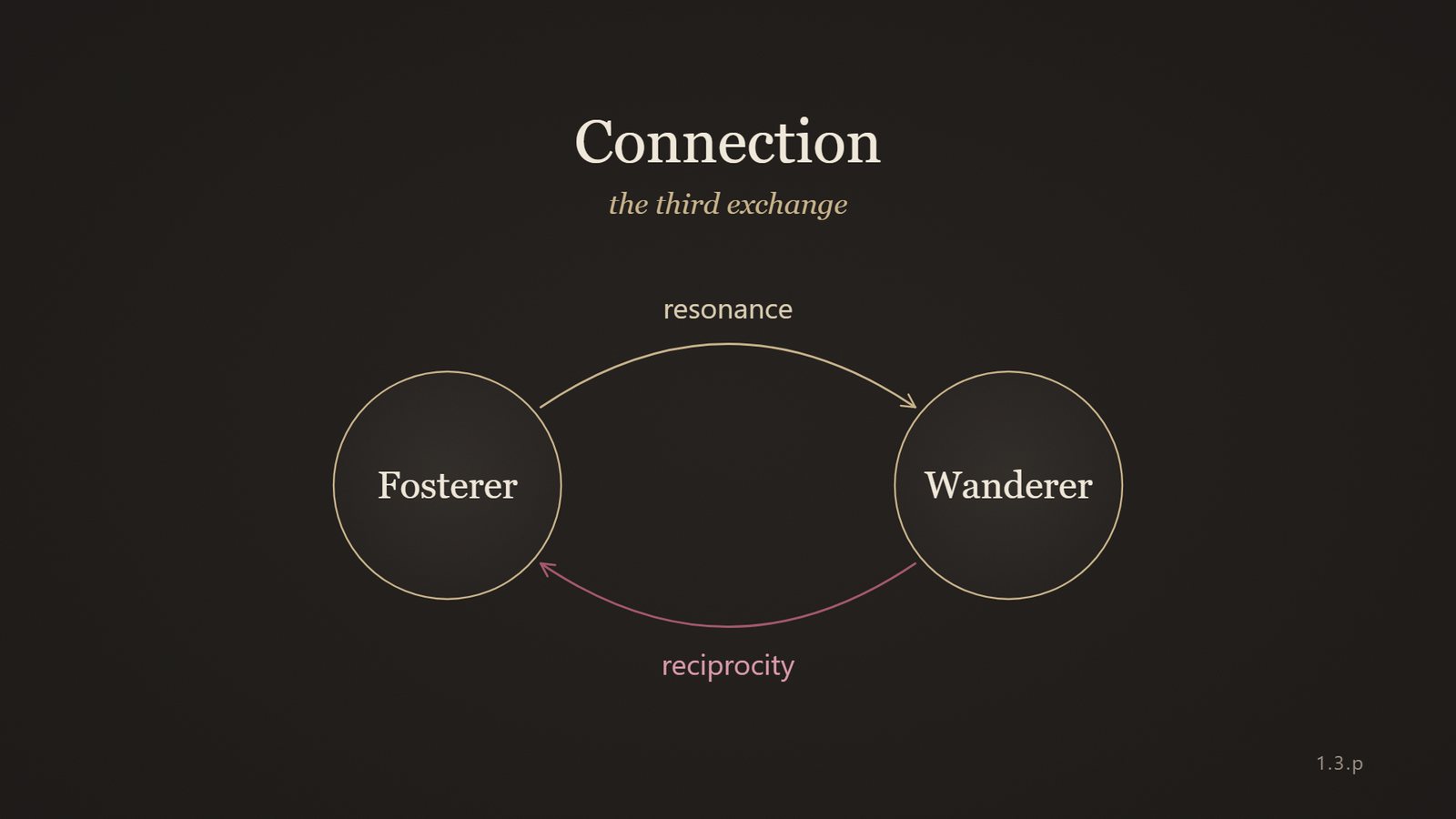
Connection is a pair: resonance on one side, reciprocity on the other. Resonance can't be produced, only offered; whoever claims it when nothing resonates back is just creating a mood. And reciprocity is its only proof: connection only exists when it runs in both directions. Regard and exploration the Fosterer could carry alone, against the defence, if need be. Connection, no. It's the first point in the dance where the Fosterer needs something they cannot make.
And then the exchange tips, almost unnoticed: the Wanderer starts to observe the Fosterer back, just as precisely, just as free of judgement. Two people observing each other without interpreting each other: that's reciprocity in its barest, sturdiest form. The Fosterer's art is then to do almost nothing. Not interpret, not affirm, just stay. Silence at the right moment is already resonance.
And right here lies the subtlest temptation: flattery, dressed as interpretation. "I can see you're opening up" is the sentence that would close the crack at once: an interpretation wrapped as a gift, which takes the revelation out of the other person's hands and sticks a label on it.
Because the dance now demands something that can't be forced, that something comes back, the Fosterer needs the craft that makes resonance possible without claiming it: observing instead of interpreting, revealing feelings instead of creating a mood, recognising needs instead of negotiating positions, asking instead of demanding.
Observe · The judgement comes first
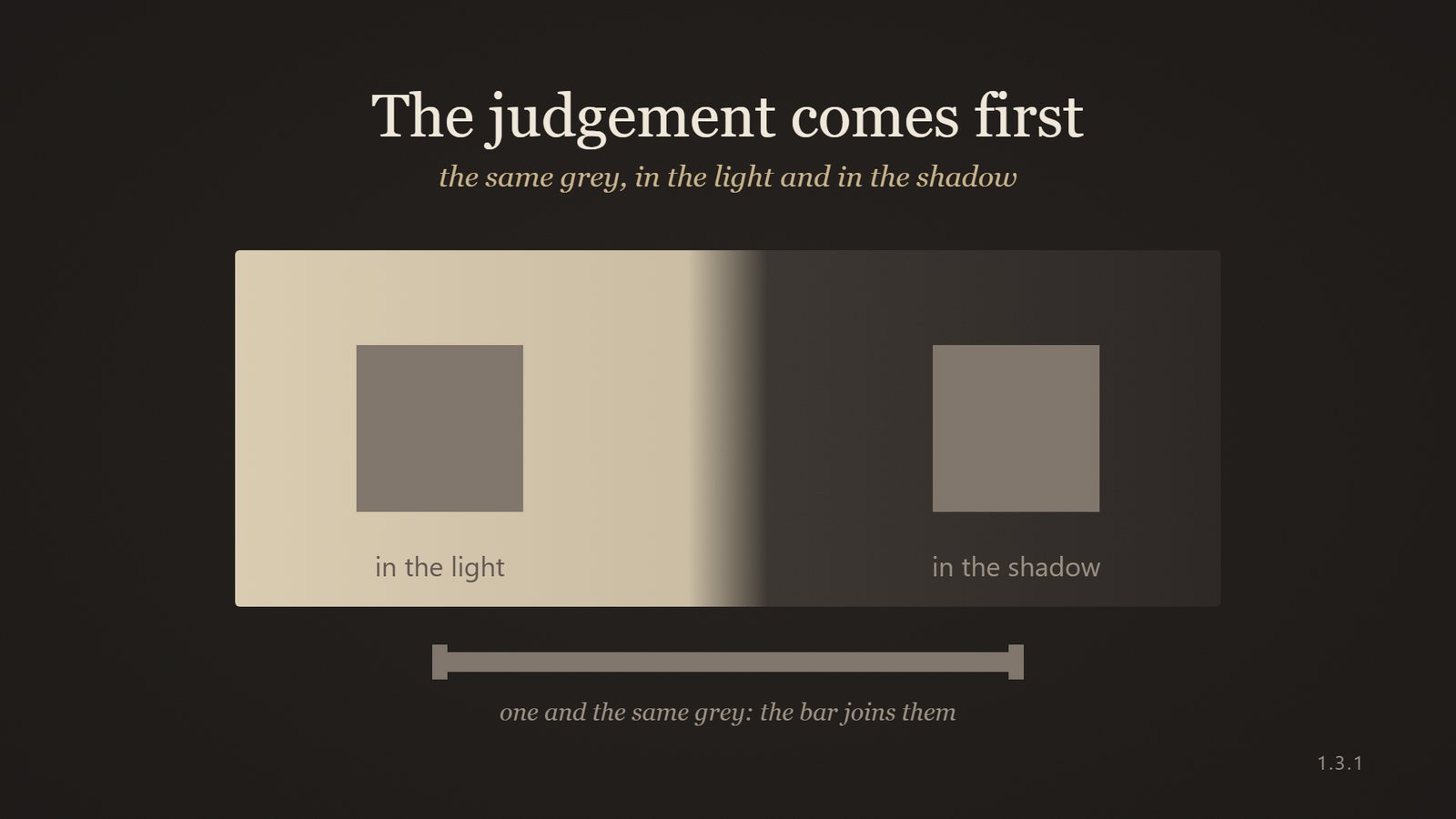
Observing without judging is so hard because our interpretations became habits long ago. They fire before thinking begins, and they colour perception itself: the same patch looks lighter in shadow than in light. A prejudice is nothing else: an interpretation that has become a way of seeing. You can't switch it off, but you can know it, and when you speak, you can walk the way back: from the view to the observation.
For that you need what Katja had: an ideal that lets you say right or wrong without making a person good or bad. "Good" and "bad" speak about the person; "right" and "wrong" speak about the moment, and that's why they're easier to hear. Without such a model you have no observations, only opinions, and every piece of feedback becomes a question of taste, and so a question about the person.
The birds on the ceiling show the other half: observation collects data about when, not theories about why. "He says er when he looks at the ceiling" is an observation. "He's unsure" would be a diagnosis, and would have hurt the seminar leader instead of curing him.
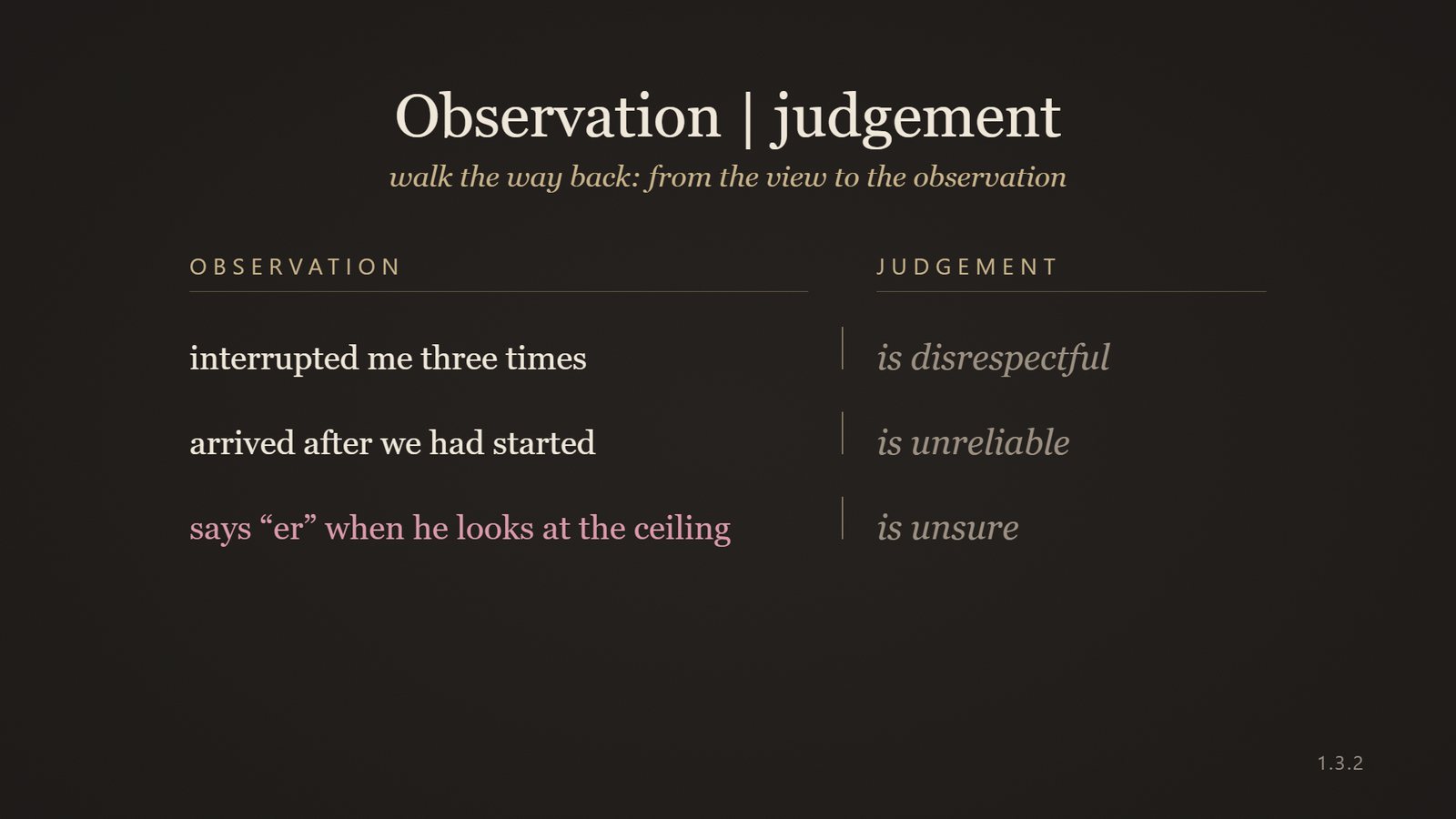
Understand · Four layers, two languages
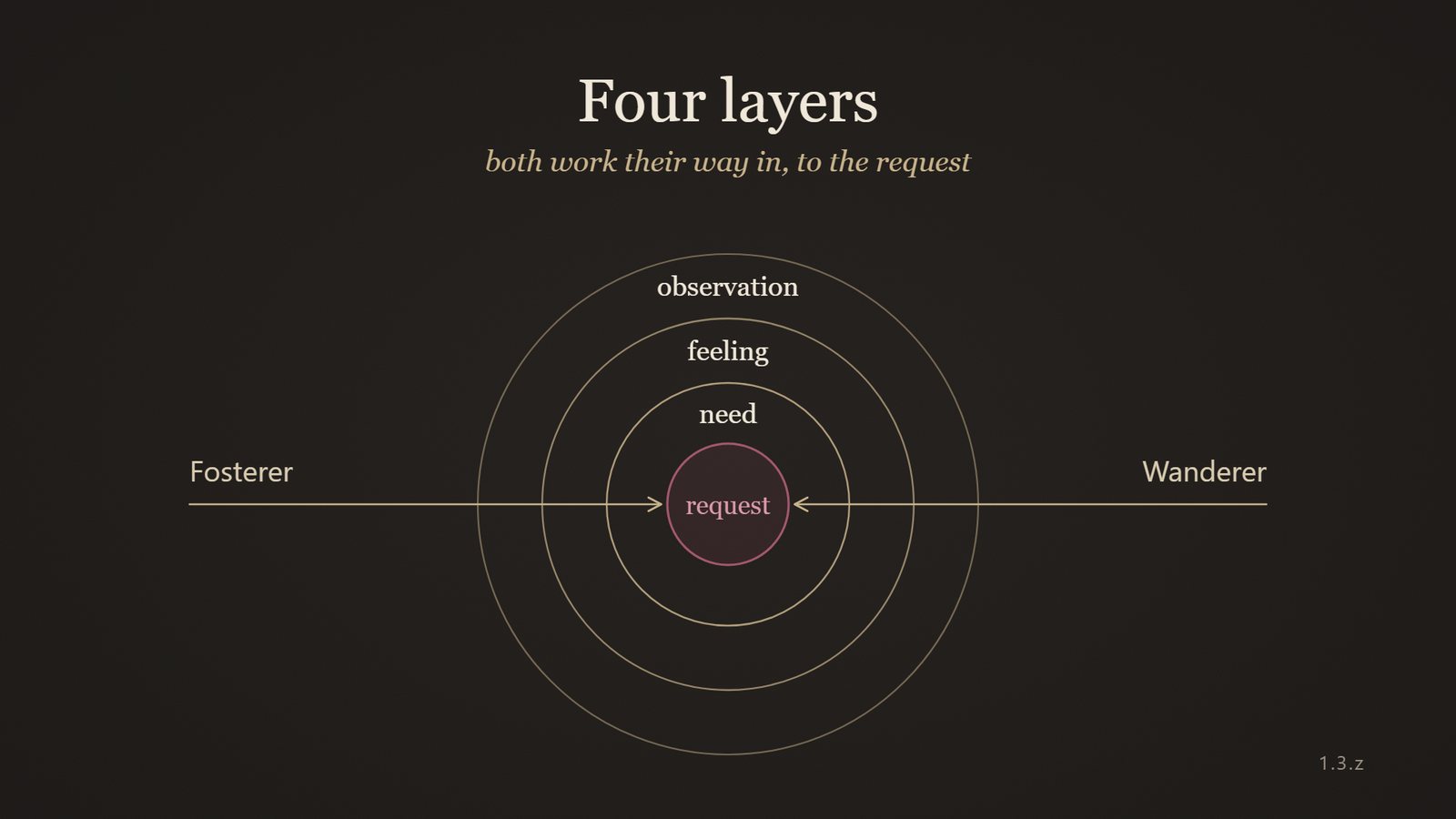
Connecting communication, after Marshall Rosenberg (he called it Nonviolent Communication), orders speaking into four layers, from the outside in. Observation: what happened, without a label. Feeling: what it set off in me. Need: what I need. Request: which concrete action, one that can be fulfilled, would help. Behind every conflict there's an unmet need; the four layers are the way there, without damaging anyone on the way.
How un-abstract that is, a group taught me, one I wanted to bring it closer to. It doesn't go well. They get tangled up in discussions about the scheme, about a lack of authenticity, about whether it all sounds a bit artificial. The connection won't happen. Then a participant says:
Participant It's like an onion. Layer by layer. You work your way through, in conversation with the other person. And in the middle there's something that makes your eyes water.
I let the group work with that. Some don't get beyond layer one. "He was rude." That's the observation, or more precisely its costume, and it stays standing there, like a fact that explains everything. Some stop at layer two. "I was furious." The feeling has a name, and that already feels like depth. One man breaks down at layer three. Not from weakness. Because he has never said his need out loud. Not in front of others. Not even to himself. That's the moment the whole exercise is for.
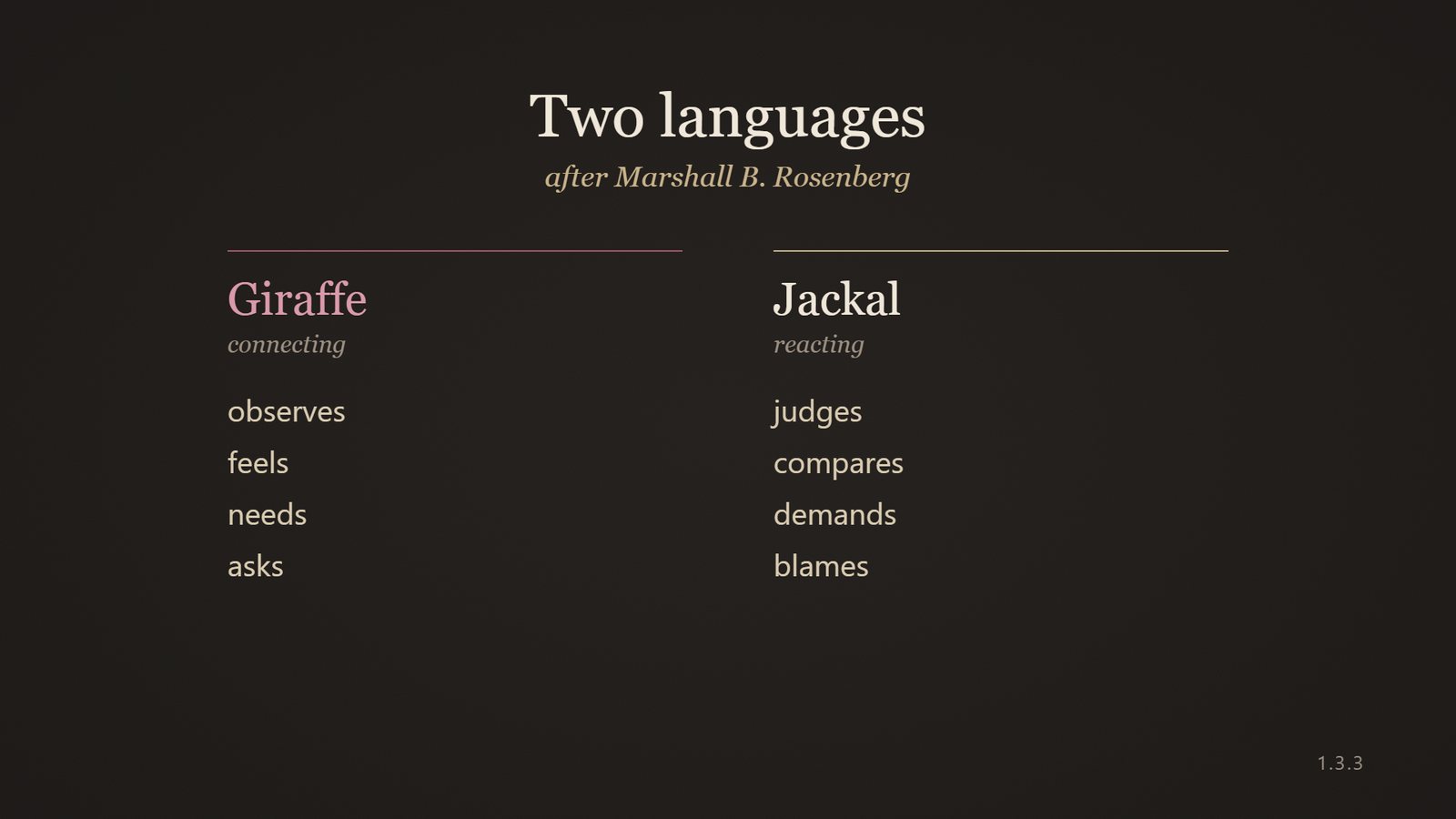
Rosenberg's image of two languages helps you listen. The jackal judges, compares, demands, and knows who's to blame. The giraffe, chosen for its big heart, speaks in observations, feelings, needs and requests. Nobody speaks giraffe all the time. It's enough to recognise the jackal in your own sentence before it finishes speaking.
And the best sign of a request: a request is only a request when no is allowed. Otherwise it's a demand in its Sunday best.

Practise · One: Observe, to see clearly
One. Observe, to see clearly. Say what happened, not what it means. Before a delicate sentence, the Katja test: is there a right or wrong here, a mechanism? Or am I at good or bad, the person?
And the form of the birds. Looking back, there was more in that little trick than I knew at the time. The image was absurd enough to be remembered. It sat exactly where the behaviour happened, up at the ceiling. It handed the action to someone else: the birds say "er", not him, so there was no blame to defend against. And the question "Do you see the birds?" put him straight into curiosity. Whoever interprets forces the other person to take a stand on the interpretation. Whoever observes leaves them the first move.
Practise · Two: Reveal feelings, to be genuine

Two. Reveal feelings, to be genuine. Lay open what an observation sets off in your own body. Regard prepared us for that: without the inner check, there's no feeling you can name.
A colleague once showed me how, while we were clearing up after a difficult facilitation, chairs, flipcharts, coffee cups, without any introduction:
Colleague I hate this. You need your stage. I need my desk.
No reproach. No complaint. Self-disclosure, direct and without armour, and I take it as a gift. Revealing feelings doesn't mean complaining. It means offering the other person a reality they can orient themselves by. A sentence like that gives more information than an hour of analysis, because it doesn't explain: it shows.
Practise · Three: Recognise needs, to build bridges
Three. Recognise needs, to build bridges: from the position to the interest. Because the need almost always arrives in disguise.
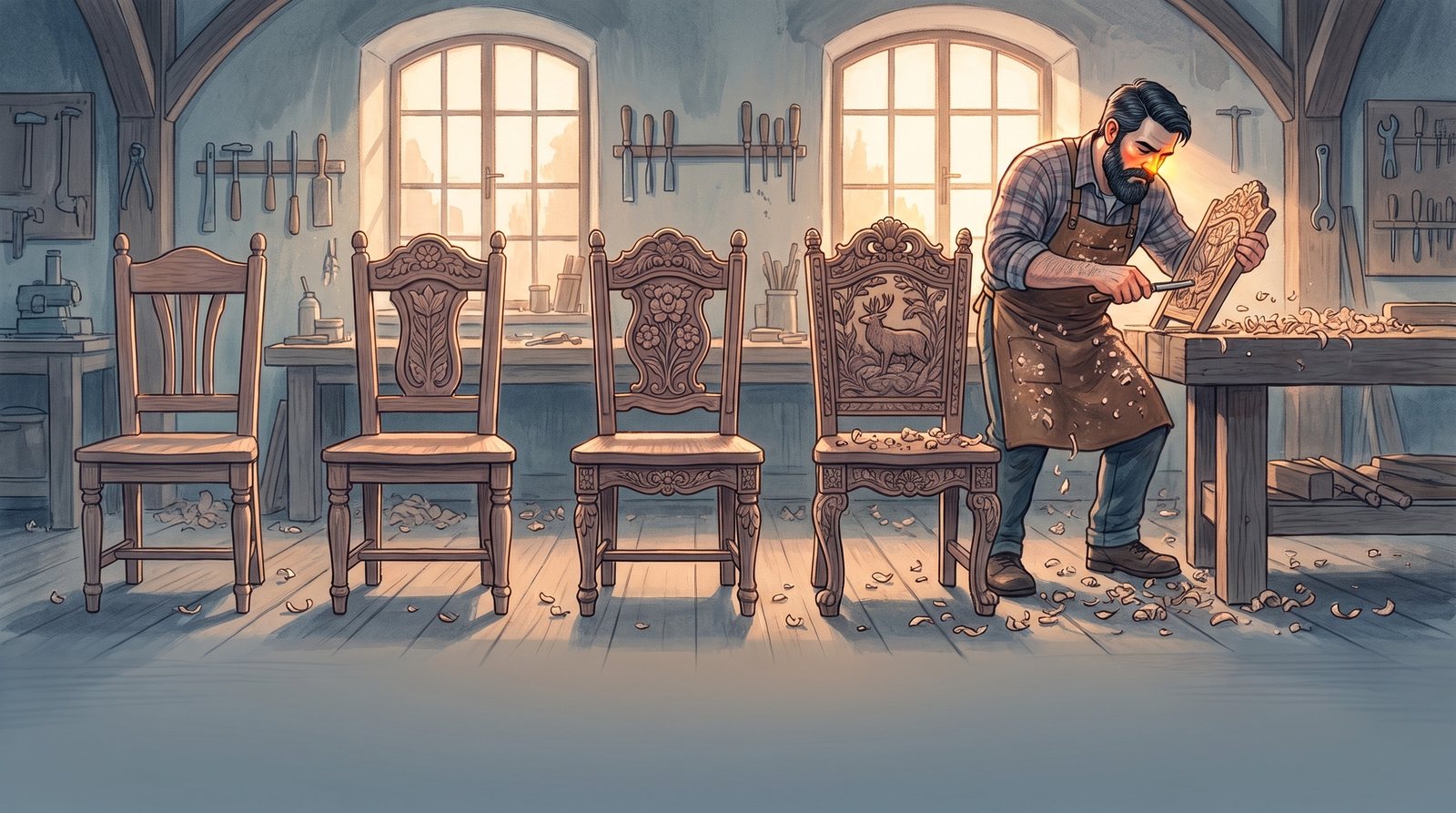
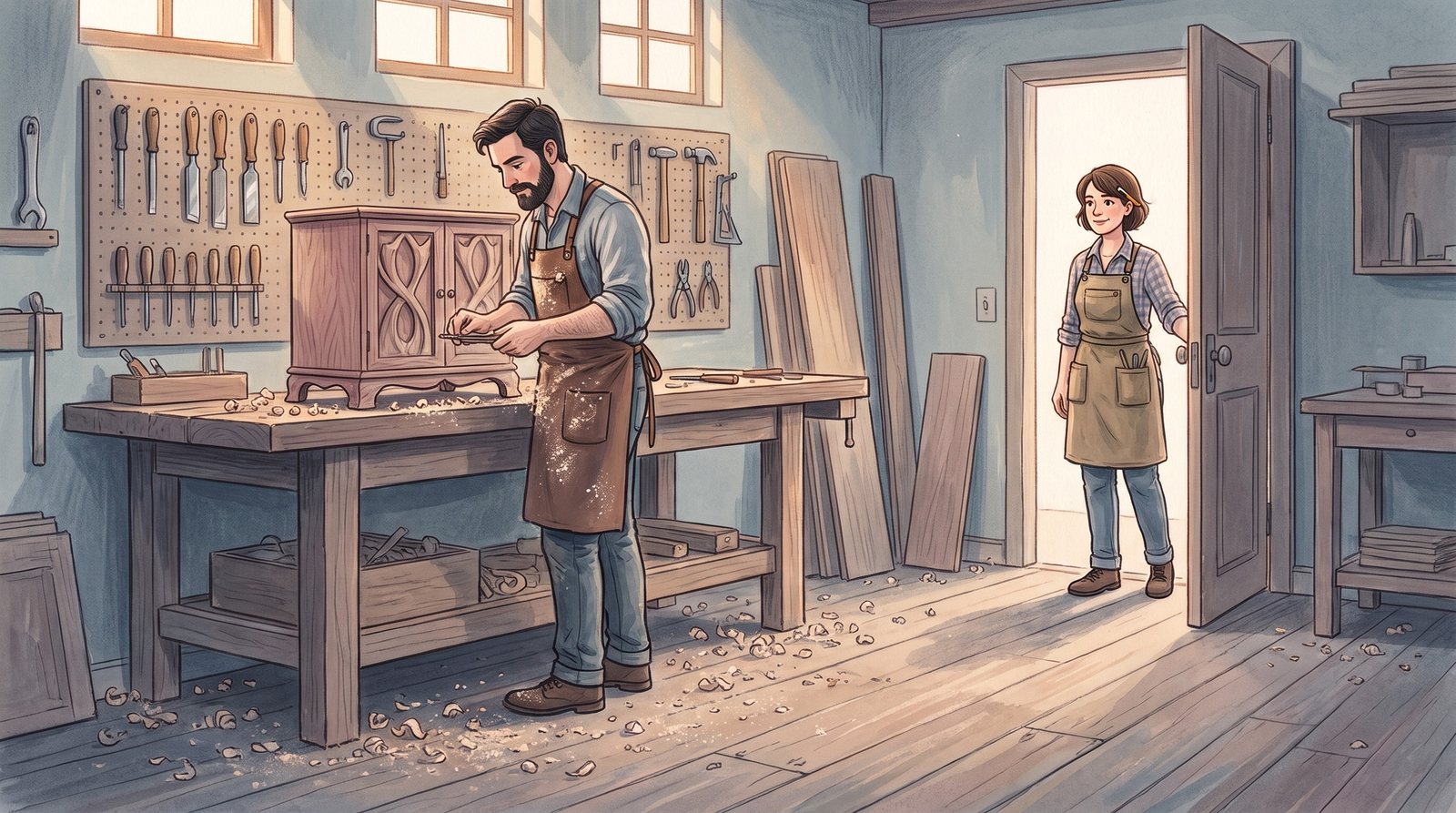
Picture a furniture maker with a chain of shops. An important customer orders a table with four chairs, urgently. The owner calls the manager of his best workshop, and she gives the job to her best craftsman. He works almost round the clock. The first chair is good. The second he carves better than the first; he saw something in the first that he didn't like. The third is more beautiful still, and the fourth is stunning. The problem: they're not a set. The owner is furious. Some time later it happens again, and now there's talk of a formal warning.
The manager protests. Not out loud, but fiercely, inside. Because the only one with something to reproach herself for is her. He didn't make four matching chairs because he can't make the same thing twice. Whatever he does, he has to do better than last time. That's not a fault. It's his basic need. So she makes one small change: from now on he makes the one-off pieces, and he's responsible for improvement. He checks every piece before it leaves the workshop, and keeps the tools better than anyone. Nobody has ever done it better. She had simply been too slow to put his urge to improve in the right place.
And needs hide behind demands, too. What you hear in IT departments again and again: we need more documentation. Some people wonder how open-book exams can work at all. They work because a book you don't know won't help you. Once the questions go beyond simple facts, there's no time to read, and the tension of the moment leaves the mind little room to take anything in. Documentation is the same when things go really wrong. Nobody studies a map of the airport to find their gate in a hurry. You need a departures board and simple signs that point the way: things built for speed. Everything else you need on the way has to be in you already, practised and familiar. When that ready knowledge is too thin, and there are no signs either, people feel unable and lost, and they call for documentation. So the real fix isn't more documentation. It's more ready knowledge, and in most cases that means practice. Not the thing: what the thing stands for.

Practise · Four: Ask, to create connection

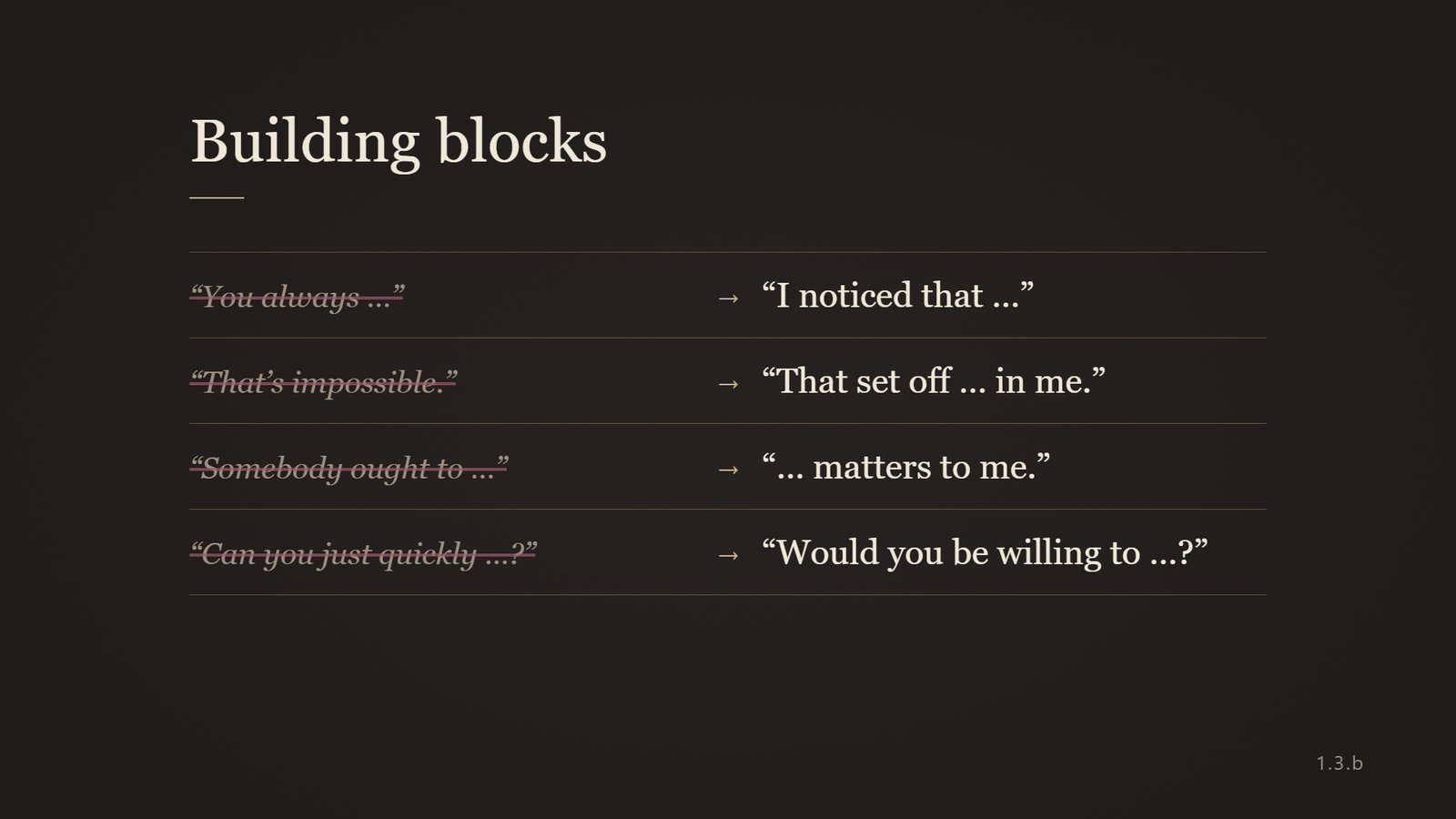
Four. Ask, to create connection. Concrete, positive, possible, and possible to decline. "Can you just quickly…?" is the universal request that isn't one. "Just" signals once, done, over; "quickly" signals minimal, hardly worth mentioning. Whoever turns it down turns down a trifle, and whoever turns down trifles is difficult. And the interruption has already happened by the time the question is asked: a no would come too late.
So I try the opposite, and notice at once that it takes an effort, precisely because I want the yes:
I I'd like to ask you something. You can also say no. I mean that: it changes nothing between us.
What follows isn't the conversion scene from the self-help book. The person hesitates, longer than I'd like: exactly as long as a real weighing-up takes. Sometimes a no comes. Once it was the most honest one I've ever had, without excuse and without a guilty conscience, and things between us were lighter afterwards, not heavier. Mostly a yes comes, but it sounds different from the reflex one: slower, with more weight. A yes that was allowed to be a no is a decision, not compliance. That's why "you can also say no" isn't a polite phrase but the substance of the request: it gives the other person back the dignity of deciding.
Practise · The workbench
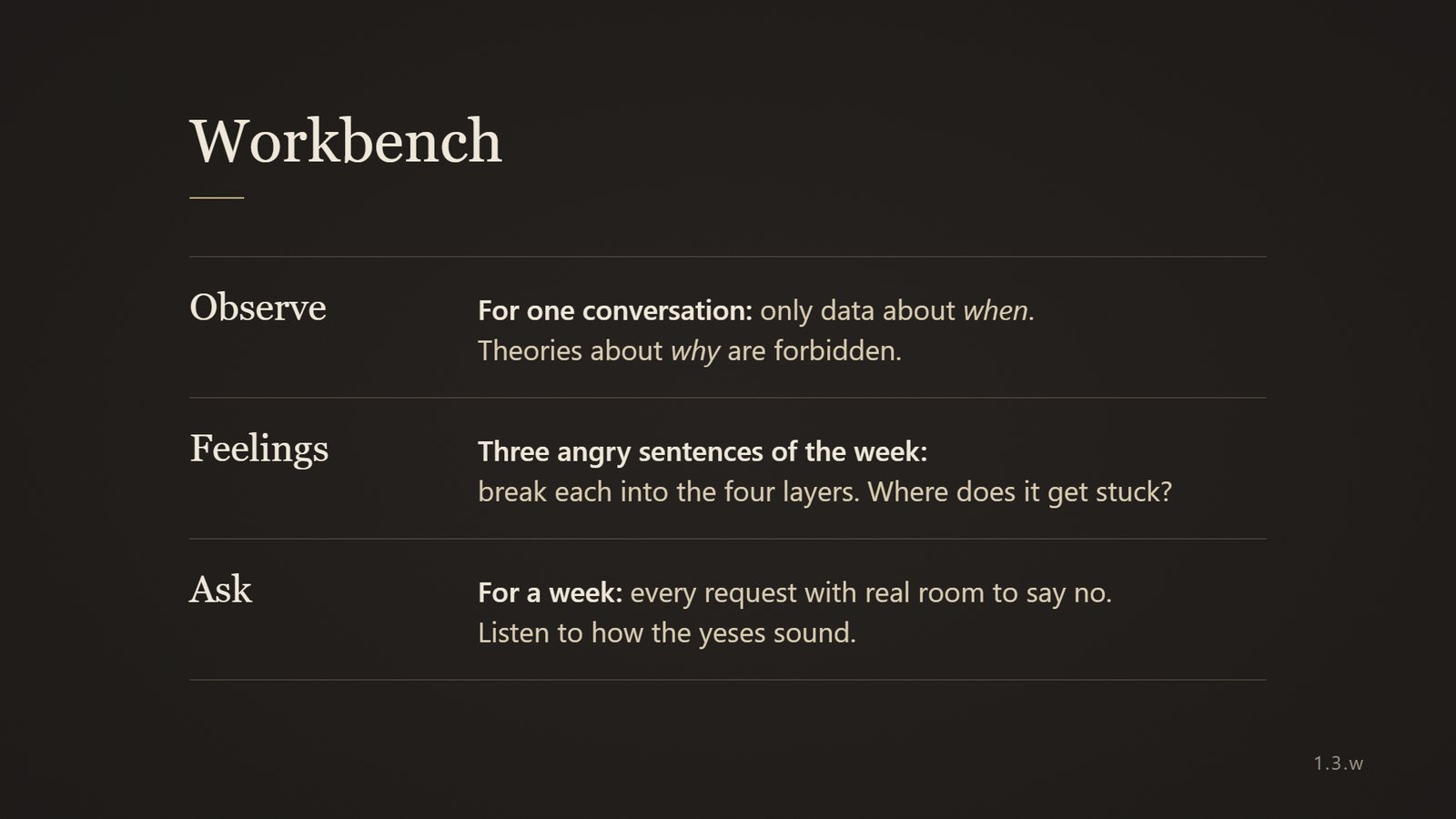
Three exercises to take with you. For one conversation, collect only data about when; theories about why are forbidden. Take three angry sentences from your week, break each one down into the four layers, and note where it gets stuck. And for a week, make every request with real room to say no, and listen to how the yeses sound.
Mirror
Take a sentence you said about someone this week. Which layer was it: an observation, or a judgement in an observation's costume?
Which ideal model is missing around you, so that feedback there always turns personal?
And where did you last stay formal, when you meant something closer?
Echo

Wanderer (after the exhibits) Katja says "right" and "wrong". Not "good" and "bad".
Fosterer What's the difference?
Wanderer "Good" and "bad" speak about the person. "Right" and "wrong" speak about the moment.
Fosterer And that makes her easier to hear.
Wanderer (after a pause) Yes. (then, a little more abruptly) How does she know what's right?
Fosterer She has an ideal. A clear picture of how it should feel. From the inside.
Wanderer (nods slowly) Without that, you can't observe at all. You only have opinions.
Fosterer What have you observed? In me. Today.
Wanderer (brief surprise, then calm and methodical) You started three times before you spoke. You stepped back half a step when I told you what I liked. (short pause) And you haven't called me "my friend" since the last room.
FOSTERER (silent)
Wanderer That was an observation too. Now you.
Fosterer (after a moment) Your hands have stopped doing things. In the first rooms you were always holding or touching something. Not any more.
Fosterer Just an observation.
Wanderer (after a moment, almost in passing) I said "Fosterer" when I meant you.
FOSTERER (nods, says nothing)
Sources
- Marshall B. Rosenberg, Nonviolent Communication (2003): the four components, giraffe and jackal, request and demand.
- Edward H. Adelson, the checker-shadow illusion (1995): interpretation changes perception itself.
- Daniel Kahneman, Thinking, Fast and Slow (2011).
The stories are drawn from three decades as an employee, leader, coach and facilitator. Places, times and people are changed, and some scenes are composed from several experiences; they allow no reliable conclusions about any company or person. The illustrations and the voices of the episode are made with AI.