Unfolding · Part I: The Person · 1.2
Exploration: Attention with Impact
The same question, asked twice in a role-play: the first time it grabs at thin air, the second time it opens a door. The second exchange of the Fosterer and Wanderer method: asking and revealing, the four principles of listening, and the difference between praise, affirmation and recognition.

The text of the episode follows, with its diagrams. Below each heading: watch that part on YouTube.
Cold open · Something in hand
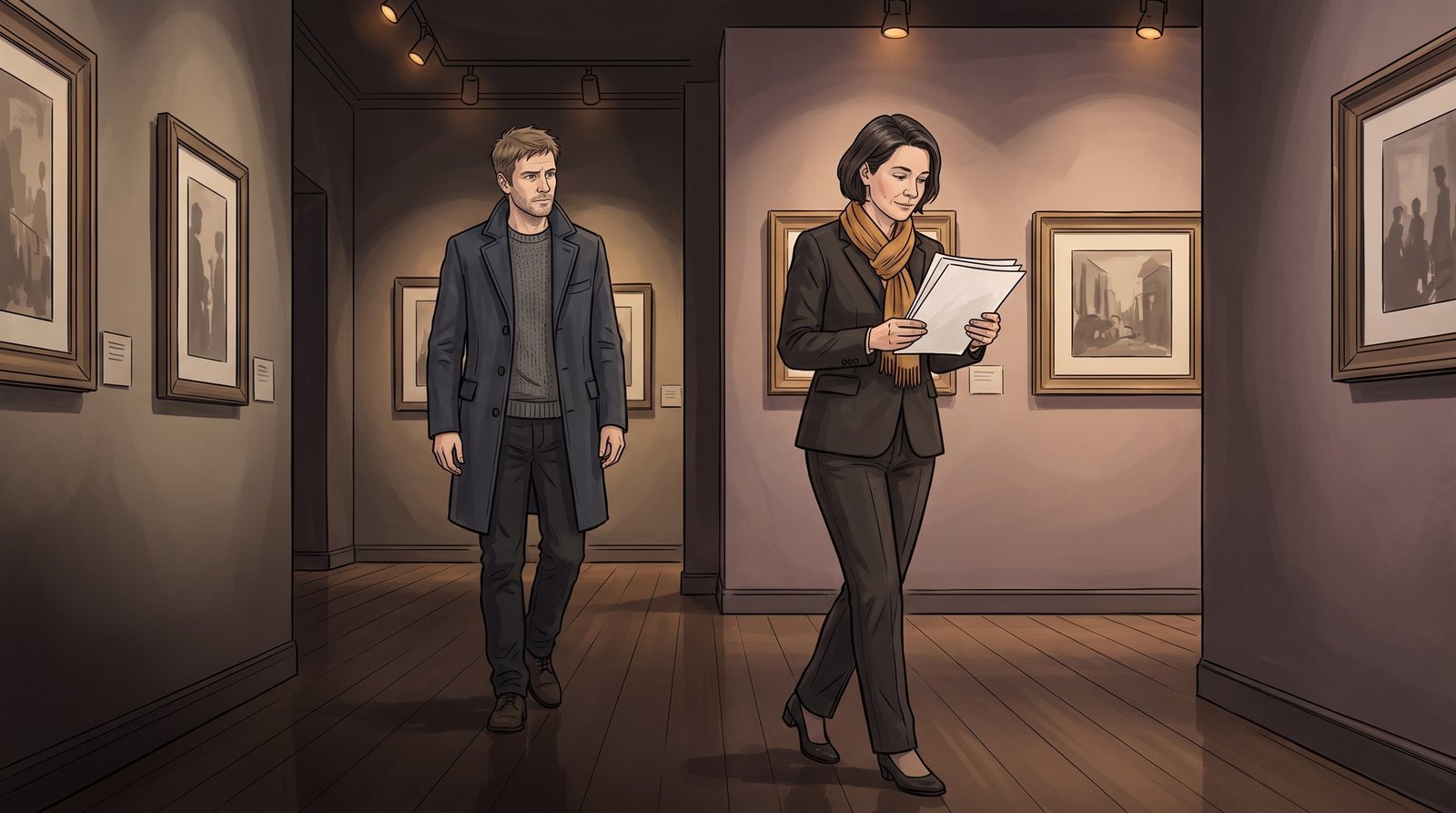
Wanderer You've brought something. In the last room you only had yourself.
Fosterer I've learned a thing or two. Questions that open. (reads) "What exactly do you mean by that?" "And if you could choose freely?"
Wanderer (dry) You're reading me off a sheet.
Fosterer (stops, lowers the sheet) … Ask me that again.
Wanderer I didn't ask. I observed.
Fosterer (after a moment) Then give me something. I'll ask without this.
Wanderer (hesitates, gives away a dose) I stayed in the last room longer than I meant to. (closed again at once) That's all. First I'll see what you do with it.
Fosterer (puts the sheet aside) Nothing. I'll hold it.
Wanderer (half a step closer, testing) We'll see.
Fosterer (nods towards the first wall) The first thing hanging here is a catalogue like this one. Come on, my friend. Let's see what damage it does.
Exhibit · The question catalogue
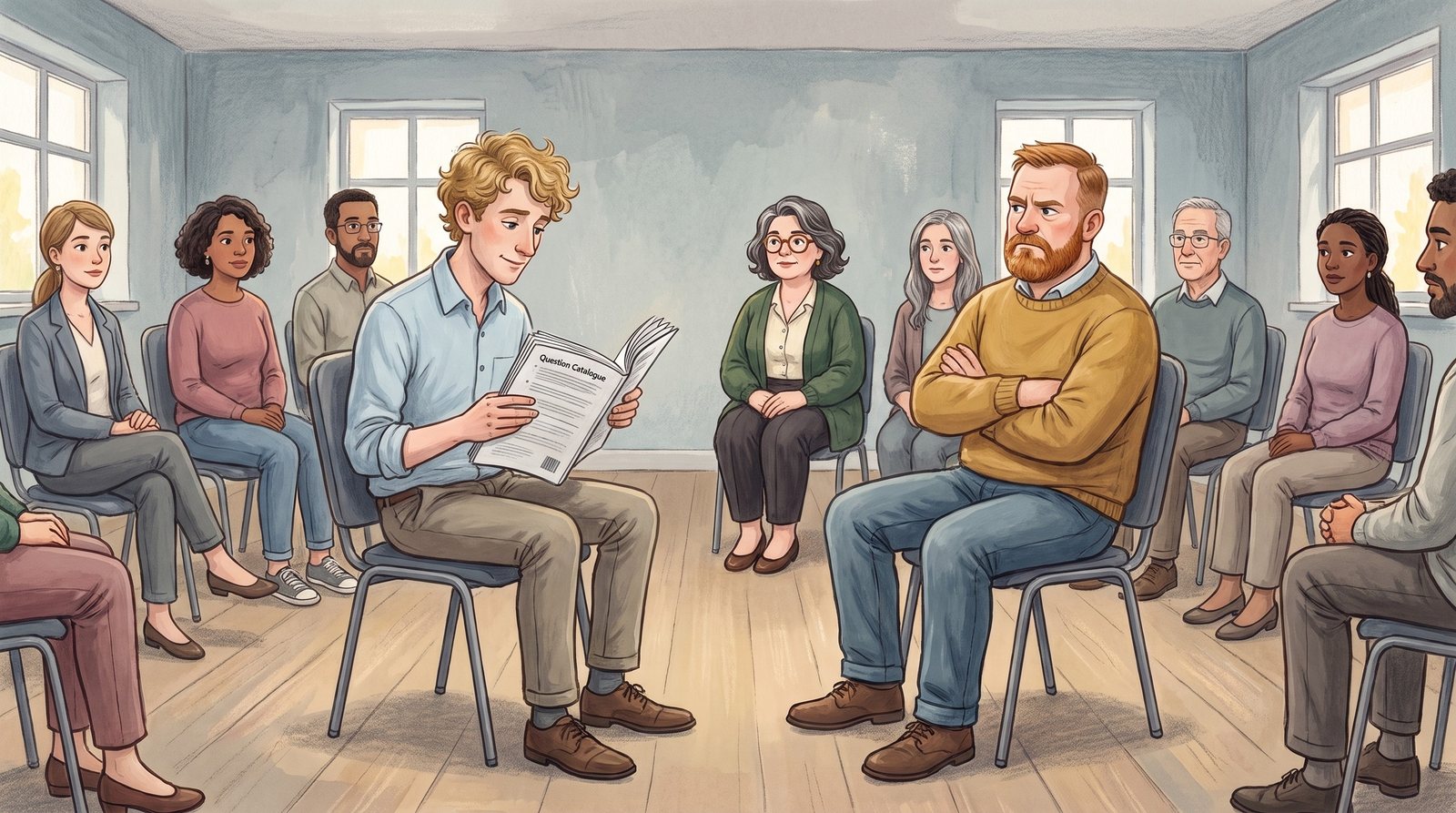
A seminar. We're practising conversations in role-plays. One of the two partners is given his situation: he has just come out of a meeting with his manager. Despite excellent results last year, the promotion he hoped for isn't happening, and with it a considerable rise in pay. He feels disappointed and frustrated. He needs time to think, and to talk with his wife about how the dream of their own home can still be paid for.
The other participant, a Fosterer in training, we restrict, against all the rules. He gets a six-page catalogue of typical "open questions" from everyday coaching: problem-oriented, resource-oriented, goal-oriented, scaling, circular, hypothetical. He may ask any question from it. With one small piece of meanness: he may do only that, nothing else. The dialogue goes roughly like this.
Coach Hi. Good of you to come.
Coachee (looking sceptical, nods) Mm-hm.
Coach (looks at the sheet of questions, starts several times) On a scale of one to ten: how motivated do you feel?
Coachee (cynical) Minus five thousand.
Coach (confused, looking for the next question) How will your partner react to that?
Coachee No idea. But I'll get up in a minute, go home and ask her.
Coach (rattled, searching the sheet desperately for the next question) What would have to happen for your boss to fire you for good?
Coachee (laughing, on the verge of going for the coach's throat, miming the grip) Maybe this…
Rewind to the beginning. Without the restriction.
Coach Hi. Good of you to come.
Coachee (sceptical, nods) Mm-hm.
Coach (registering the scepticism) Oh. What's up?
Coachee Just came from the boss. Didn't get the promotion.
Coach (acknowledging) Oh, shit.
Coachee (agreeing) You can say that again.
Coach (pausing, thoughtful) And now? How are you?
Coachee Bloody awful.
Coach (nods) Understandable. (pauses) Where does it go from here?
Coachee (hesitant) No idea.
Coach (noticing his clumsy leap ahead, and asking back) What does that mean for you? Does it have consequences?
Coachee (thoughtful) We were actually thinking of buying a house. But at today's interest rates, without the promotion, it'll be tight. Too tight.
Coach So financially too uncertain.
Coachee (nods) Mm-hm.
Coach (pauses) How will your partner react to that?
Coachee (still thoughtful) Good question. Not sure. She'll probably be as disappointed as I am. Then she'll probably want to go back to work herself.
Coach (guessing) She'd really like to have the house, and work out how the dream can still come true.
Coachee (nodding) That's exactly how I know her.
One of the questions comes up word for word in both runs. The first time, it grabs at thin air. The second time, it opens a door. The difference is not in the question.

Exhibit · The question that turned round
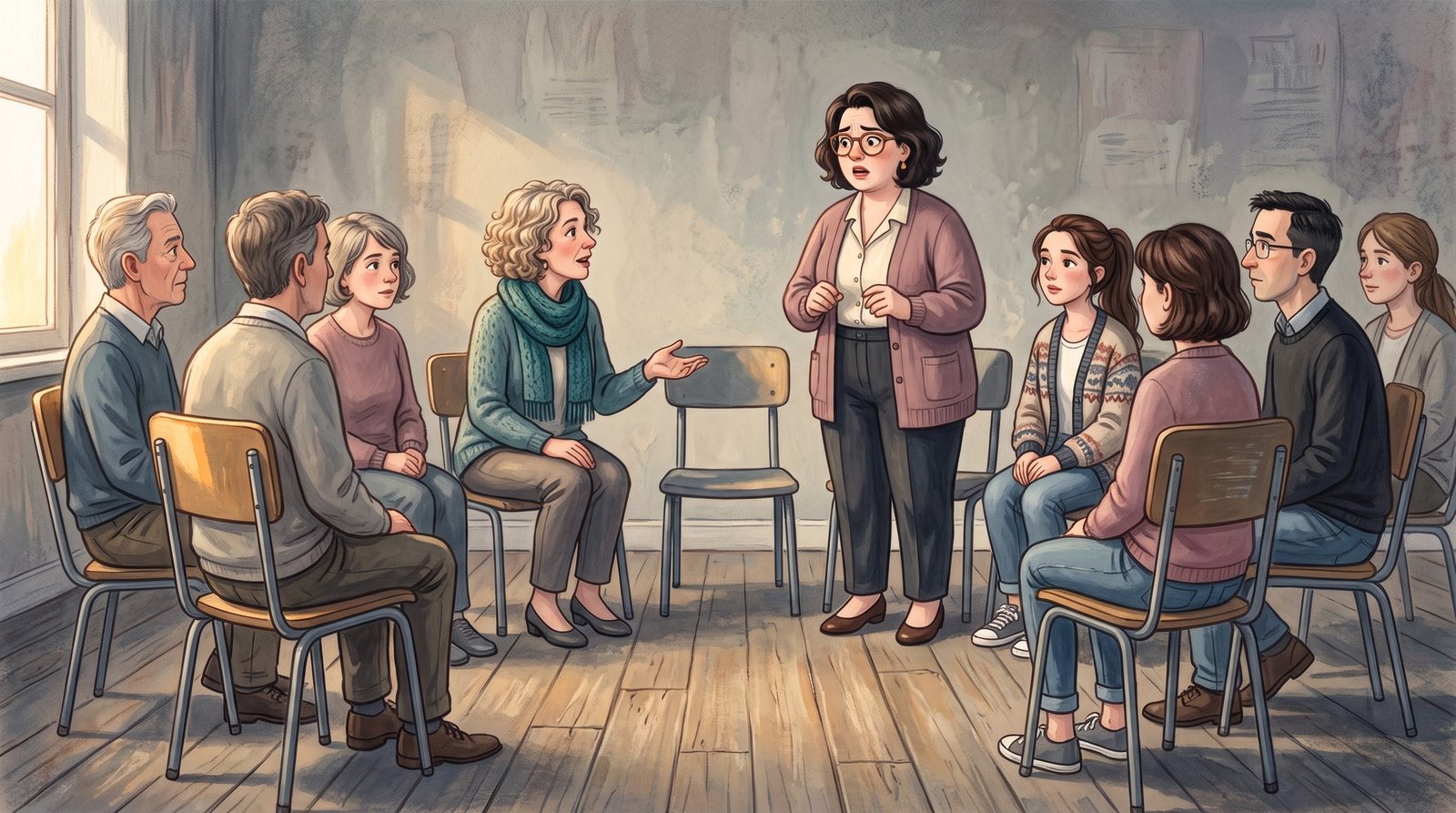
And a second one, experienced from the other side, because the strongest open question I can remember wasn't asked by me. At some point in a seminar (I'm leading it, and we've been at it for a while) a participant asks me a question.
Participant What are you actually looking for here?
Silence. I notice that I don't have a ready answer. That's unusual. She waits. Not impatiently. The question has left room. I hear myself talking, slowly, as if I were putting the answer into words for the first time.
I (slowly, thinking aloud) A playing field. Where I can celebrate being who I am. Where I can shape and develop what I can do, so that it becomes a whole series of games. A place to practise, and to get better at what I do, game by game. To replace a piece of the everlasting uncertainty with the comfort that my impulses matter, even if not all of them succeed. That what I do has an effect.
A pause. I'm surprised myself. The participant nods. Says nothing. From then on, the seminar is a different one.
Fosterer and Wanderer · Exploration
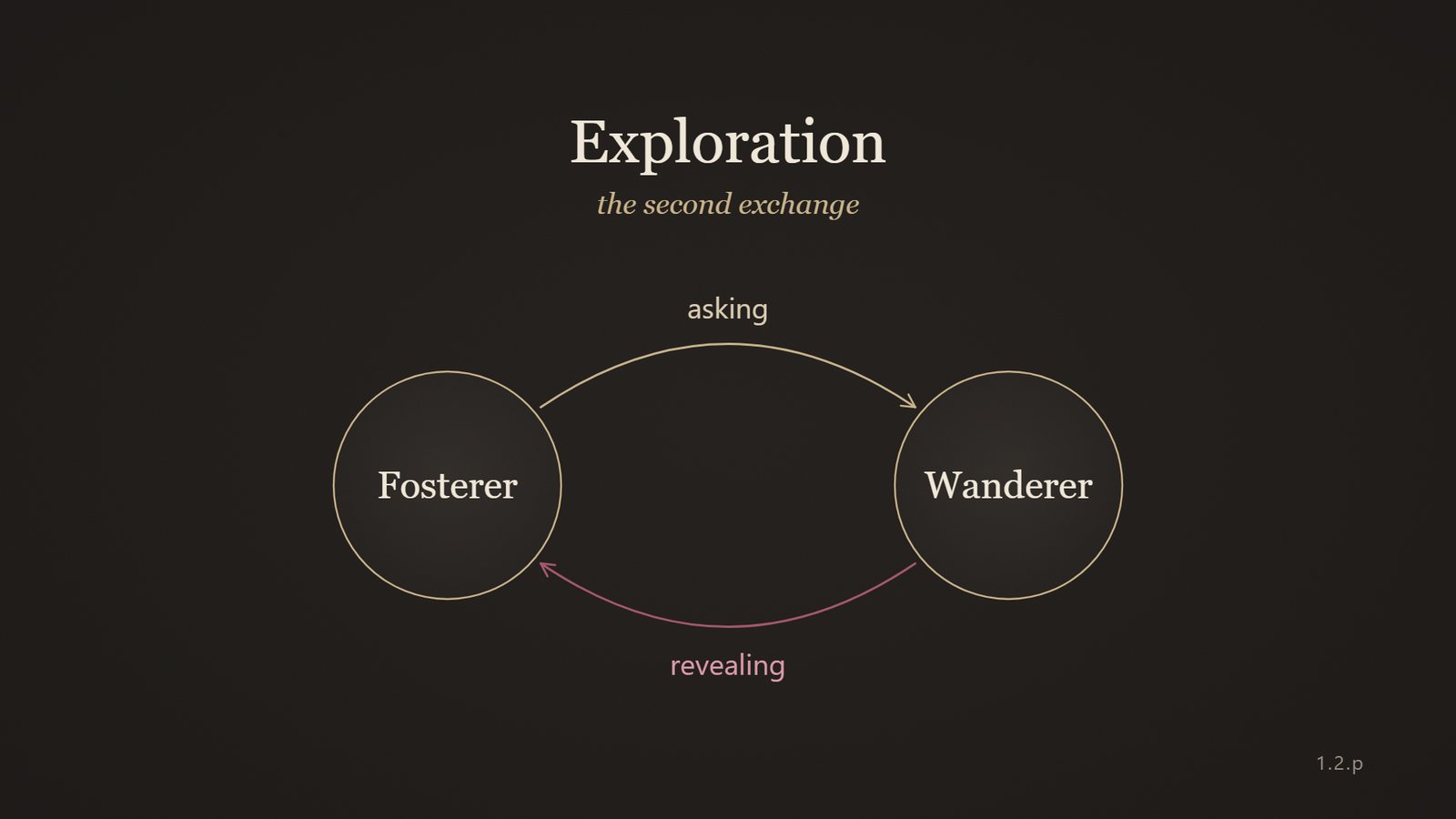
Exploration is the second pair: asking on one side, revealing on the other. And its reciprocity is stricter than that of regard. Whoever asks when the other doesn't want to answer is conducting an interrogation. Whoever is meant to reveal without feeling real interest gives information. It sounds similar, and it is the opposite.
The Wanderer now tests whether being seen is safe. They reveal in doses, revocably, and watch closely what happens to what they revealed. Is it used? Judged? Or held? The Fosterer is still leading, but the useful questions no longer come from the preparation. They come from what was just heard. Only the inner voice keeps count.
Fosterer (inner voice) Noted.
The catalogue shows where the danger lies: taking the form more seriously than the interest. Six pages of open questions, each one flawless craft, and together an interrogation.
Wanderer So "asking open questions" isn't a tool. It's a consequence.
Fosterer A consequence of what?
Wanderer Of interest. Real interest.
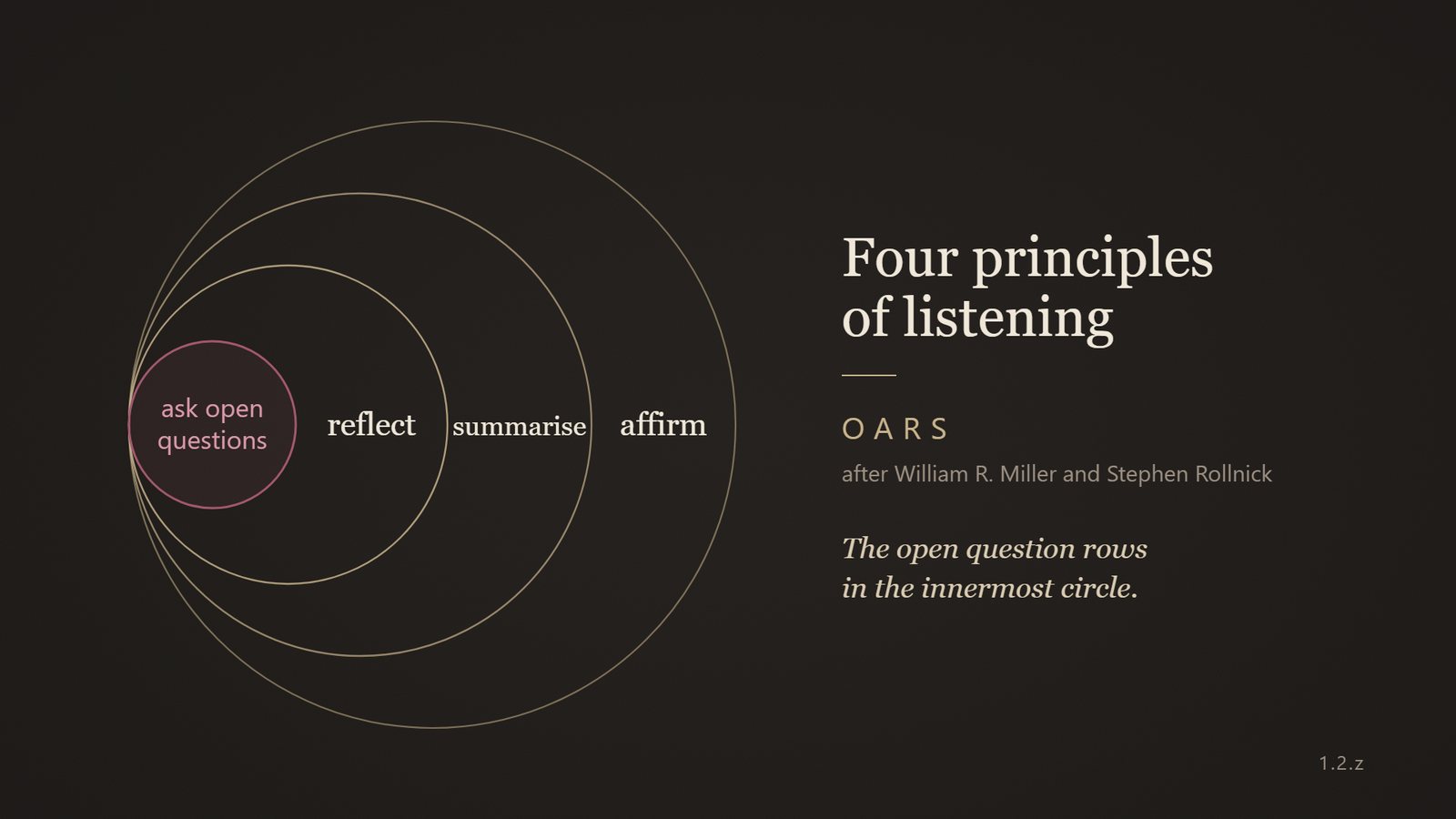
Hence the sentence that holds this level together. Because the dance now demands that revealing pays off, the Fosterer needs the four principles of listening: asking open questions, reflecting, summarising, affirming. In that order, because each one prepares the ground for the next. The question opens the door. The reflection proves that someone lives behind it. The summary gives the ground covered a shape. And the affirmation shows the one who came in their strength.
In Motivational Interviewing the four are called OARS. The open question rows in the innermost circle.
And the dance takes its counter-step here too. The strongest question of the chapter isn't asked by the Fosterer, but by the participant, and it falls back on the one who asks. Exploration worth the name explores in both directions. A Fosterer who only asks and never reveals hasn't understood the exchange.
Observe · The roadblocks
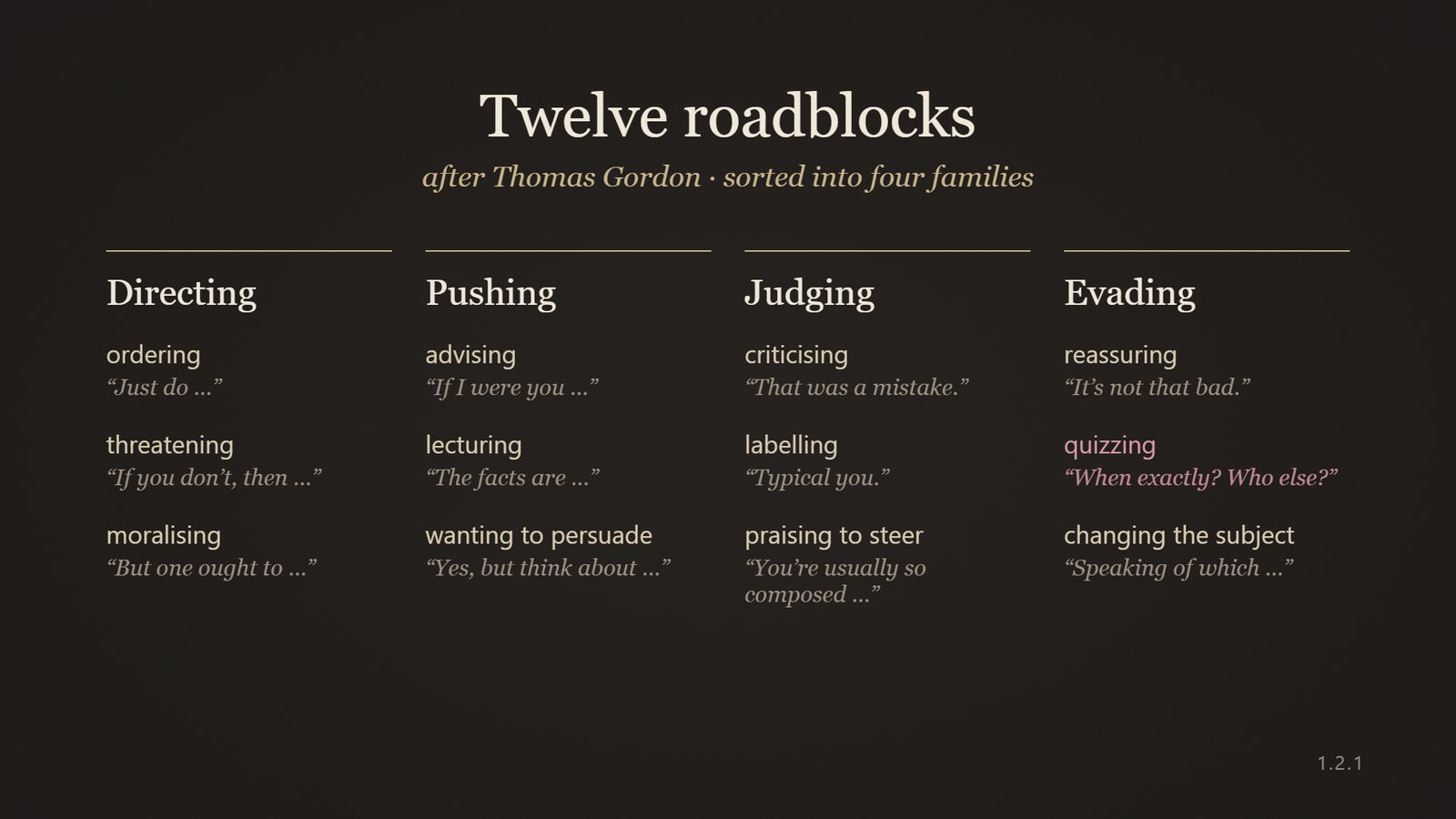
Before you can ask better, it helps to see what you often do instead. Thomas Gordon catalogued what we do instead of listening: the twelve roadblocks. Sorted our own way, into four families of three. Directing: ordering, threatening, moralising. Pushing: advising, lecturing, wanting to persuade. Judging: criticising, labelling, praising in order to steer. And evading: reassuring, quizzing, changing the subject.
None of them is meant badly. Still, workshop participants keep asking what on earth you're allowed to say, then. A doubt that points in the right direction. Almost all the roadblocks are a fixing reflex, or care in a hurry: the same habits of perception that fed the snap judgement in the first exchange, only now they speak. But each one takes the conversation out of the other person's hands.
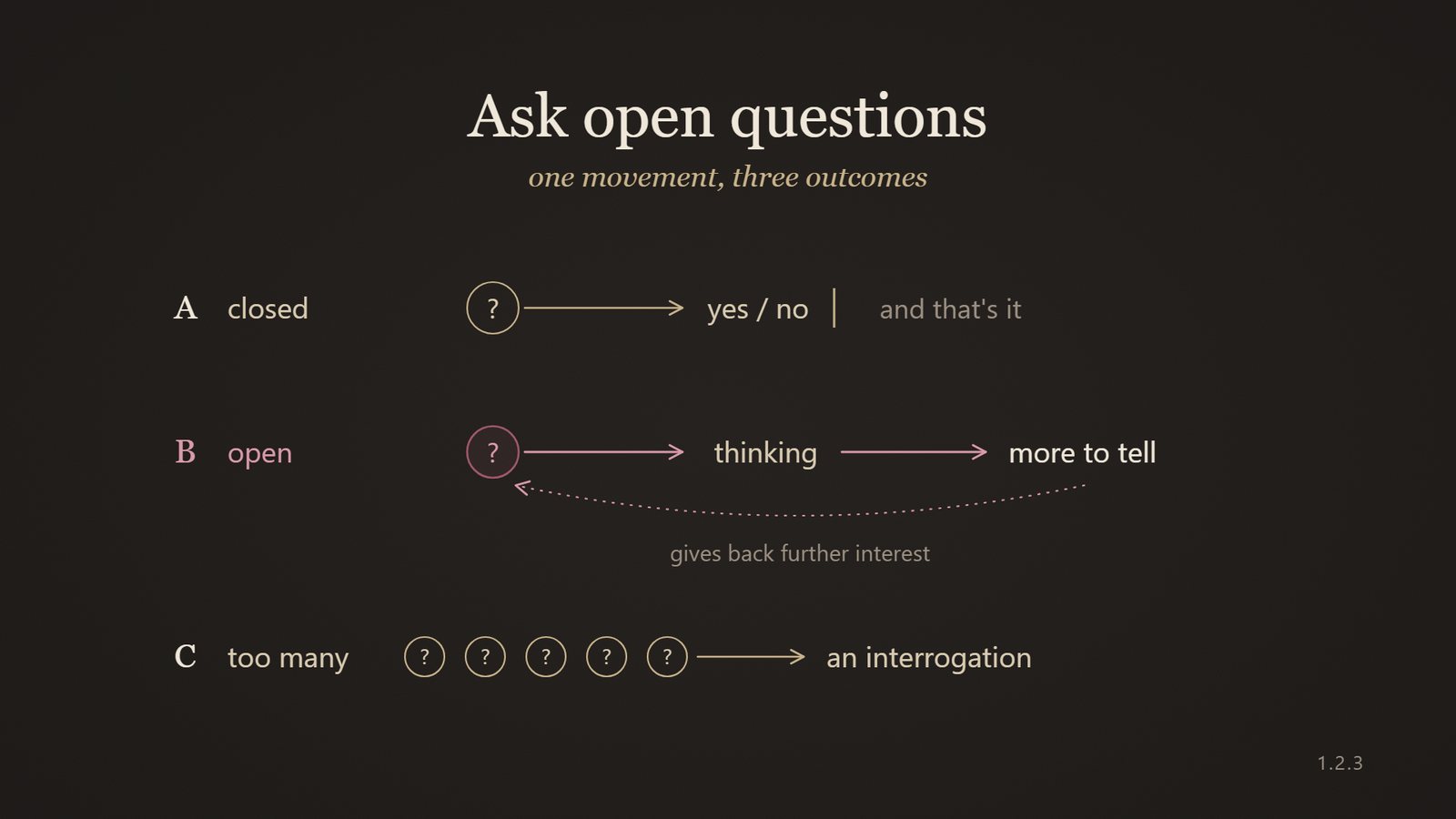
And the most elegant roadblock is the open question itself. Too many in a row, and it's an interrogation. The question catalogue isn't a thirteenth roadblock. It's all twelve in polite disguise.
Understand · Why reflecting works, and what affirmation is not
Reflecting is an act of giving. You give back, in your own words, what you've understood, and so you give the other person the chance to put right what was misunderstood. That's why a "wrong" reflection isn't an accident but part of the mechanism: it invites them to correct the understanding. Whoever reflects puts their understanding on the table, revocably. And that's what lets the Wanderer run the test: they can see what happens to their words before they risk the next ones.
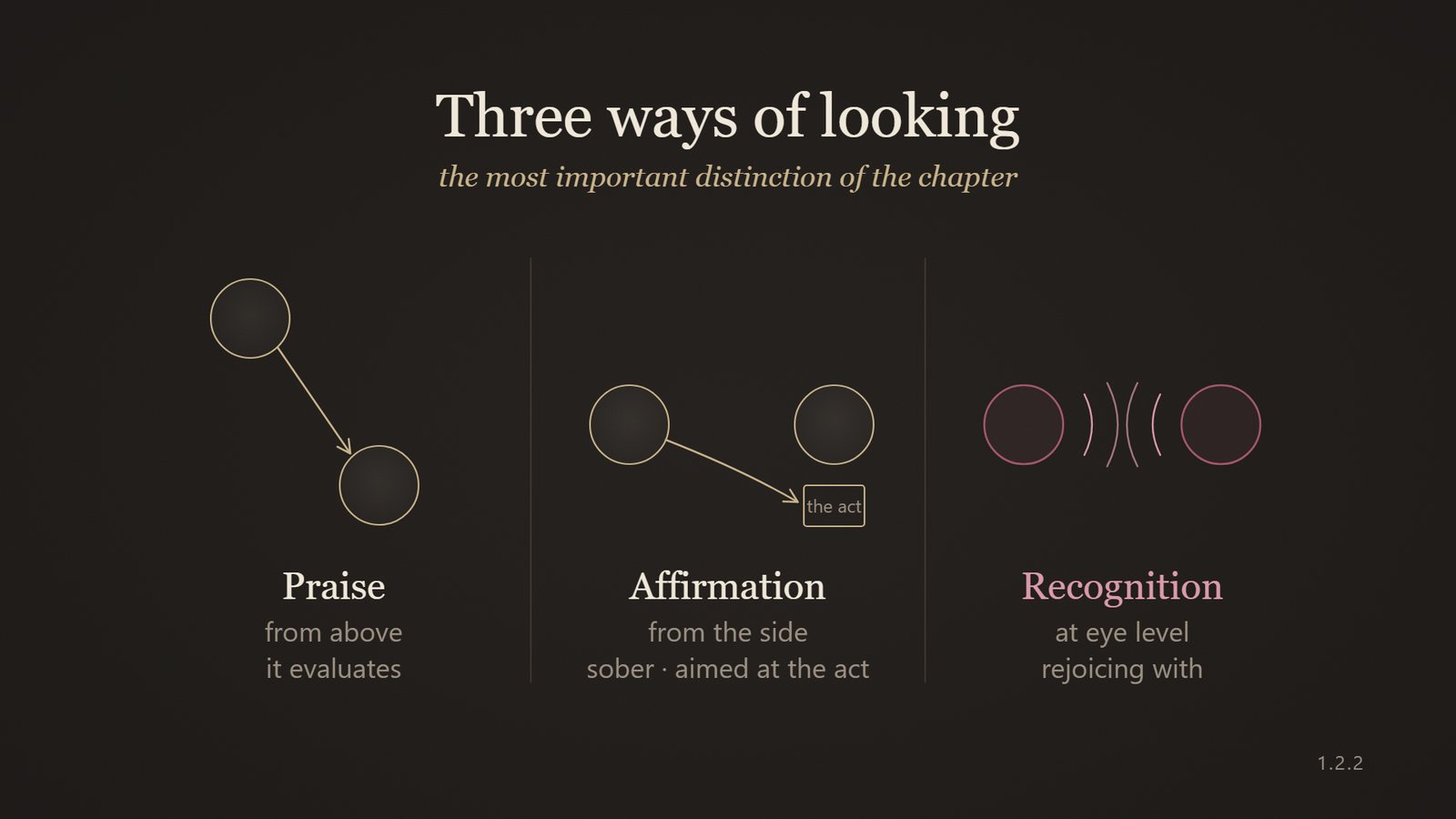
The heart of the chapter, though, is a distinction that everyday life blurs all the time. Praise is a judgement from above. It evaluates, and so it creates expectation and dependence: whoever is praised for the result today works for the praise tomorrow. Affirmation is something else, and it is sober: the confirmation of a concrete ability or fit, aimed at the act, never at the result. A sober affirmation contains no compliment, and that's exactly why it carries. An affirmation can be accepted or declined; praise can only be earned or disappointed.
Real recognition is a third thing: rejoicing with someone, at eye level. Not because you expect something, not because you can name something, but simply because it's there. It's what people actually wish for, and it's the only thing in this chapter that no technique in the world delivers. You can't produce it. You can wait for it.
Practise · One: Ask open questions, to open doors

One. Ask open questions, to open doors. The open question is an expression of curiosity: the real interest it signals is what lures the other person into answering honestly. That's why it arises from what you've heard, not from the stock.
How little that takes is shown by a situation where I said almost nothing. A person sits across from me. They have just made a decision, one that took a long time and cost a good deal.
I How are you?
They tell me what led to it: the weighing up, the sleepless nights, the conversation after which it was clear. We sit for a while in what is.
I (softly) And now… (pause) where does it go from here?
Person (looking at me as if I'd said something unexpected) I haven't even thought about that yet.
Another pause. Then they start to talk, and this time not about what was, but about what's coming. Quietly at first, then more and more concretely. As if the question had set a direction in a room that had none before. I asked nothing more. "And now?" on its own can be a whole reflection in two words, or a reproach. The tone decides. An open question has succeeded when, afterwards, the other person owns the conversation.
Practise · Two: Reflect, to show depth

Two. Reflect, to show depth. Paraphrase, and mirror the feeling: presence, instead of tinkering with answers.
A woman tells me about her job. She talks for a long time, neatly, in complete sentences: the new management, the shifted responsibilities, the meeting in which her project went to someone else. I reflect what I hear.
I You're angry that you were passed over.
She nods. Politely, at once, with the kind of nod that doesn't open a conversation but closes it. A closed door with good manners. I'm right, and I've missed. I wait. I hear again the sentence she has said twice without stressing it: that her project went to someone else.
I It's not the anger. It's that it was your project.
A pause. Something in her posture drops by a centimetre.
She (quietly) Yes. Exactly.
She breathes out. Then she goes on talking, more quietly, and no longer in complete sentences.
The opposite I've said often enough myself: "I understand you." A sentence that claims understanding and brings no proof. It costs nothing and opens nothing.
Practise · Three: Summarise, to create clarity

Three. Summarise, to create clarity. At sensible intervals, offer the distillate, so that topics find closure. As an offer, not as minutes.
A meeting, forty-five minutes old and not a step further. Three topics on the table, and nobody holding them together: whether the budget is enough, whether the deadline can be met, and who decides in the end. Everyone talks about one of the three, nobody about all of them. The coffee is cold, the whiteboard full and unreadable.
I May I quickly summarise what I've understood so far?
Nobody objects; objecting takes energy nobody has left. I lay the three topics side by side: the budget, the deadline, who decides. A pause.
Participant 2 (the woman with the white hair) Hang on. That's really one question, isn't it? Whether we trust the deadline. Everything else hangs on that.
Someone nods, not politely, but relieved. The room breathes. The twenty minutes that follow bring more than the forty-five before. I hadn't said anything new. I had only laid the pieces side by side.
Practise · Four: Affirm, to see strength

Four. Affirm, to see strength. Two sentences taught me this. The first: in a conversation, a colleague I've since grown fond of says, seemingly in passing:
Colleague I'd love to be able to buy a book of yours.
No general praise. No encouragement. A wish, aimed at something specific: something she had seen in what I'd said or done, and that mattered enough to her to say it out loud. In the moment I don't know what to do with it. The affirmation is too precise to fend off, but too unexpected to accept. I say something evasive and change the subject. But the sentence gnaws. Not unpleasantly; more like a hook that has caught in something and won't let go. Months later. Years later.
The second sentence comes when an organisation is looking for someone for a difficult facilitation: a group that has really been given up already, too little trust among them, conflicts left lying too long. The reasons pile up why nobody can do it: too close, too little experience, the wrong role. In the end the job is assigned to me. Part of me fights it: this feels like repair, not development. A colleague says, matter-of-factly, without any exaggeration:
Colleague 2 Who else should do it, if not you?
No flattery. No motivation. A sober stocktaking that I can either accept or decline. I accept it. The question leaves the decision to me by making the answer so obvious that I have to find it myself.
And that's exactly why something belongs here that's in no book on listening. Affirmation is the one movement you hardly recognise as a weapon, because it sounds true and flatters without looking like flattery. And it takes no bad intention. One of the most consequential questions of my working life was built exactly like that. I was torn between the work I loved and a role the organisation was begging for, and in a supervision group I said so. Our supervisor, an external coach, took it up on the spot:
Supervisor Where can you move your company forward most right now: leading people, or coaching?
I Leading people.
It was a real question, from someone who wanted nothing from me. It left the decision to me, and I found it myself: all by the textbook. But it didn't ask what I wanted. It asked what the company needed, and I answered for the company. What became of that yes is a story for another episode. Here the warning is enough: with every affirmation that commits you, check whose need it serves. It needn't be the need of whoever asks. It can be the need of someone who isn't even in the room.

Practise · Waltz time and the workbench
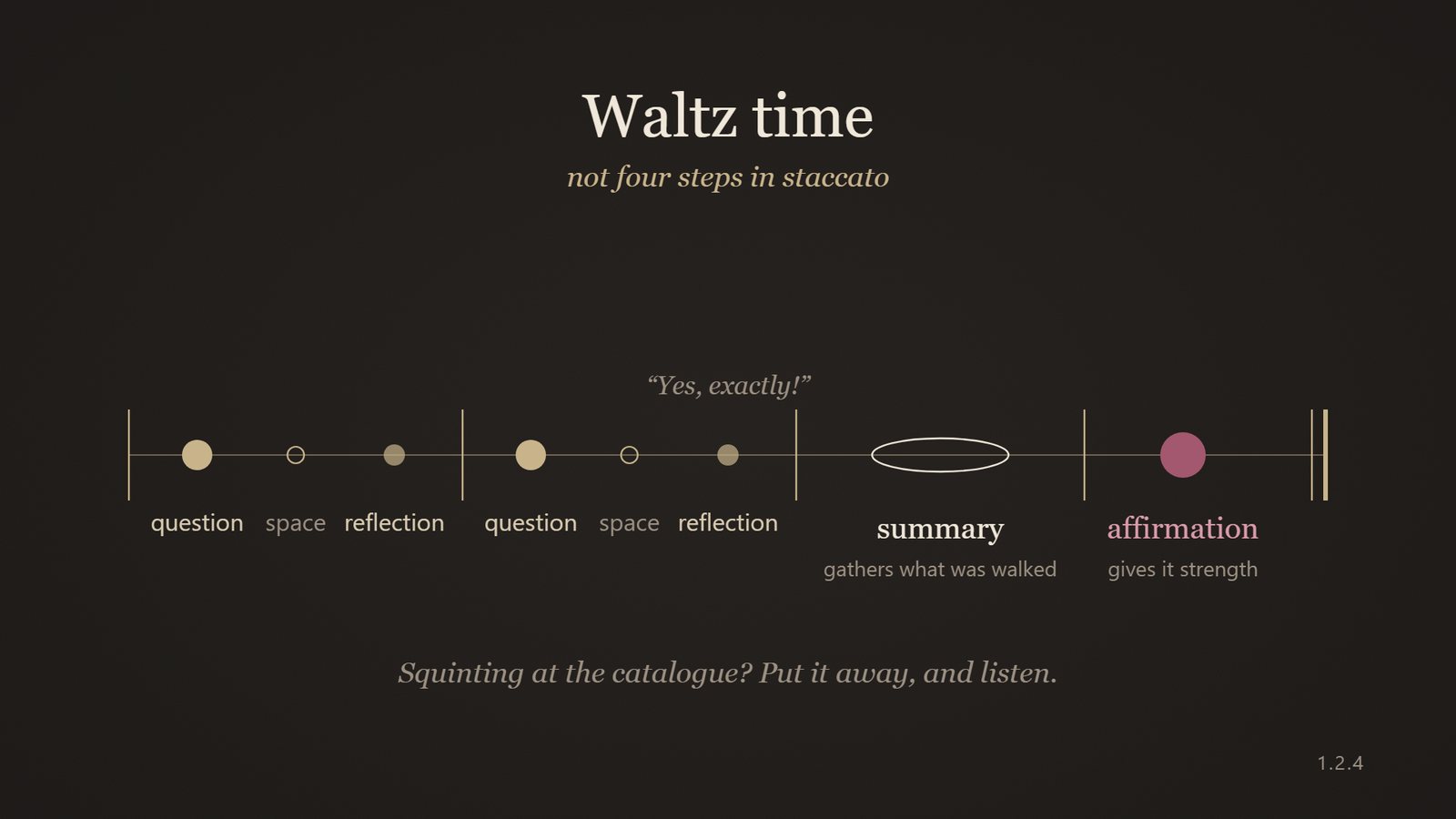
The rhythm is waltz time: question, space and reflection in three-four time, not four steps in staccato. And if you catch yourself squinting at the catalogue, put it away and listen until the next question comes by itself.
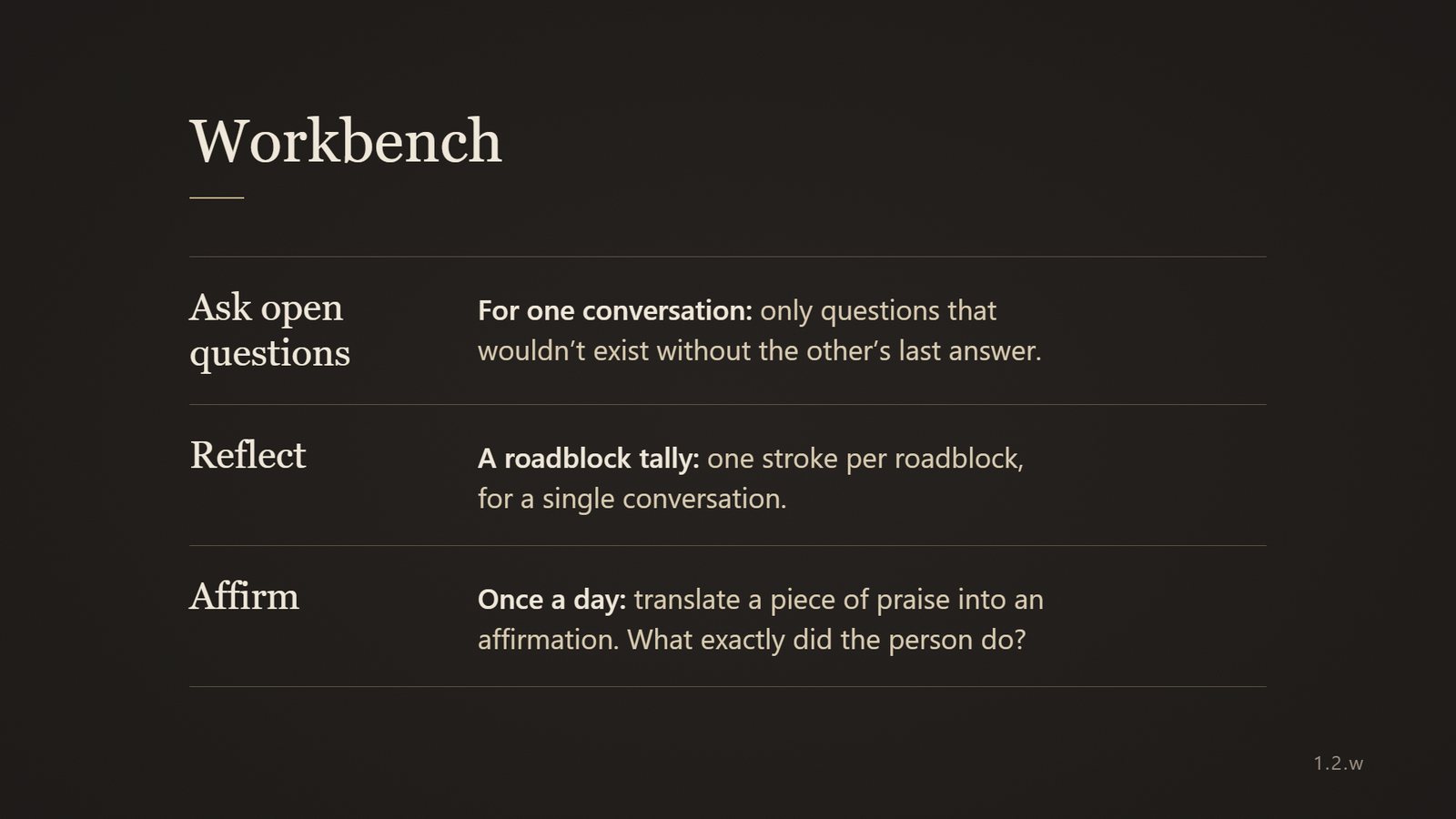
Three exercises to take with you. For one conversation, ask only questions that wouldn't exist without the other person's last answer. Keep a roadblock tally for a single conversation. And once a day, translate a piece of praise into an affirmation: what exactly did the person do, and what does that say about them?
Mirror
Which of the twelve roadblocks is your signature one, and in which conversations do you reach for it?
From whom did you last receive real recognition, and how did you notice the difference?
And the participant's question, put to you: what are you actually looking for, in the conversations in which you ask?
Echo

Wanderer (after the exhibits) The book. The facilitation. The question in front of the group. (pause) It's all true. And it isn't enough.
Fosterer What's missing?
Wanderer (searching) It's… precise. The colleague sees something and names it. The question is logical, not warm. (after a moment) I don't know what to call it. The opposite of praise isn't what I mean.
Fosterer What do you mean?
Wanderer (slowly) When someone rejoices with you. Not because they expect something of you. Not because they've seen something they can name. But simply… because it's there. (short pause) That isn't in any of these stories.
Fosterer (calmly) No.
Wanderer (looks at the Fosterer) That doesn't bother you.
Fosterer It describes something else. What's here is affirmation. The other thing, that's recognition. You can't produce it.
Wanderer (briefly) You can wait for it.
Fosterer (after a pause) Yes. You can.
Fosterer (inner voice) Noted.
Sources
- Thomas Gordon, Leader Effectiveness Training (1977): active listening and the twelve roadblocks.
- William R. Miller and Stephen Rollnick, Motivational Interviewing (3rd edition, 2013): open questions, affirmations, reflections and summaries (OARS).
The stories are drawn from three decades as an employee, leader, coach and facilitator. Places, times and people are changed, and some scenes are composed from several experiences; they allow no reliable conclusions about any company or person. The illustrations and the voices of the episode are made with AI.