Unfolding · Part I: The Person · 1.0a
The Methodical Minimum: For Those Who Lead
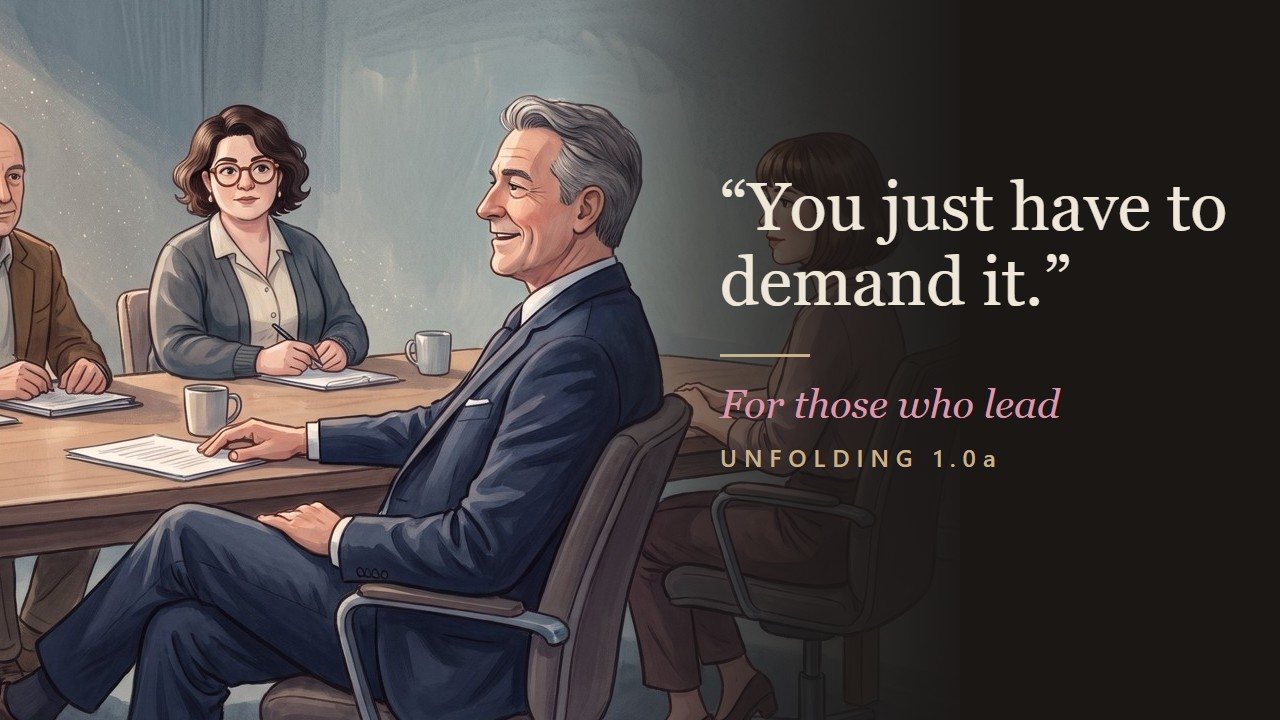
“The cool thing is: you just have to demand it from your people.” A sentence from top management, and a team that said: this can't go on. For those who lead: rule zero, the three zones, and five reversals, each beside its tenet from the Overture.
The text of the episode follows, with its diagrams. Below each heading: watch that part on YouTube.
Cold open
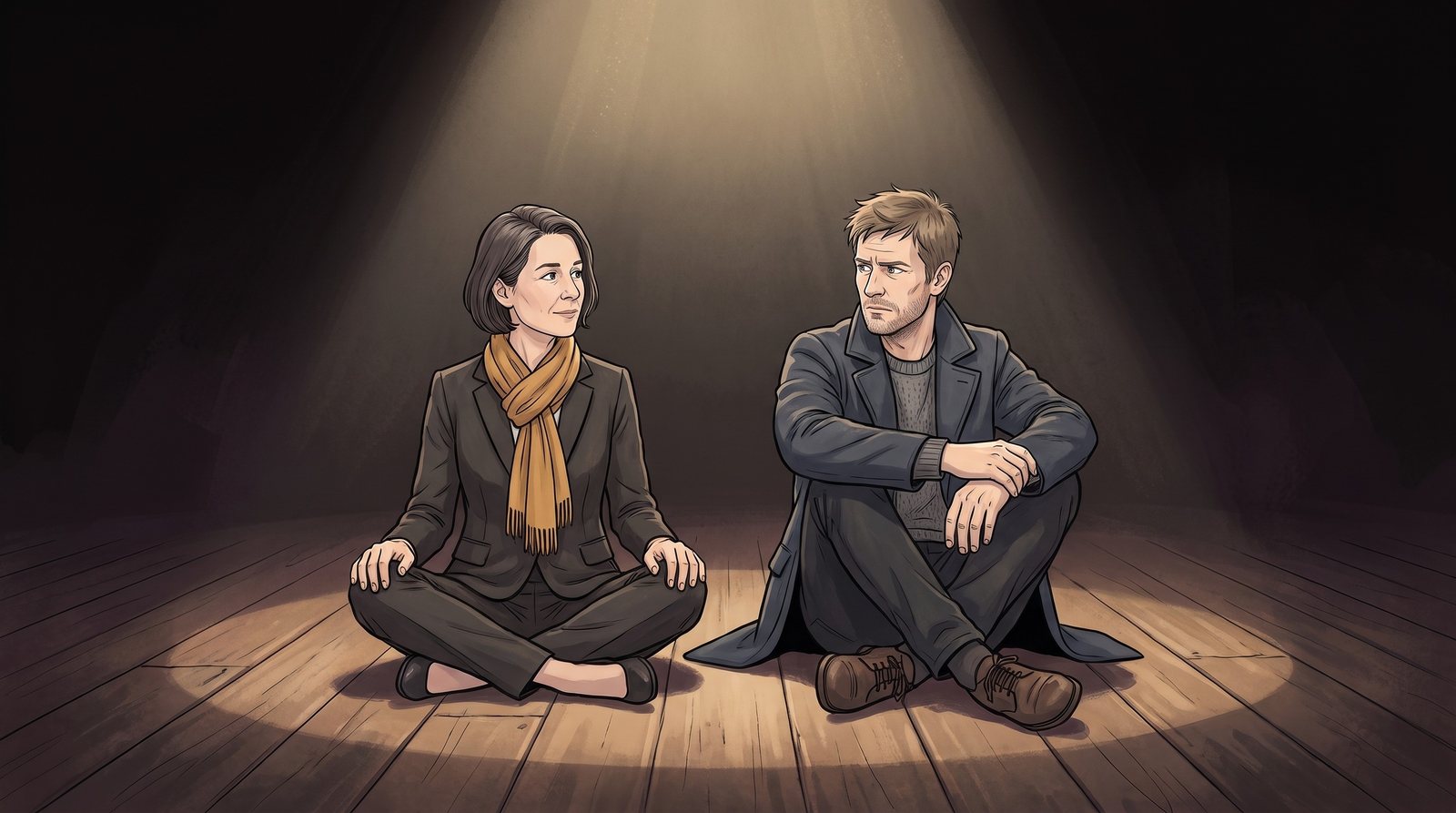
Fosterer Come on, you can't sit here all the time. You have to move. Change! Be a good Wanderer!
Wanderer I don't have to do anything.
Fosterer Can't you see? I'm your ally.
There's a moment in that scene that's easy to miss.
The Fosterer stops pulling and sits down on the floor, beside the Wanderer. That is the whole first reversal, physically. This episode is for those who lead, and for everyone who would like to be fostered by those who lead them.
Why does unfolding need Fosterers at all? Because the starting point is rarely curiosity. It's the conviction that nothing here can change: in the Wanderer, who has stopped expecting that wanting changes anything, and more often still in whoever leads them. They've inherited an operating system that calculates in averages, feels in quarters and speaks in should-sentences. It isn't stupid; it's proven. It only has one property nobody ordered: it reliably produces exactly the passivity it complains about.
Whoever hands out should all the time wakes avoidance, not ambition.
And then you wish for people who take responsibility, bend rules, ask forgiveness instead of permission, and wonder why they don't come. They can't come. Their breeding ground has been optimised away.
Exhibit · The cool thing is

The house had its agility behind it without noticing. It had grown up in that makeshift agility you have as long as you don't know anything yet. Now it knew “how things are done”, and wanted to do them like the big ones: a road many houses take exactly once.
At that time I sat in a meeting where people were talking about exactly this kind of person: initiative, ownership, the whole wish-image. A member of top management leaned back and said the sentence I have kept ever since:
A Member Of Top Management The cool thing is: you just have to demand it from your people.
I didn't contradict.
That's my dent in this story, and I leave it there. But I didn't act on it either, and in the end that cost more than any contradiction.
Rule zero
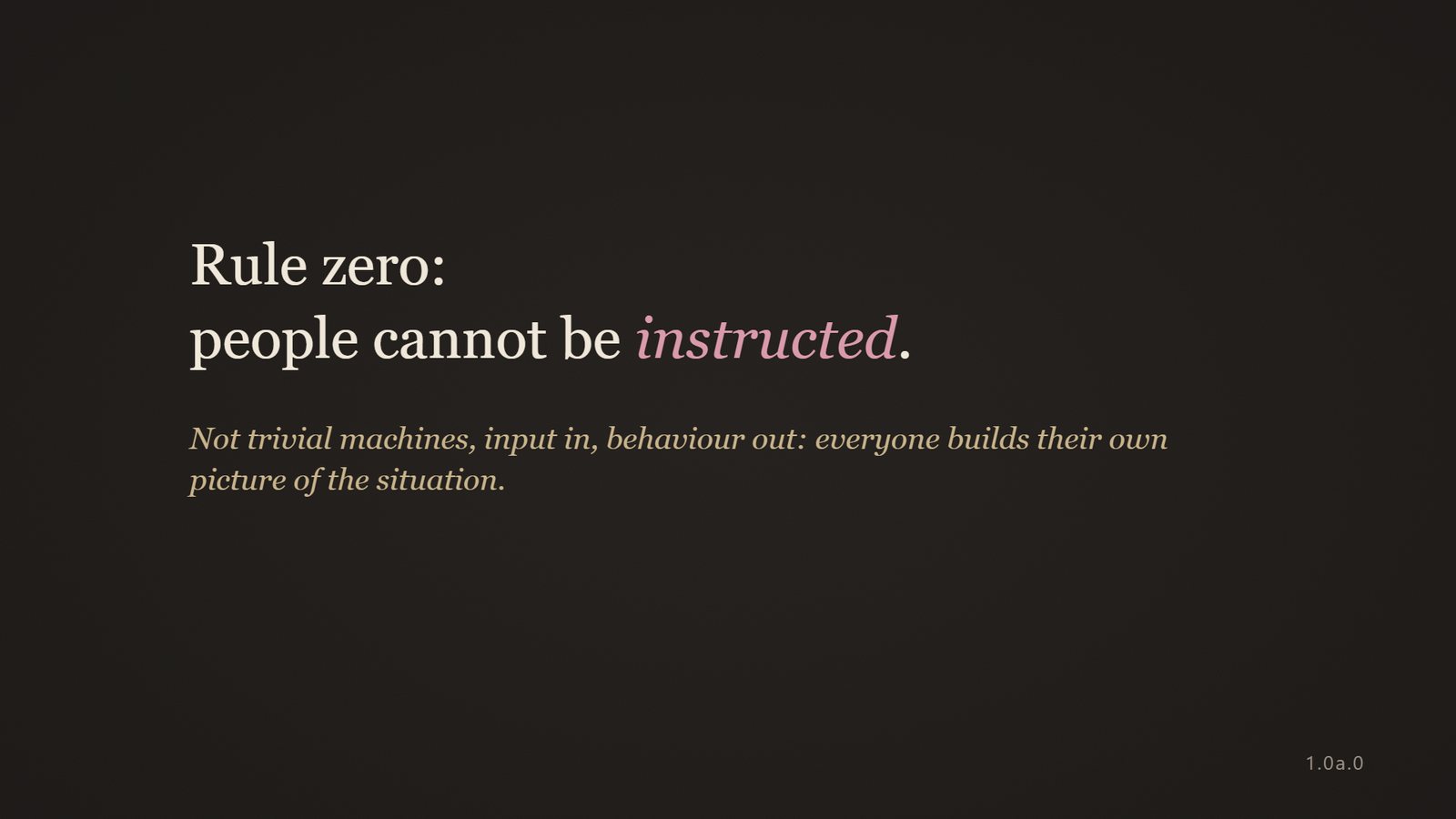
The sentence about demanding isn't meant badly. It's just wrong physics. It treats people like trivial machines: input in, behaviour out. People aren't trivial machines. What an announcement does isn't decided by the announcement, but by the structure of whoever receives it. Everyone builds their own picture of the situation, and development means that this structure rebuilds itself, in its own way, at its own pace.
From outside there are only perturbations: impulses a person answers the way they're built, not the way the one perturbing meant them. Whoever can't bear that openness and keeps instructing gets what demanding always reaps: work to rule, at best.
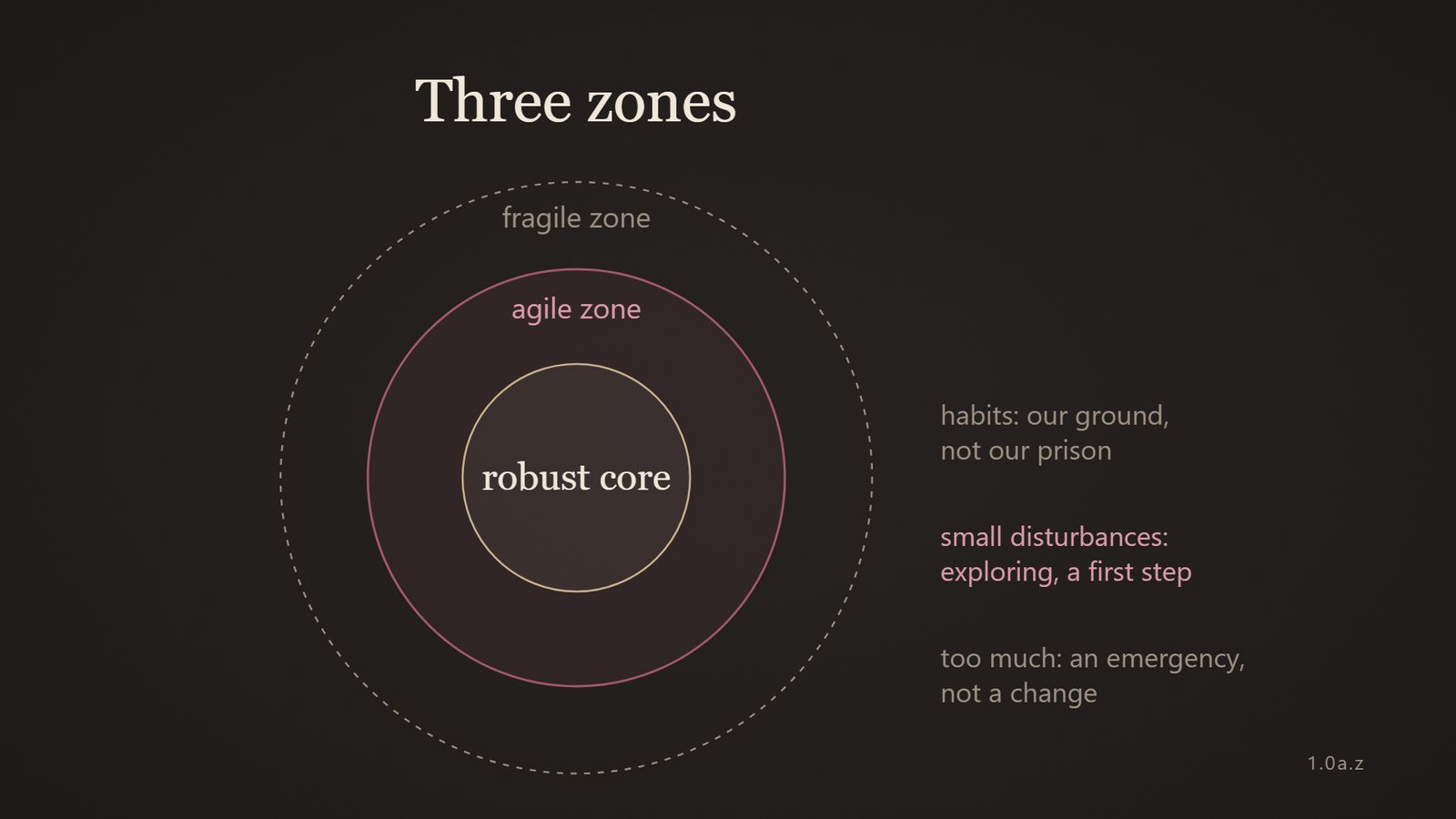
How much perturbation a person can turn into change depends on three zones. Inside lies the robust core: habits, deeply rooted, hardly shaken; our foundation, not our prison. Around it lies the agile zone, where small perturbations let us explore and the core can slowly grow. Beyond it, the fragile zone: perturbations too big, too frequent, too uncontrolled, where we swing between drifting and hoarding to save our integrity.
The dance this series is about happens in the agile zone.
Push the Wanderer into the fragile zone, and you don't get change. You get an emergency.
Five reversals
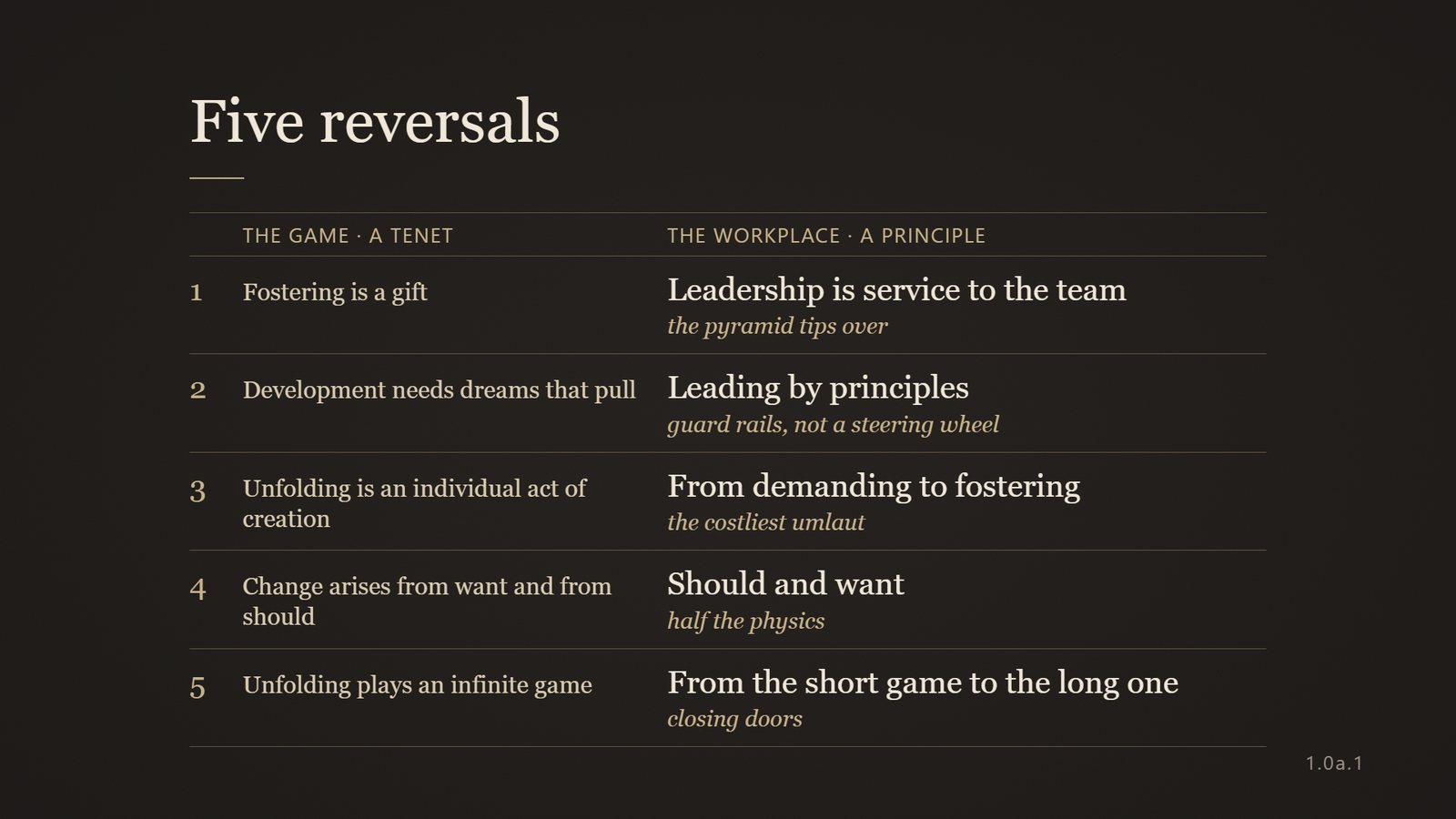
The tenets of the Overture describe the game in pictures: a table, cushions, a shot. Whoever leads has to read them once from the other side, and there the pictures turn into reversals: five places where the usual operating system has to change direction before any craft can help. The same five sentences; only now you stand on the side that can do something.
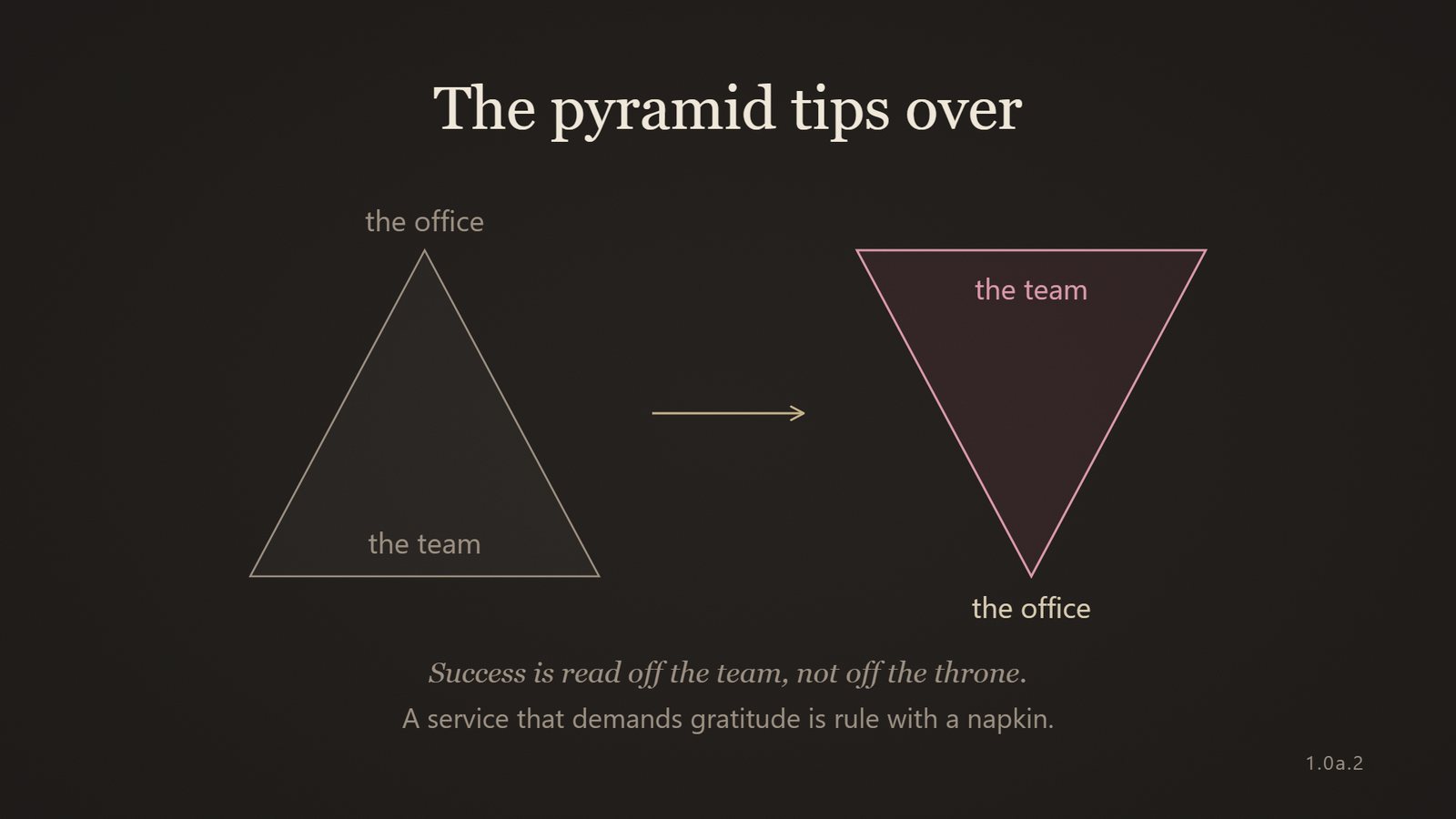
One. Leadership is service to the team: the pyramid tips over. Remember the moment on the floor. The office stays; nobody asks for responsibility to dissolve. But its direction of view turns: success is no longer read off the throne, but off the team.
Whoever serves asks first and announces later; whoever serves measures themselves by what arrives with the others, not by what they sent out.
And because fostering is a gift, the test from the Overture holds here on duty: a service that demands gratitude is rule with a napkin.
I learned how far the pyramid has to tip the hard way. I had started the night operation alone, and my contract with the owners came from that time: not a paper, a practice. I could make promises because I could carry them myself. My availability, my back, my decision.
Then the business grew faster than the labour market supplied good people. A few years later I was responsible for about two dozen people, and the hub was to run round the clock. The people I had hired had their second and third children.
And I?
I mediated. For three years I translated between what the owners demanded and what the crew could do, back and forth, and took it for diplomacy. The story I told myself wore a costume of virtue: I ask nothing I haven't carried myself. It was even true. It was only the wrong currency: I negotiated in my own resilience, and paid out of other people's lives.
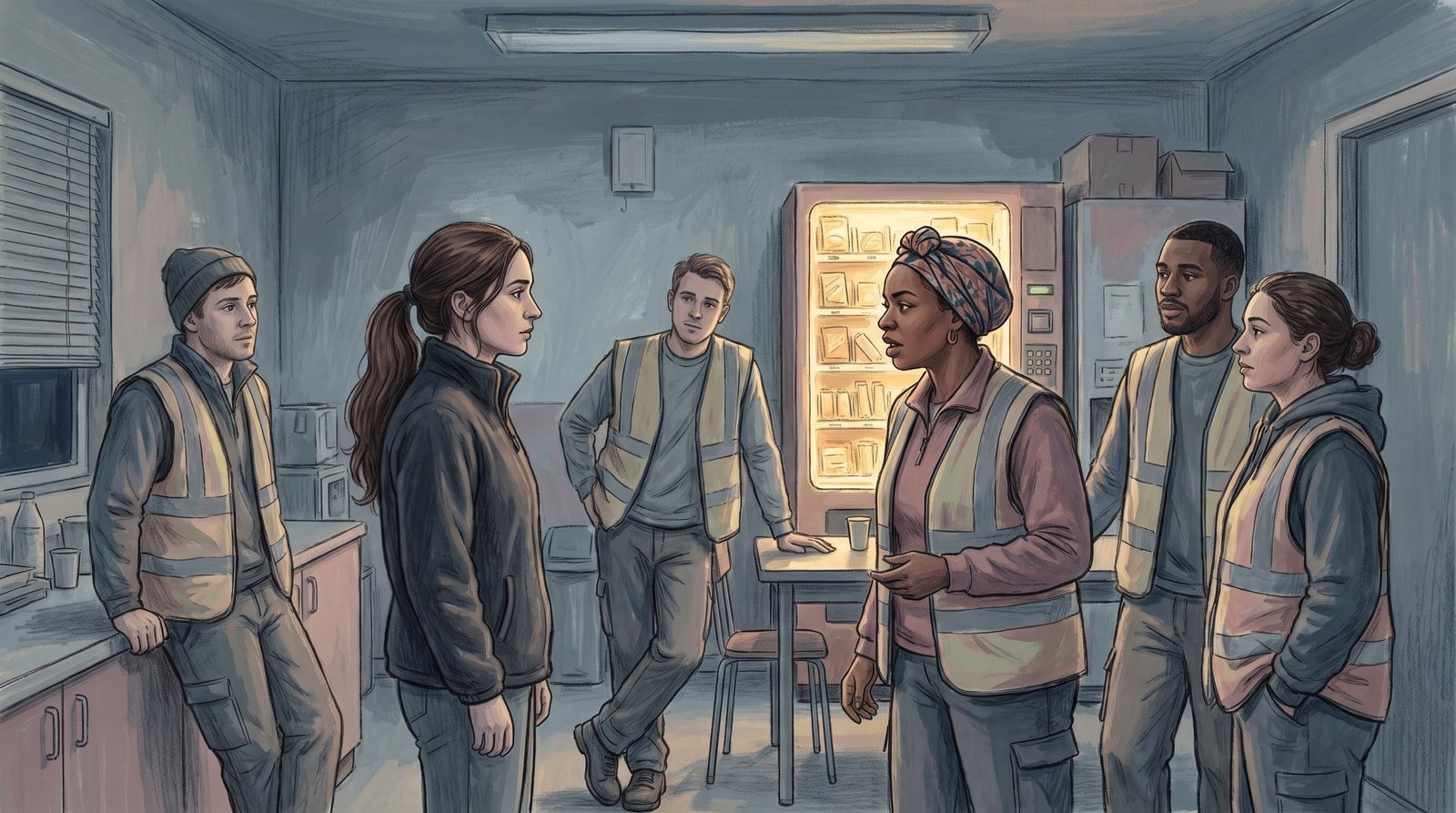
Then the team said it, with exactly the clarity I had hired them for:
Team This can't go on.
And I sat in a position that no longer was one.
Keep playing the translation game, or take seriously the experts I had brought in myself. I chose the second. What I didn't know was how long the bill would be: it took a year until the team believed me again. Trust comes back on foot. And every conflict I had translated downwards now went upwards, on my own spine, because no other was available.
Two. Leading by principles: guard rails, not a steering wheel. The Overture gave the picture: cushions that make the game possible, a dream that pulls instead of pushing. At work that means: whoever demands the ability to act from their people can't want to steer at the same time. They have to frame the space in which it grows.
The work moves out of the instructions and into the conditions: stating principles that help decide questions of direction; granting permissions that deserve the name; building rooms and rhythms in which people reach each other.
That's uncomfortable, because conditions work slowly and are hard to show off. Only, the alternative isn't leadership. It's remote control, with people as puppets.
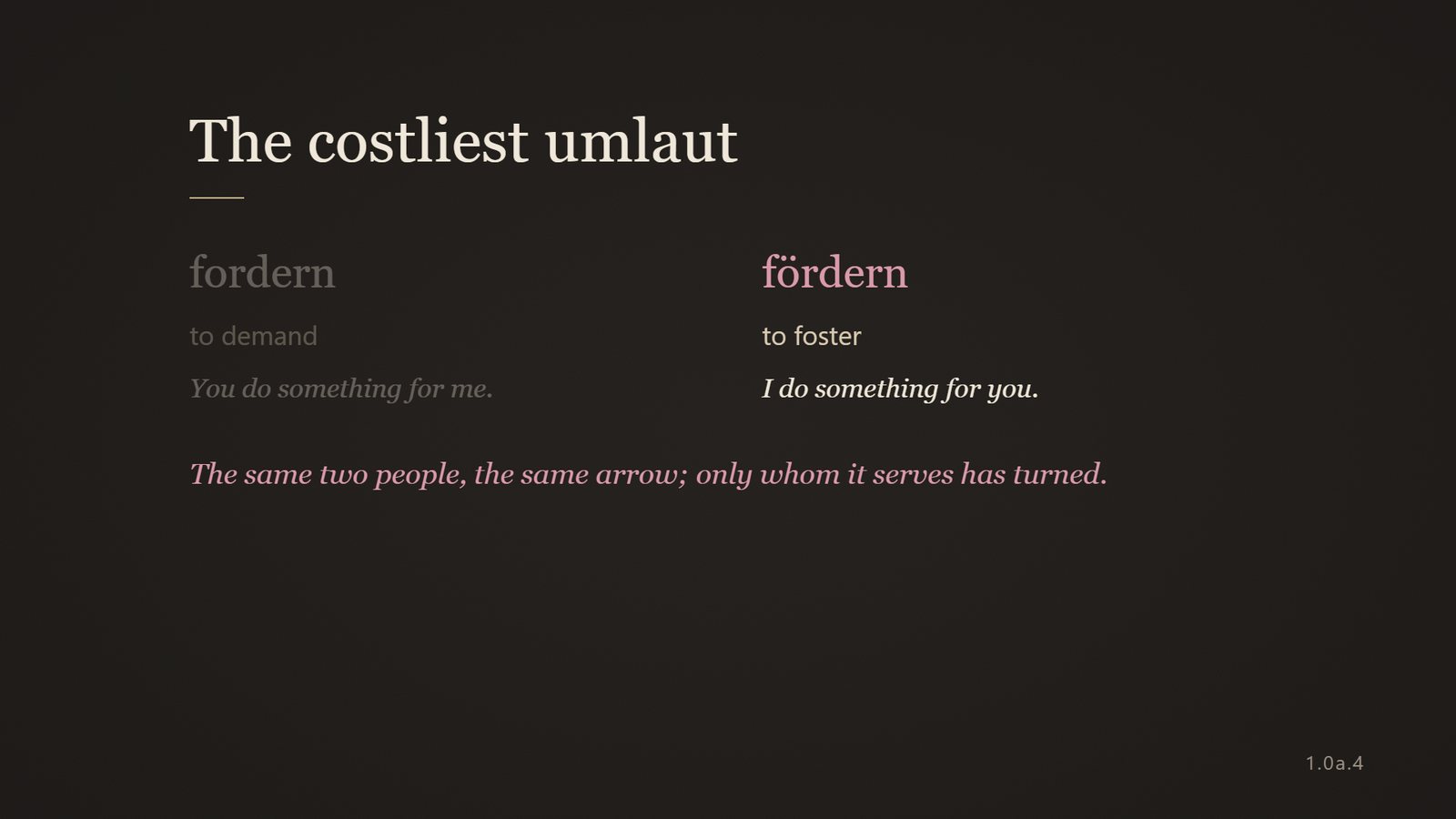
Three. From demanding to fostering: the costliest umlaut. In German the two words differ by two dots: fordern, to demand; fördern, to foster. Demanding means: you do something for me. Fostering means: I do something for you. The same two people, the same arrow; only whom the matter serves has turned. That's the whole “servant” in servant leadership.
In my first version of this thought stood a sentence I've softened since, without taking it back: the results companies celebrate are the by-product of individual development.
So the first question of fostering leadership isn't “where's the result?”, but “who is growing here, and on what?” Whoever has no answer doesn't have a performance problem. They have a fostering vacuum, dressed up as a performance problem.
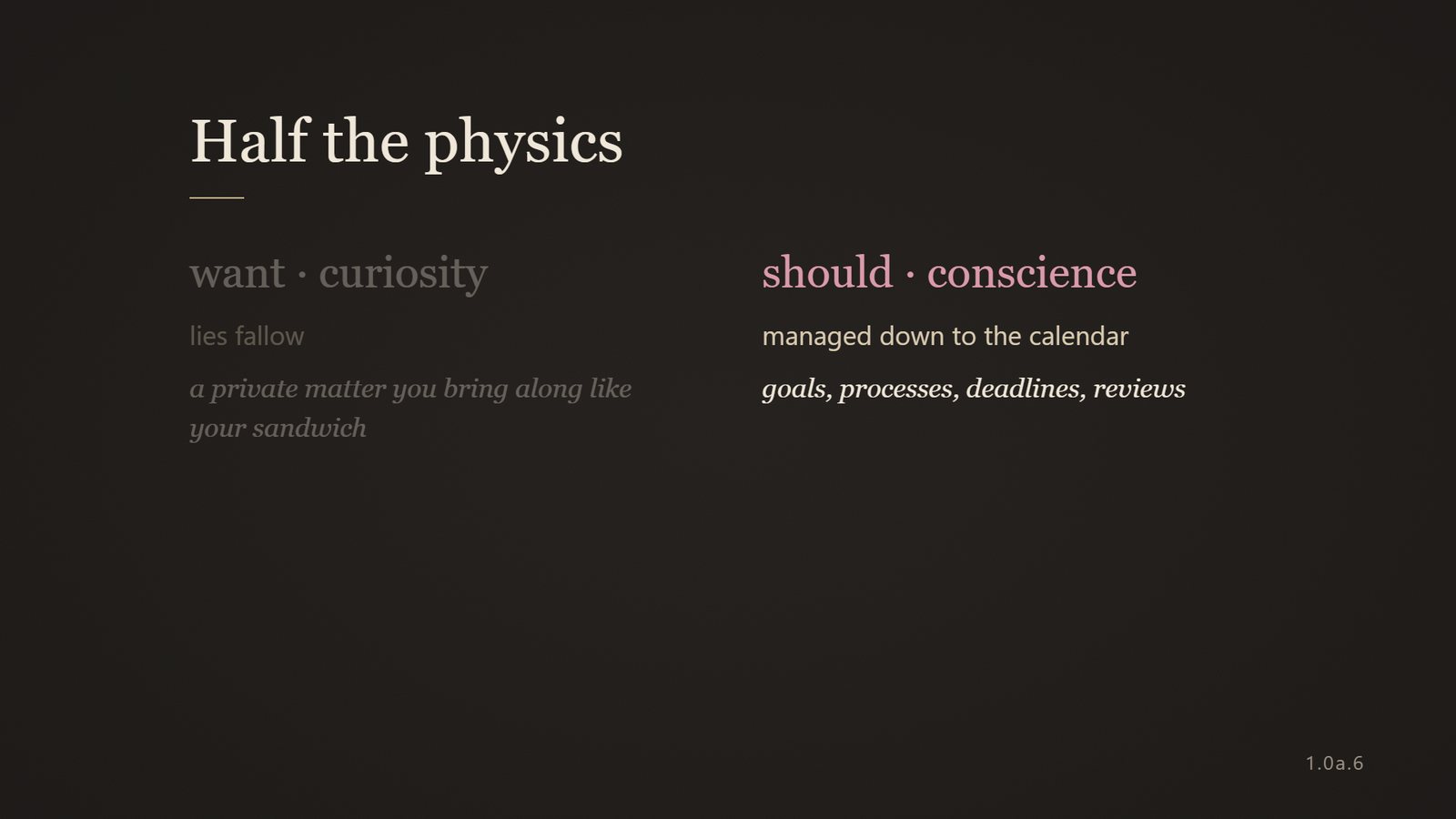
Four. Should and want: half the physics. Organisations master one half of this physics brilliantly: goals, processes, deadlines, reviews. Should is managed right down to the calendar. The other half lies fallow. Curiosity counts as a private matter you bring along like your sandwich.
Yet curiosity has mechanics, not poetry: it needs safety, a where-to, and the experience that wanting changes something.
Whoever hands out should all the time switches people to avoidance; they become careful, not ambitious. That's no question of the workforce's character. It's the half of the physics that's missing.
Five. From the short game to the long one: closing doors. The short game isn't a plan; it's a reflex, and a comfortable one, because it feels like seriousness: saving the world under time pressure, priority zero before priority zero. Only nothing grows in that mode of what it promises: no creativity, no renewal, no lead.
The way out doesn't begin with a goal, but with giving something up: closing doors.
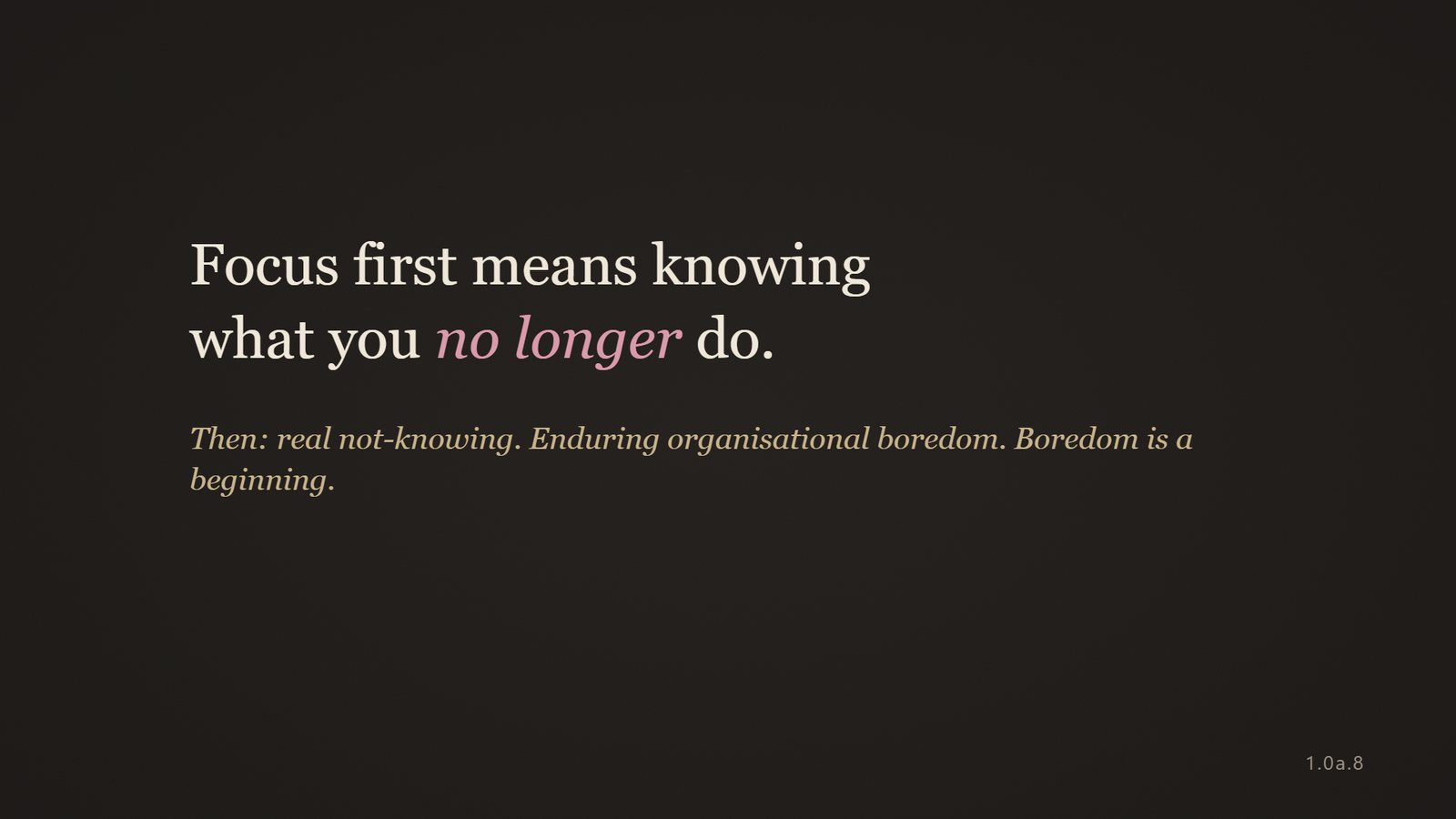
Focus first means not knowing where to, but knowing what you no longer do, and locking those roads for good, without a substitute drug. What follows is uncomfortable: real not-knowing. And the ability that carries it has no glamorous name: enduring organisational boredom. Boredom is a beginning.
This minimum isn't a method, and it replaces none; it only opens the door through which methods can work at all.
And it isn't a question of intelligence: brilliant minds stay stuck in the operating system of their training all their lives, and nobody is to blame for that. It's a question of exposure and practice. That's what the rest of this series is for.
Mirror
Which of the five reversals costs you the most? And whom does it cost when it doesn't happen?
Where did you last demand the ability to act, and withhold the conditions for it?
Where does the border between your agile and your fragile zone run right now? And who besides you knows it?
Which of your crises would be none without crisis mode? And which door would you have to close to find out?
Echo

Wanderer You keep talking to them.
Wanderer I thought this was about me.
Fosterer It's about the one who wants to foster. If they don't turn around, next year someone like you will be sitting here again.
Wanderer Then by all means, keep talking.
Sources
- Robert K. Greenleaf, Servant Leadership (1977).
- Humberto Maturana and Francisco Varela, The Tree of Knowledge (1987).
- Heinz von Foerster on trivial and non-trivial machines.
- E. Tory Higgins, “Beyond Pleasure and Pain” (1997).
- James P. Carse, Finite and Infinite Games (1986).
The stories are drawn from three decades as an employee, leader, coach and facilitator. Places, times and people are changed, and some scenes are composed from several experiences; they allow no reliable conclusions about any company or person. The illustrations and the voices of the episode are made with AI.