Unfolding · Part I: The Person · 1.0
Overture: The Game and the Dance
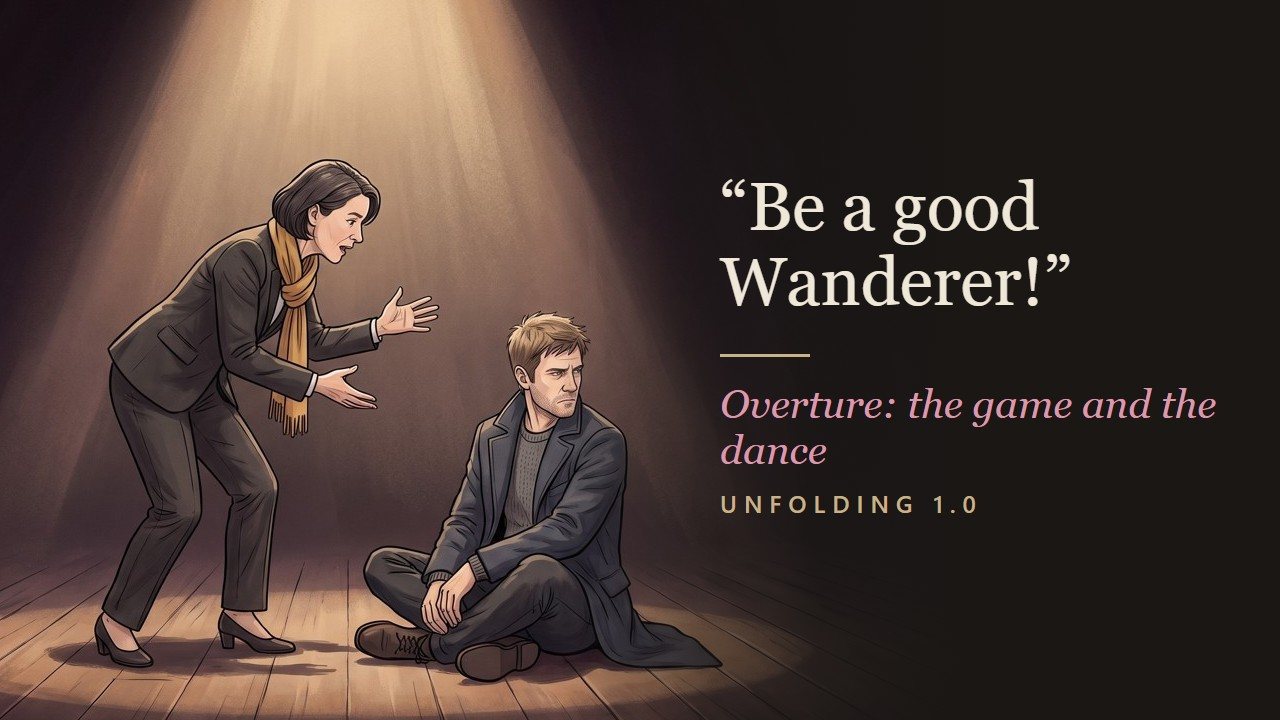
A Wanderer on a bare stage floor who won't move, and a Fosterer who tries every trick. Then a couch, years ago, and a coach who came without a plan. The overture of the Fosterer and Wanderer method: the two roles, the four exchanges, perturbing and affirming, and the five tenets.
The text of the episode follows, with its diagrams. Below each heading: watch that part on YouTube.
Cold open
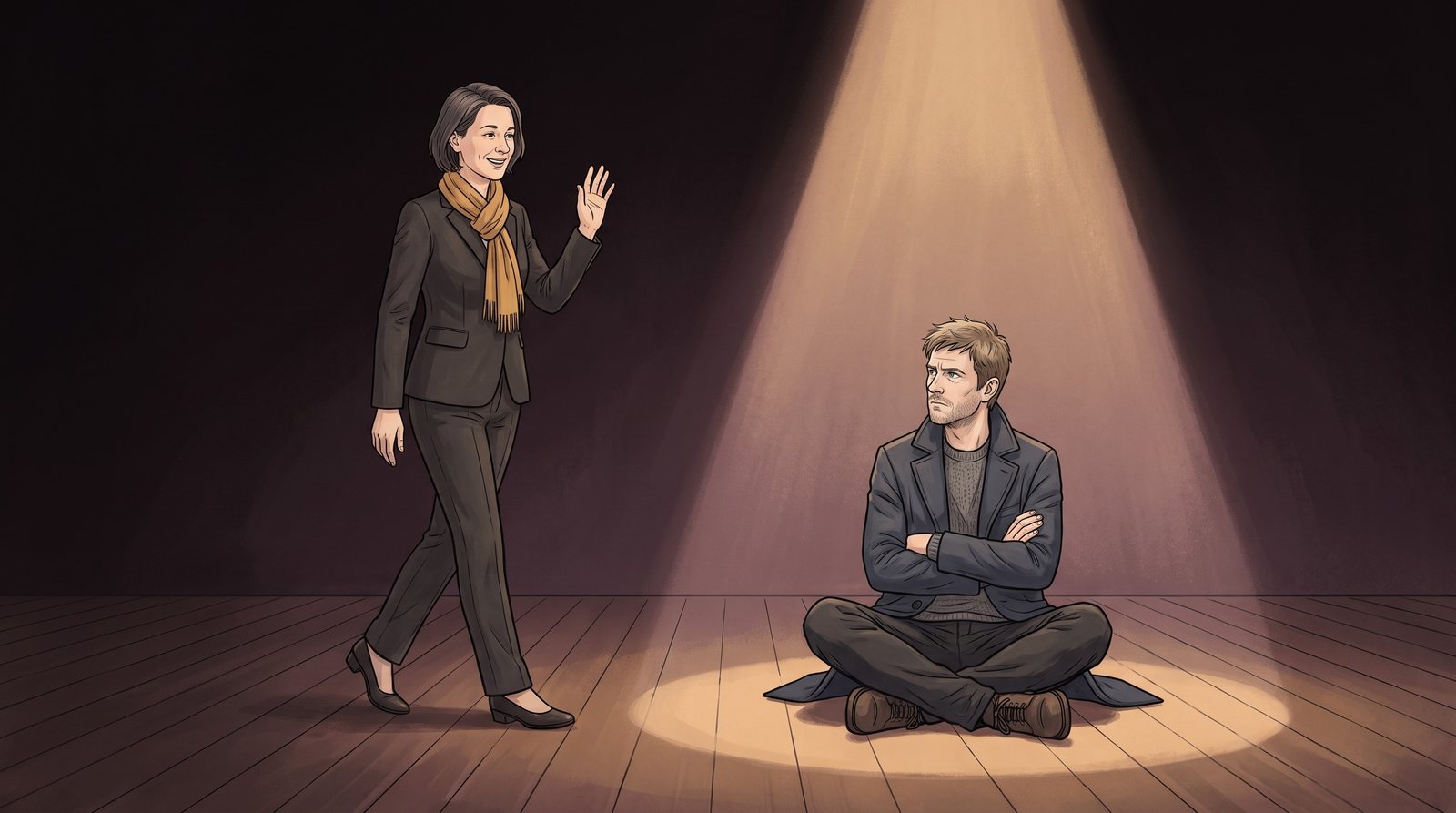
Fosterer Good day to you.
Wanderer Who are you?
Fosterer I'm your Fosterer.
Wanderer I know all about your sort.
Fosterer Come on, you can't sit here all the time. You have to move. Change! Be a good Wanderer!
Wanderer I don't have to do anything.
Fosterer Can't you see? You're calcifying here! Wait a month, and only your skeleton will be sitting here. Now pull yourself together! Give yourself a push!
Wanderer I don't want to.
Fosterer I know exactly how you feel.
Wanderer You don't know a damn thing about me.
Fosterer I only want to help you.
Wanderer I don't see that.
Fosterer Just trust me.
Wanderer You're as much a cog in the system as I am. You're only following your script. One of the Ever-Faithful, guarding the sacred order.
Fosterer Can't you see? I'm your ally.
Wanderer Why should I ally myself with a system's lackey who only cares about carrying out the director's plans? Collect your trophies somewhere else, and let me sit in peace.
Fosterer I hate the director's plans myself! I'm a free spirit! Besides, people need humanity, not schedules.
Wanderer And that's why I don't care what you think I should.
Fosterer What do you want, then?
Wanderer To sit in peace. And not to do penance as your experiment, your guinea pig.
Fosterer I'd only like to walk with you a little. Feel a little closeness.
Wanderer Closeness? Are you ready to resist your own complacency, your devious fanaticism? And don't you come at me with conjuring tricks, you artist of manipulation. Motivation arises in harmony, not in resistance.
Fosterer If I manage not to be an obsessed guardian of order, would you want to try it with me then? Could I lure you out of your proud Hoarder's corner with that?
Wanderer Don't insult my collection of memories.
Fosterer I beg your pardon. Might you give me a second chance?
Wanderer If I may keep my comfort.
Fosterer (inner voice) What a pedant.
Fosterer Your unfolding remains your own creation, with the wide world as its breeding ground. Would you perhaps like to drift around in it with me a little, as a distraction?
Wanderer Now you're flattering me …
Wanderer And you'd shape the drifting, friend of humanity? Become a real master craftsman: a Fosterer with … the skill to act?
Fosterer If you feel like it.
Wanderer Feel like it? We're nowhere near that yet. But I'm curious about you.
Fosterer (inner voice) Good.
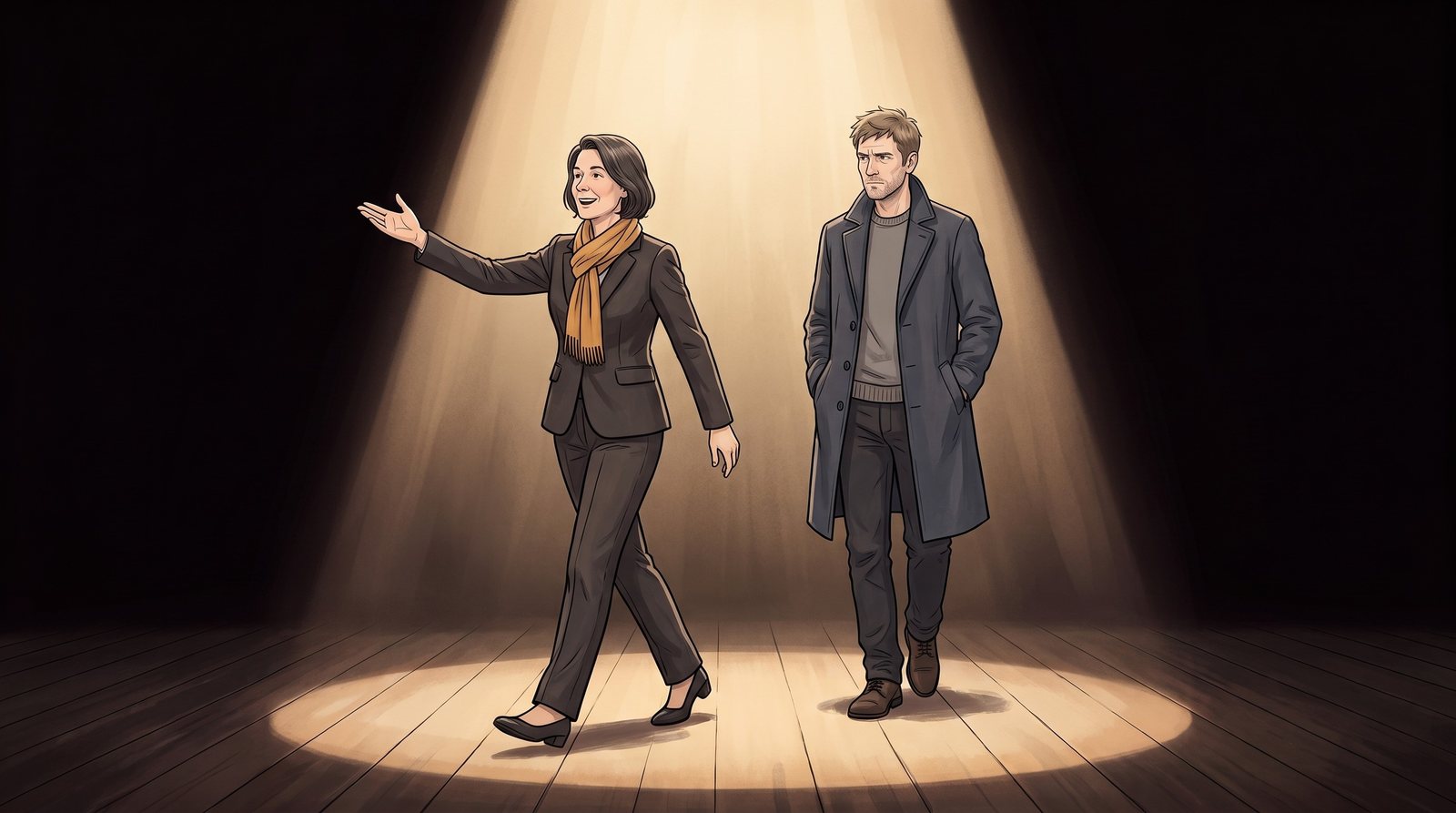
Fosterer You want to! Then let's set off. There's so much to explore! And what comes next?
Wanderer That's not for you to decide.
Wanderer Your zeal is already cutting off my air.
The gallery
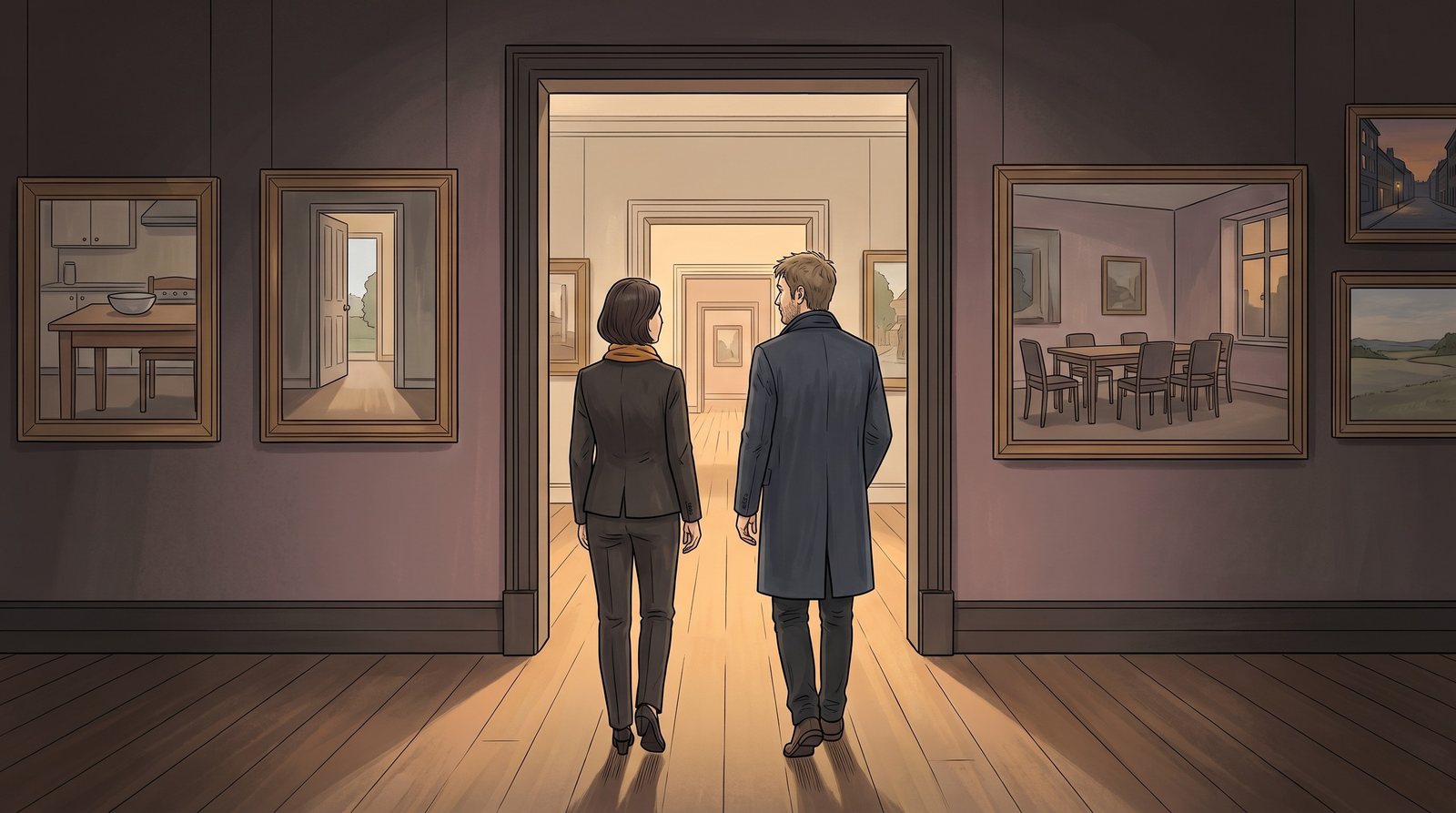
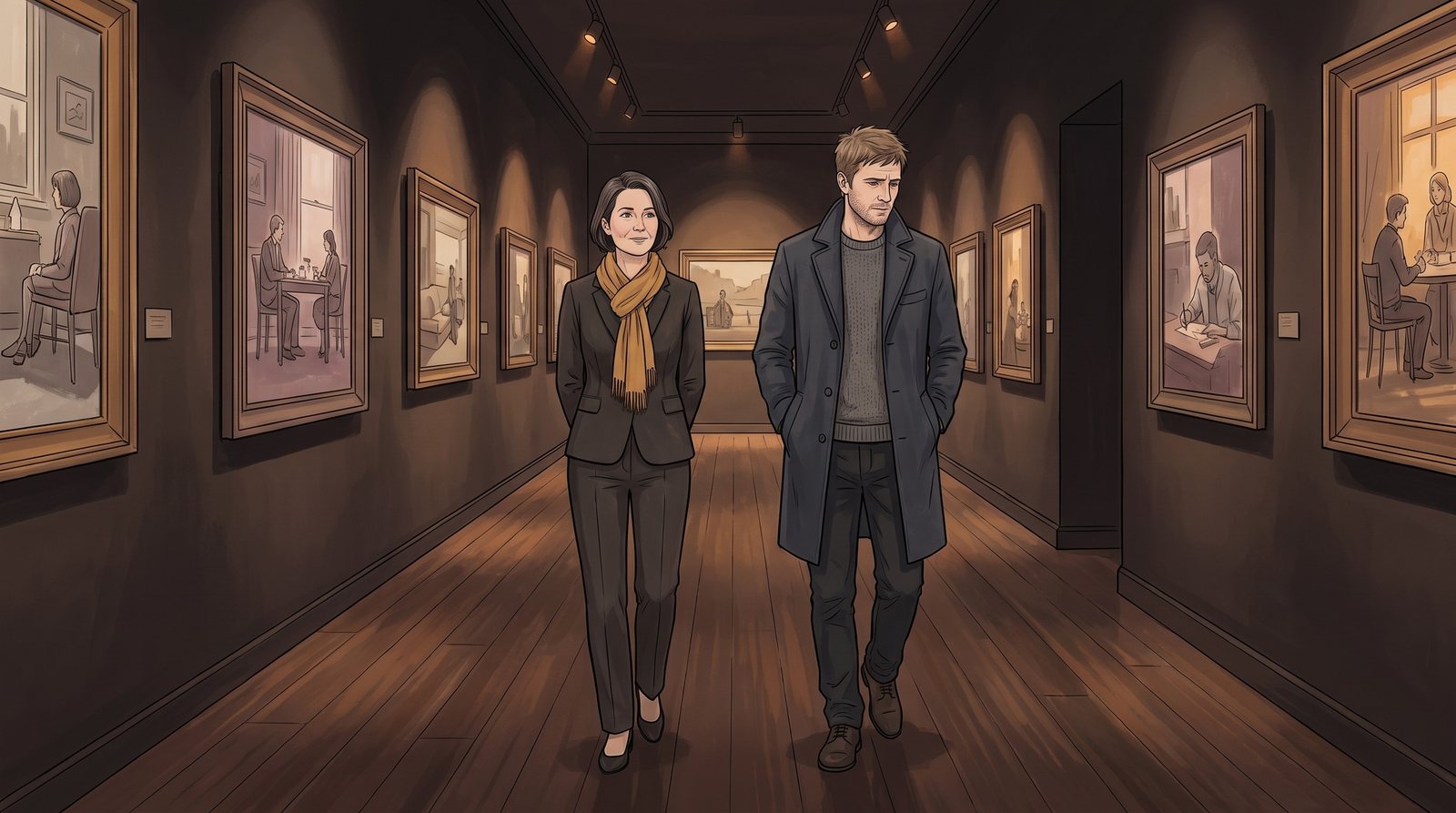
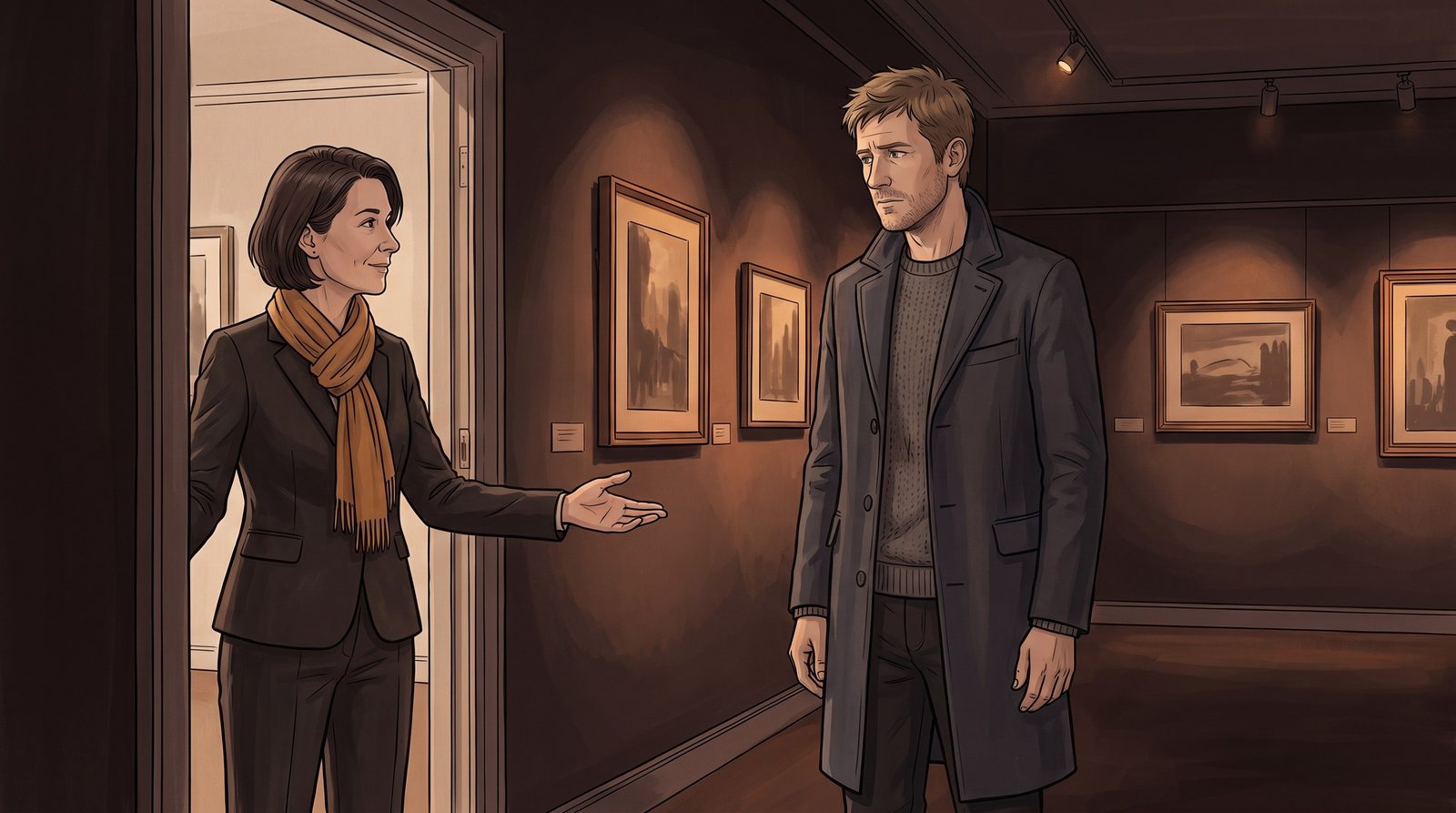
With their last step the empty stage dissolves. Around the two of them a house appears, with many rooms and picture after picture on the walls: an exhibition. From now on the Fosterer and the Wanderer are its visitors. They go from room to room, stop in front of the exhibits, and carry their conversation a little further at every wall.
Look closely at what happened on that stage. A deterrent: “your skeleton”. Claimed empathy: “I know exactly how you feel”. Then luring, and flattery. None of it moved anything. What moved in the end was a single word, and it came from the Wanderer: curious.
The pictures on the walls belong to neither of them. They are the memories of a third: a Collector who never sets foot on the exhibition floor and is still present everywhere. Wherever we stop in front of an exhibit, we hear her voice, in the first person, living the scene once more. So “I” in this series means the Collector first, and then anyone who has been in a similar place, or will be. The “I” is an offer to recognise yourself.
That the Wanderer, a hoarder of their own memories, walks through someone else's collection is no accident: you read other people's memories more clearly than your own.
Watching isn't an indiscretion here; it's the exercise. The first exhibit hangs right by the entrance.
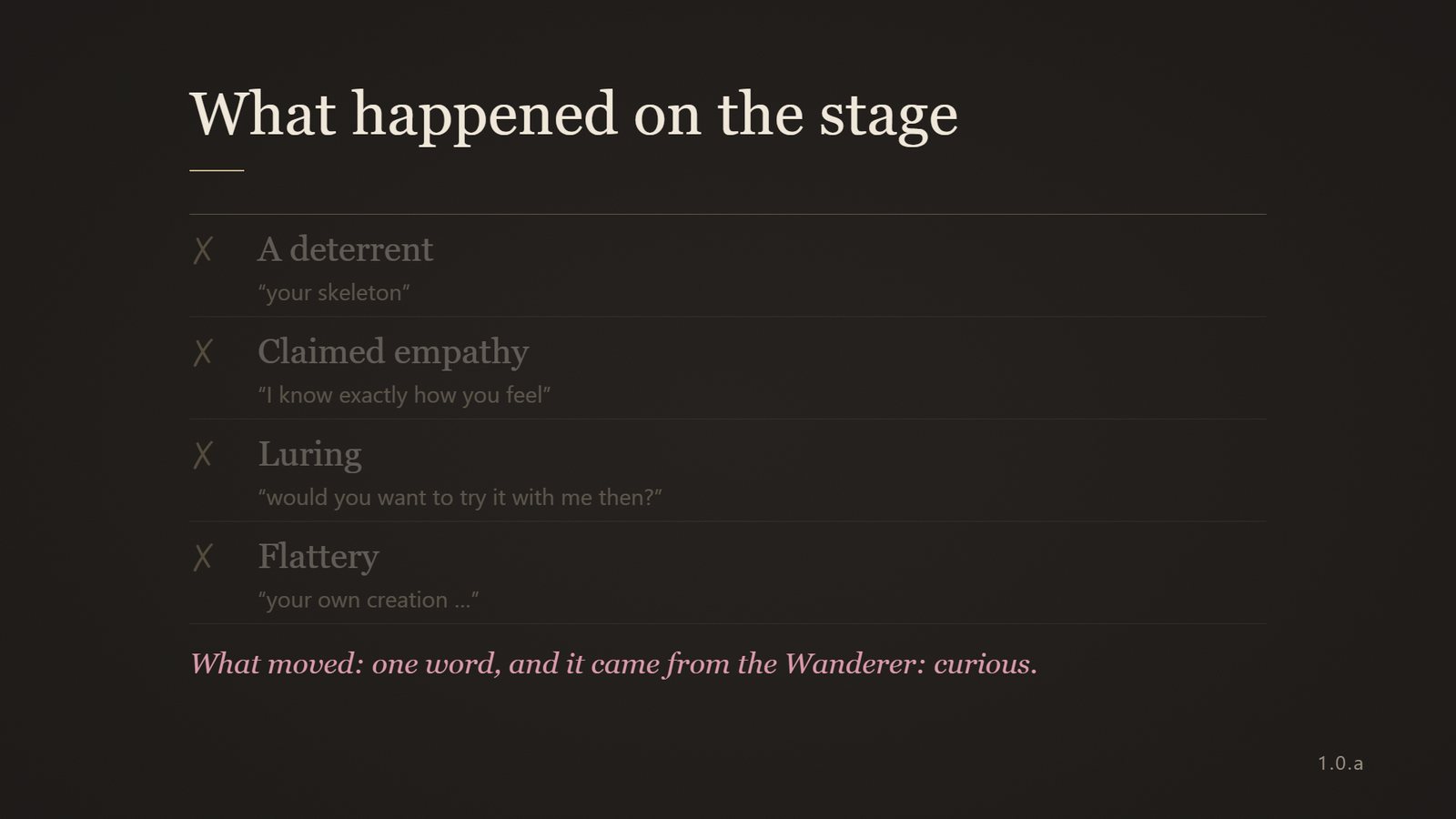
Exhibit · The coach who had no plan

More than ten years ago. I'm sitting on my couch, not on a stage floor, looking for a spark. I had just turned down a job offer. I can't remember any more why; my body simply didn't move in that direction. I wasn't in denial. I knew I was stuck. It was more of an unwillingness: the thoughts I had didn't fit the time or the place, or nobody wanted to hear them from me. I had coached and led for years myself; I knew exactly what I would have said to someone sitting like this.
For weeks I thought about calling a coach.
Then I did.
There is something between people that is faster than any word. I knew it from the best years before: one look across the room, and you know what the other thinks of what's happening; and however long you haven't seen each other, you carry on the sentence as if no time had passed.
When I sat opposite her, I searched her face for the signals I expected: the timetable, the gentle steering, the goal behind the friendliness.
They weren't there. There was curiosity. Not “where do I steer you”, but “let's see where this goes”. Friend, not foe. I knew it faster than I could explain it, and for the first time in months I didn't defend myself.
I used her, honestly, to pull me out of my bubble until something new came along. And the conversation turned, session by session: sometimes she accompanied me, sometimes I accompanied her. At some point she said:
Coach Send me an invoice for this supervision.
I never sent one.
That was years ago, and we still talk. In the end I chose one of the exits that were open. The resistance had never been to the way out; it was to letting go. What I found in those conversations was the one truth nobody wants to hear.
The more you steer people, the more they push back. The more genuinely you're interested in them, the more surely they find their own way. Back then, it helped me stay myself.
The same scene twice: once on a stage floor, once on a couch. You recognise it at once, from both sides. Each of us has been the one who wanted to move someone, and each of us has been the one who wouldn't be moved. On the stage, the Fosterer first had to unlearn pulling; across the table, someone had never needed it. This series is about what happens between those two when it works.
We give the two roles names: the Fosterer and the Wanderer. In German, Förderer and Wandler. And that the roles can swap: the exhibit has already given that away.


Observe
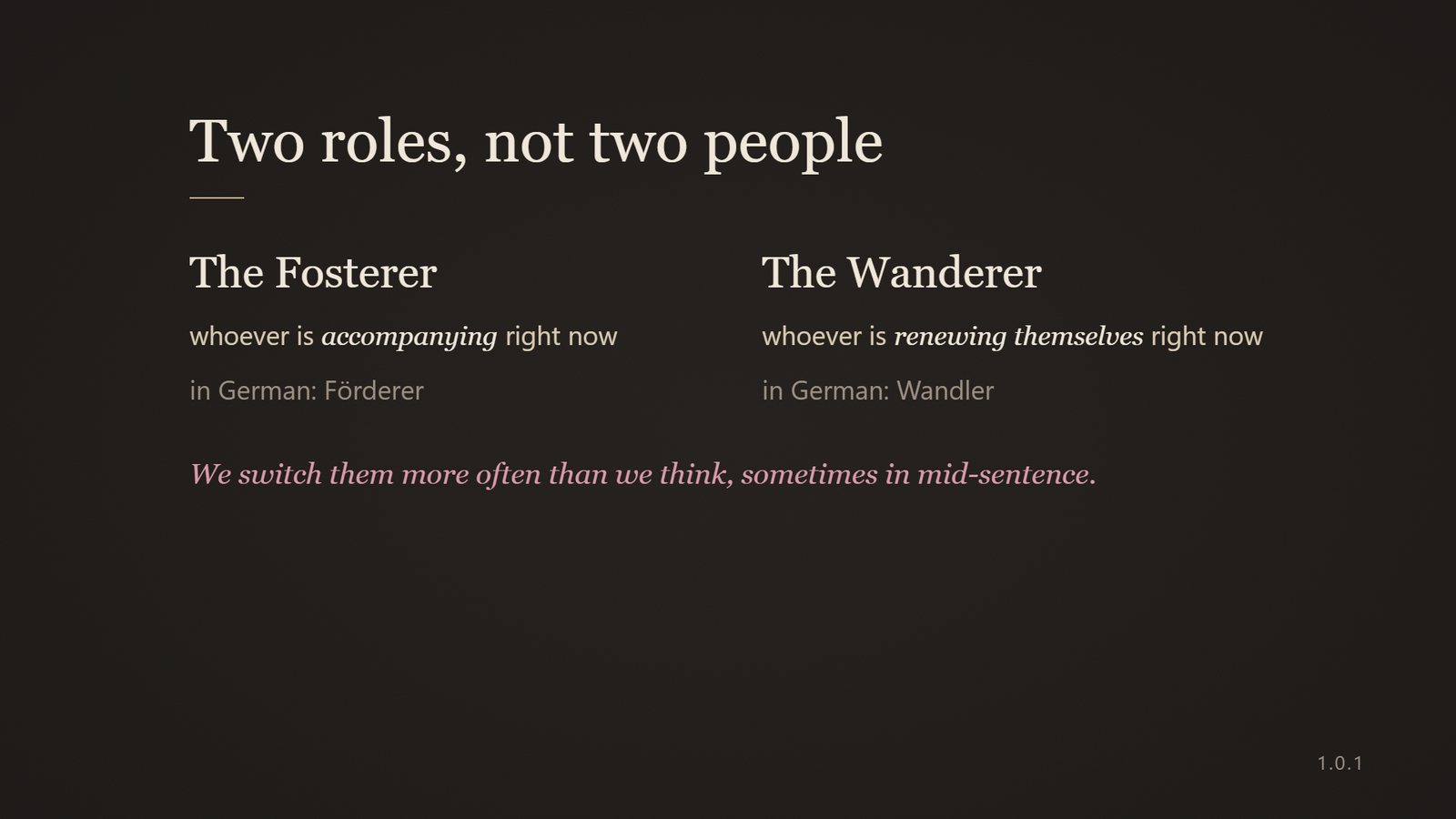
The Fosterer and the Wanderer are roles, not people. We switch them more often than we think, sometimes in mid-sentence. The Fosterer is whoever is accompanying right now; the Wanderer is whoever is renewing themselves right now.
Listen to the floor once more. Near the end, for one sentence, it's the Wanderer who fosters:
Wanderer And you'd shape the drifting, friend of humanity? Become a real master craftsman: a Fosterer with … the skill to act?
What drives them isn't symmetrical, but it's related. The Fosterer is torn between humanity and skill: the warm stance that lets the other be as they are, and the craft that wants to make a difference. Lose one and the work turns clumsy; lose the other and it turns inhuman. Either way: unprofessional.
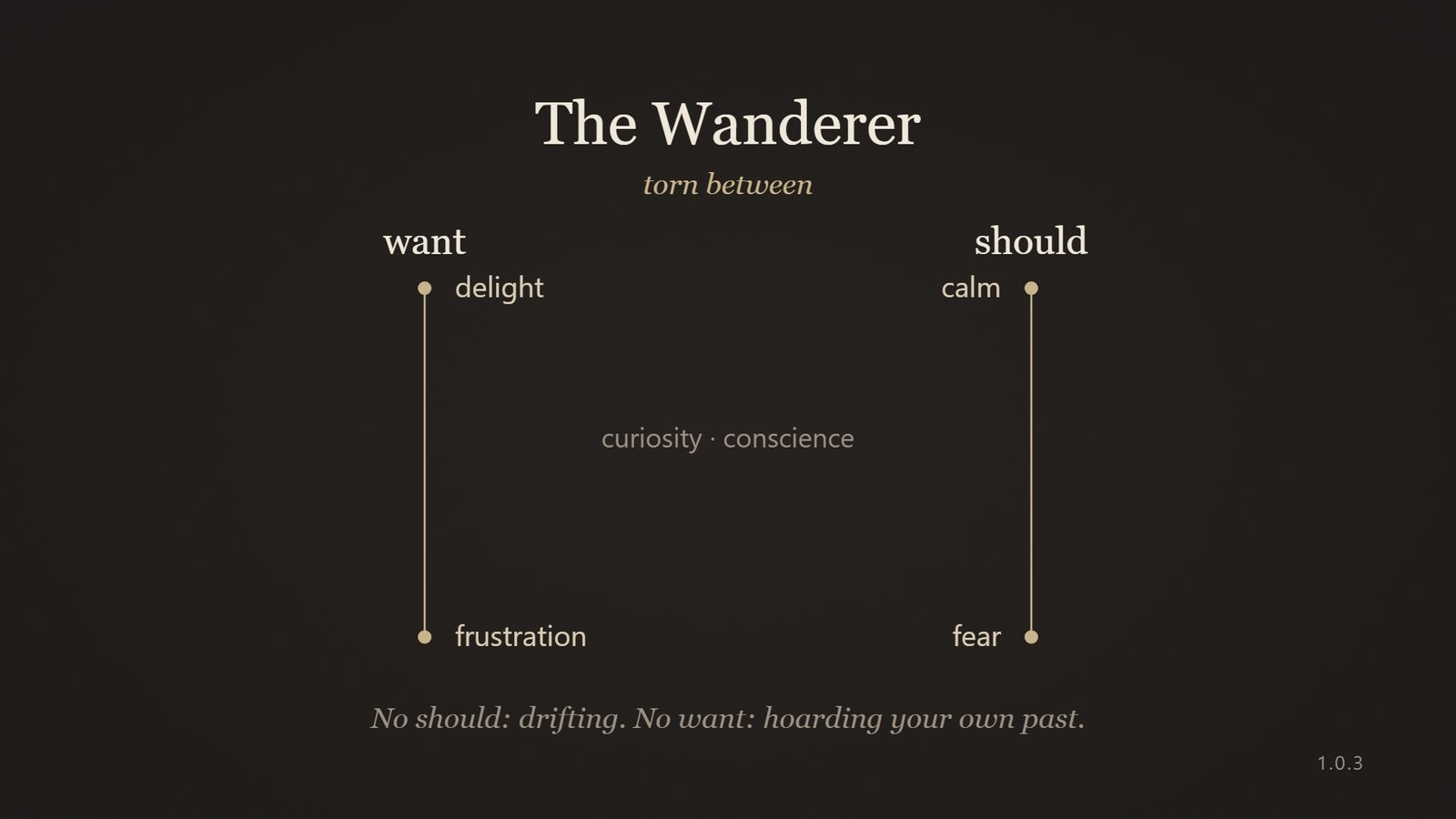
The Wanderer is torn between want and should: the curiosity that pulls towards goals and ideals, and the conscience that keeps norms and fulfils duties. Want swings between delight and frustration; should, between calm and fear. Neither is the good one. Someone with no should at all drifts without direction; someone with no want at all hoards their own past.
Wanderer Don't insult my collection of memories.
The misery starts elsewhere: when “should” dresses up as “want”. When duty puts on a costume of enthusiasm, and nobody may say any more that it pinches.
And both carry something stronger than any resolution: habits. They aren't weaknesses. They're crystallised practice, and every one of them once solved a real problem. Only often a different one from today's. Habits are rarely wrong; they're just in the wrong context. That's why they're so robust: they've earned their right to stay. And somewhere behind them waits the best-practised habit of all: no longer believing that anything here can change.
It, too, once solved a real problem.
Understand
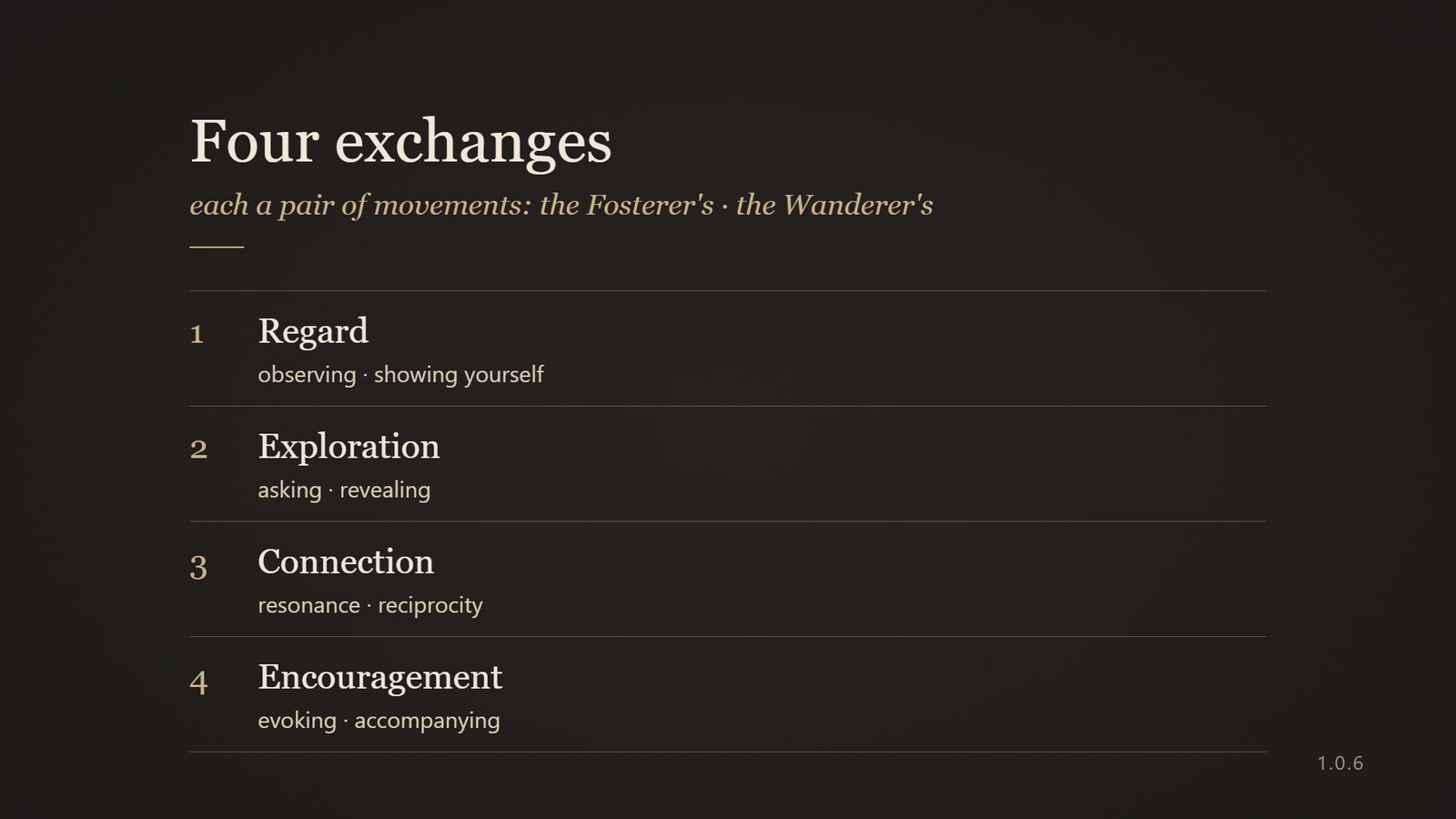
Human unfolding is a game of fostering and changing, and its parts build on each other. Four exchanges keep it going, each a pair of two movements that need each other.
Regard: observing, and showing yourself. Exploration: asking, and revealing. Connection: resonance, and reciprocity. Encouragement: evoking, and accompanying.
The order is a reading aid, not a timetable. No exchange is ever finished; whoever arrives at the fourth keeps coming back to the first, the way a dancing couple carries the basic steps into every figure. Episodes 1.1 to 1.4 follow these four exchanges, and later parts climb the same four steps again: in the team, and in the organisation.
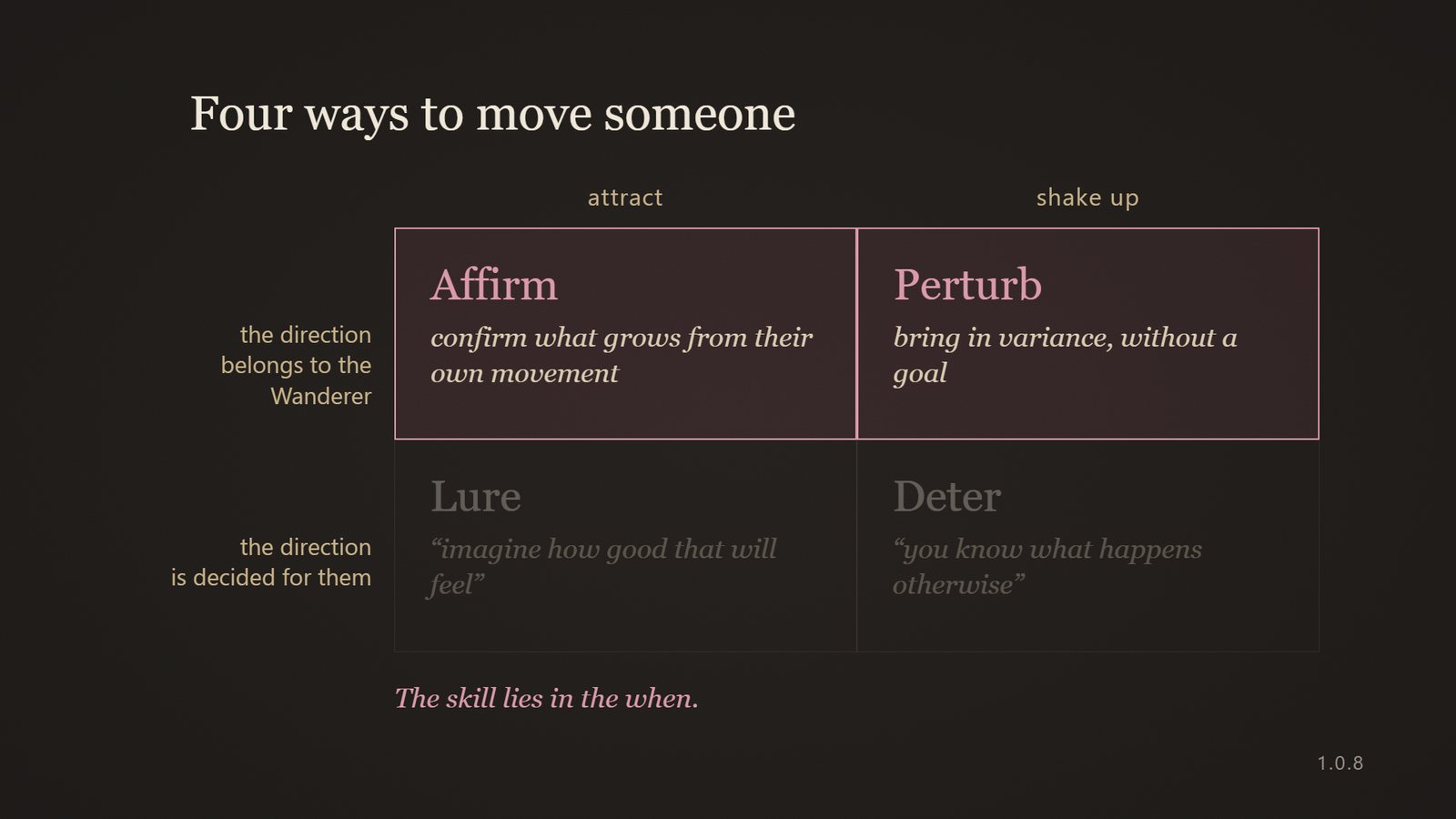
Why does the Wanderer move at all? Around them works a field of lures and deterrents: prospects that pull, and prospects that scare. The field only describes; it's part of the landscape. It becomes a problem when the Fosterer starts using it as a toolbox. On the floor we heard both.
Fosterer Wait a month, and only your skeleton will be sitting here.
Fosterer Could I lure you out of your proud Hoarder's corner with that?
A deterrent, and a lure. Both are manipulative, because both take away the one thing that separates unfolding from training an animal: that the direction belongs to the Wanderer.
What's left for the Fosterer, then? Surprisingly little, and exactly the right thing. Break the craft down to its simplest, and two non-directive acts remain.
Perturbing: bringing in variance, without a goal. The jolt that only says “not the same”, and leaves it to the Wanderer what instead. A contradiction reflected back, a question left standing, a silence at the right moment.
Affirming: confirming what crystallises out of the Wanderer's own movement. Not praise from above, but rejoicing with them, at eye level.
Wanderer I still don't know why I'm walking with you.
Wanderer Maybe because nobody's pulling.
Fosterer Nobody's pulling. And you came anyway.
A silence that leaves the question standing. Then a sentence that only confirms what the Wanderer found on their own.
The Fosterer's skill lies in the when: when a perturbation is needed to break up rigidity, and when an affirmation, to settle a new form. Everything else, asking, naming, offering, falling silent, is technique in the service of these two acts.
Behind it stands a sentence that will follow us into Part III.
Having the last word on meaning cannot mobilise anyone; only doubt can. Whoever tells the Wanderer what their situation means suppresses exactly the variance change could come from. Giving information isn't that. Judging the meaning is.
Practise
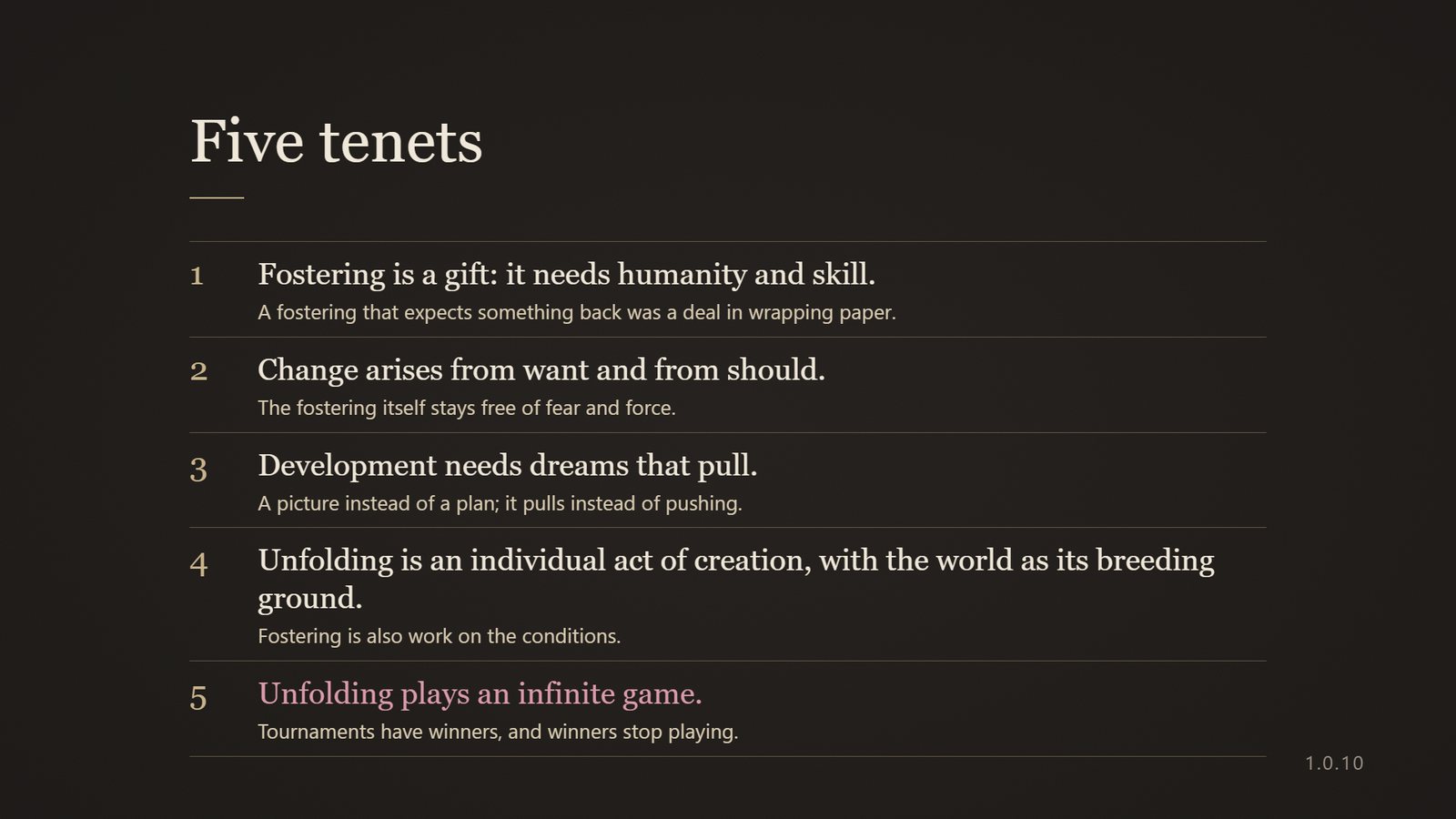
The game is played on a table bounded by tenets, and the bounds set it free: inside them there's freedom, and using the room is welcome. Five tenets carry human fostering.
One. Fostering is a gift: it needs humanity and skill. It's meant in the same sense as the sentence “leadership is service to the team”; the two spell each other out. A gift asks nothing back. And a test comes free with it: a fostering that expects something in return wasn't one. It was a deal in wrapping paper.
Two. Change arises from want and from should. Both deserve respect, but the fostering itself stays free of fear and force. Whoever makes motivation out of people's fear of going without acts in a deeply inhuman way.
Three. Development needs dreams that pull. Without a where-to, even a picture instead of a plan, development turns into drifting. A dream isn't a timetable; it gives the want a place, and it pulls instead of pushing.
Four. Unfolding is an individual act of creation, with the world as its breeding ground. Every step forward has to be opened up by the Wanderer; the surroundings decide too whether it can succeed. So fostering is always also work on the conditions.
Five.
Unfolding plays an infinite game. No tournament may end it: tournaments have winners, and winners stop playing.
Wanderer Five tenets. Sounds like five rules to me.
Fosterer Rules would steer you. These don't. Come, I'll show you.
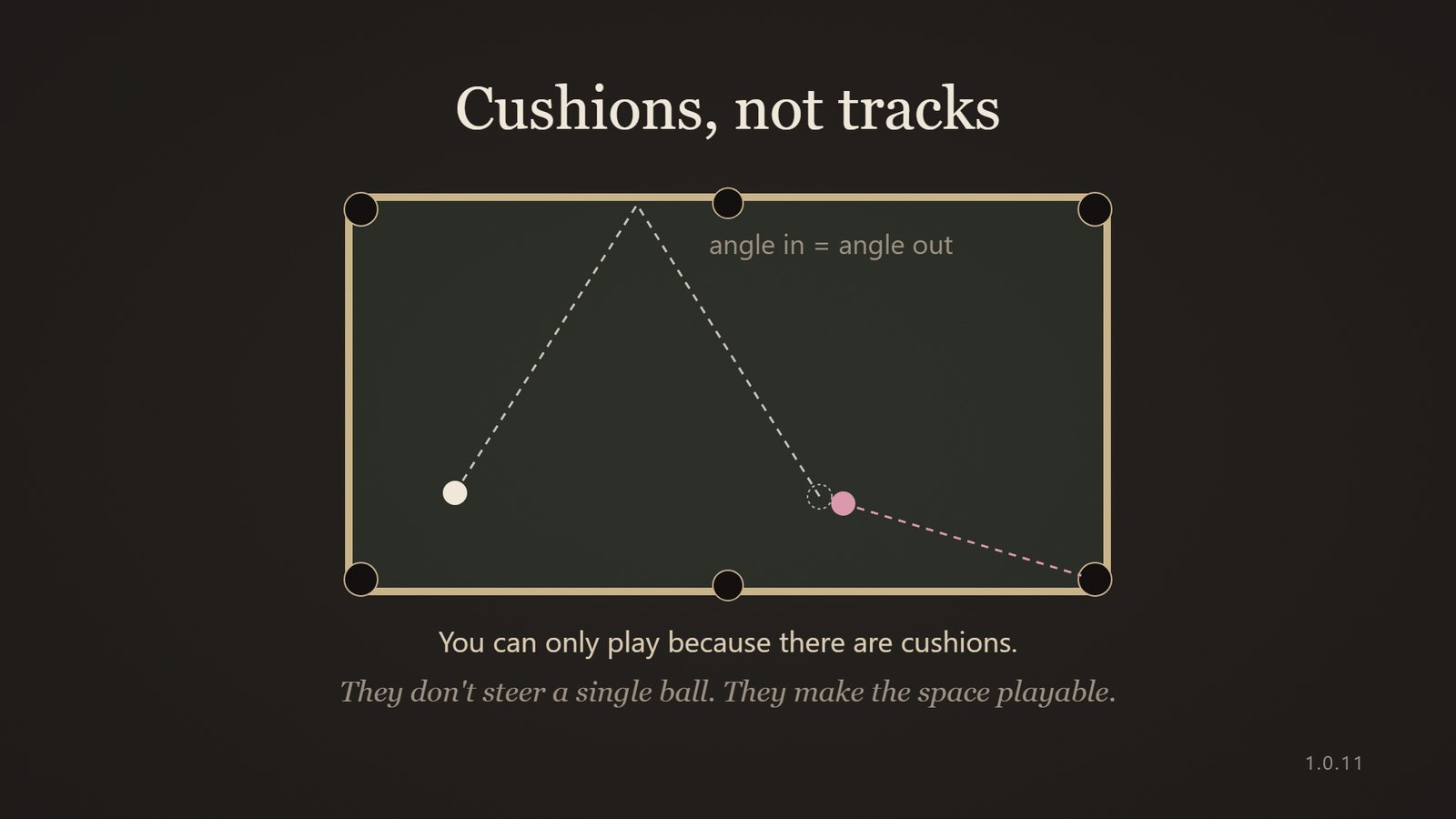
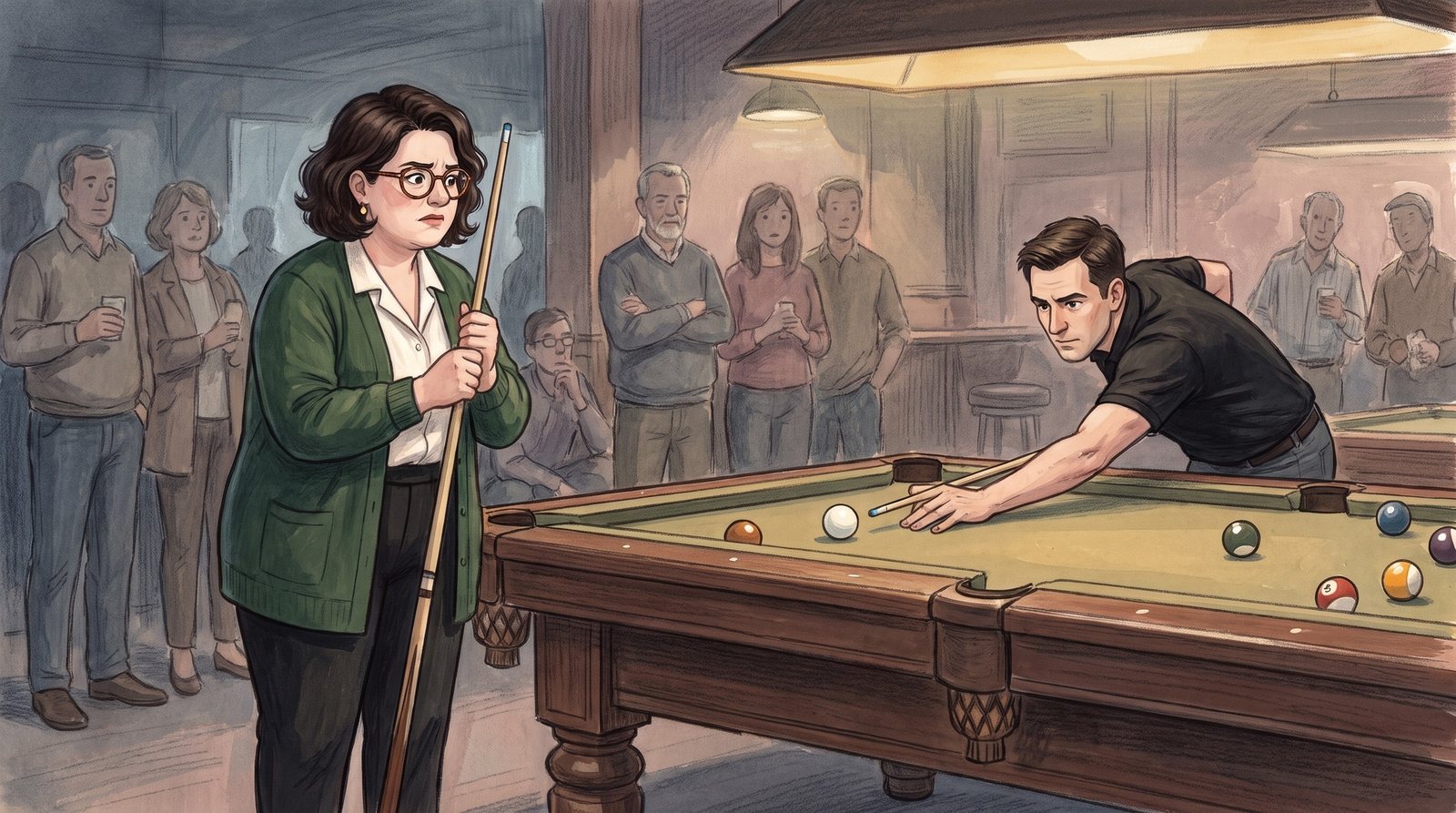
Tenets like these aren't rules, and you can see the difference at a billiards table. Why do the balls drop into the pockets at all? Because everywhere else there are cushions they bounce off: angle in equals angle out, as reliable as a promise. You can only play because there are cushions. These tenets are the cushions. They don't control a single ball on its way; they make the space playable, and throw back what wanted out. The game still needs energy: the shot sets the balls moving, it doesn't steer them. Whoever takes their principles for steering has mistaken cushions for tracks.
Watch the player instead of the balls.
When she aims, she thinks in functions: hit it there, at this angle. What really happens is a long chain of tiny readjustments, leaving out whatever doesn't fit the situation and the goal. Skill isn't an accumulated abundance; it's a cultivated restriction. The master doesn't have more possibilities than the beginner. She has fewer: the right ones are left.
What carries this restriction, and what topples it, I learned in a quarter-final. I was leading five–nil in a race to seven, and I was playing well; all eyes on the table. Then came the first mistake, long overdue; I'd simply had a run. My opponent played the way people play in quarter-finals: five games to three, then five to four.
And then it crept in, the one fear: don't lose now, not after a lead like that; that would be the ultimate embarrassment.
In that fear my technique crumbled, because it's a game of fine movements: another unforced error, and another: five to six, five to seven, handshake.
What had tipped over has a name.
I no longer wanted: I'm going to win this. I should: I mustn't lose this. Should swings between calm and fear, and fear is no state in which a nervous system does fine work. Same arms, same restriction, same table, and two different players, depending on which of the two forces is leading.
That's the game, told in pictures: a table, cushions, a shot.
But this series has two kinds of viewer: the one being fostered, and the one who is to foster and brings an office along. For the second, the next episode translates the pictures into the workplace before the craft begins. You can skip it. You'd only notice too late.
Mirror
In which role did you spend more time this week, Fosterer or Wanderer? And which one were you in without noticing?
Where did you last want to move someone, and with which of the four means: lure, deterrent, perturbing or affirming? How did you notice which it was?
Which of your motivation tools, looked at honestly, run on fear of going without?
Echo
Wanderer You're as much a cog in the system as I am. You're only following your script. One of the Ever-Faithful, guarding the sacred order.
Fosterer Maybe. But your unfolding would still be your own creation, with the wide world as its breeding ground.
Fosterer Would you perhaps like to drift around in it with me a little, as a distraction?
Sources
- E. Tory Higgins, “Beyond Pleasure and Pain” (1997): want and should as two kinds of motivation.
- Humberto Maturana and Francisco Varela, The Tree of Knowledge (1987): why nobody can instruct a person, only perturb them.
- Carl R. Rogers, On Becoming a Person (1961).
- Simon Sinek, The Infinite Game (2019).
The stories are drawn from three decades as an employee, leader, coach and facilitator. Places, times and people are changed, and some scenes are composed from several experiences; they allow no reliable conclusions about any company or person. The illustrations and the voices of the episode are made with AI.